
15 Ways to Manage a Panic Attack at Work
Anti-panic attack checklist included!


That sudden feeling of sheer terror.
Am I having a heart attack? Dying? Going crazy? Why won’t it stop?
If you’ve ever experienced a panic attack, then you know just how terrible this experience can be. It can happen when something triggers a trauma or it can wake you up mid-sleep, seemingly for no reason.
Even after we know that the fear of what’s happening is worse than what’s actually happening, our thoughts begin to spiral and we become overwhelmed and panicked.
Let's take a closer look at why panic attacks happen and how to manage them when they do.
The Signs
Thankfully, a panic attack usually lasts less than 10 minutes. Unfortunately, once you’ve had one, your chances of having one again increases. Regardless of why you’re experiencing a panic attack, take it as a red flag that you need to seek professional help. Do not ignore what your body is trying to tell you. Talk to your doctor and be open to multiple options. The sooner, the better.
Watch out for:
- Chills
- Racing heart
- Excessive sweating
- Feeling weak, faint, or dizzy
- Have tingling or numb hands and fingers
- Tight chest and having difficulties breathing
For more info on Panic Disorders, check out the NIH's page here.
Why Panic Attacks Happen
Unfortunately, we've yet to figure out exactly why panic attacks happen. It's suspected that our fight or flight reflex is involved. Somehow our bodies misinterpret physical symptoms of anxiety, which results in a panic attack.
Other factors that may play a role are genetics and a predisposition to stress. Major stress punishes our whole body. It's hard to predict how our bodies react to stress but it is important to keep the effects of bad stress in mind. Yes, there is good stress and bad stress.
Good stress is when you get that promotion you've been working towards. When you get a new job or marriage or have children. This type of stress is defined as "good" because it benefits and motivates us.
Bad stress is when your hours get cut at work. When you have unpaid bills or divorce or loss of a loved one. This type of stress is defined as "bad" because it causes anxiety and health problems.
Learn more about stress here.
The Mindfulness Trend
Yoga. Meditation. Therapy. People have become more aware of how much their mental state affects their physical one.
There are classes, books, apps, YouTube channels, etc. that help you to become more mindful of yourself and others. These practices and perspectives have proven to relieve and manage stress.
Give mindfulness a chance.
How to Manage a Panic Attack
Sometimes, no matter how mindful we are. No matter how low-stressed we feel. Panic attacks unexpectedly happen. Here are 15 ways to help get you through it.
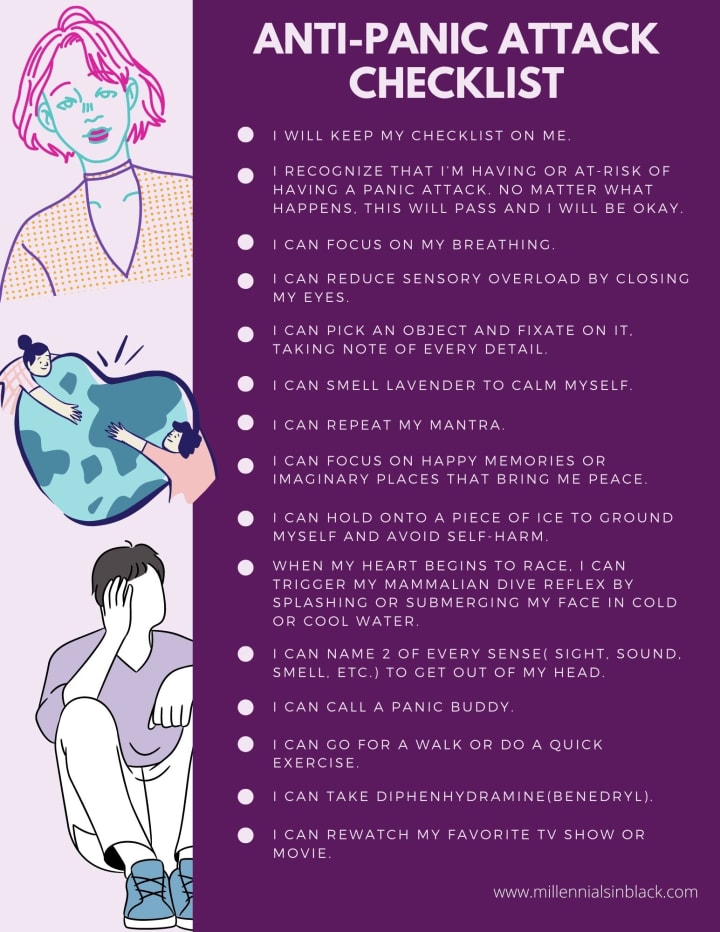
1. Don't depend on thinking clearly during a panic attack. Keep an Anti-Panic Attack Checklist handy, either on your phone or a printout. This will give you the clear direction needed to get through a panic attack.
2. Recognize that you’re having or at risk of having a panic attack. Remind yourself that no matter what, it will pass and you will be okay. Fear is a natural response to a panic attack.
3. Breath. Practice box breathing and breathe with your stomach, not your chest. Exhale for 4 seconds, inhale for 4 seconds, hold your breath for 4 seconds, repeat.
4. Close your eyes or put earplugs in or plug your nose. By reducing the amount of sensory input, we reduce our chances of becoming overwhelmed.
5. Pick an object and fixate on it. Note every detail of the object. Grab paper and pen and write down every feature you notice.
6. Keep lavender on hand and smell it as needed. Essential oils work great for this.
7. Repeat a mantra in your head. Make it positive and me it yours.
"I am at peace. Nothing can hurt me."
8. Have a happy memory or place in your mind. Use your imagination to explore that place. Tell yourself that all those dark thoughts don’t exist in this place, they are far far away.

9. If ice is available, grab a piece and hold onto it for as long as you can. By forcing yourself to feel the somewhat painful burn of the ice, you’re forcing yourself to be present and reconnect with your body. (This is also a healthier alternative to self-harm.)
10. If your heart begins to race, splash or submerge your face in cold or cool water. What you’re doing here is triggering your mammalian dive reflex which naturally lowers your heart rate. (Spencer Ash, over at theinertia.com, has a good article explaining what MDR does to your body.)
11. Take note of 2 things for every sense. Get back into your body and out of your head. This helps you to be present by focusing your awareness on your surroundings. 2 sights, 2 sounds, 2 smells, etc.
12. Call a panic buddy. A panic buddy is someone who has been made aware of your potential situation and will do their best to support/help you if you were to ever call during a panic attack. This needs to be someone who helps you to feel calm and nurtured.
13. Go for a walk or do a quick exercise. Move. Lunges, squats, pushups, jumping jacks, whatever you can do. Get out of your head and into your body.
14. If you’re not allergic and it makes you feel drowsy, take an antihistamine like Diphenhydramine (Benadryl). Histamine makes our brain feel awake and active, decreasing this makes us feel drowsy and calm.
15. Watch your favorite tv show again. Pick something that you’ve already watched and know what’s going to happen. Pick whatever makes you happy or brings comfort.
Final Thoughts
Panic attacks are horrible to deal with but preparation can help get you through them. Shaking off the fear of dying or going crazy is essential. When our brains get emotional, they tend to think more in black and white. The key is to get out of our thoughts and back into our bodies.
Print and make use of the Anti-Panic Attack Checklist that I've provided or make your own. Keep that checklist on you. If you frequently have panic attacks, make a few and put them in your wallet, purse, nightstand, etc.
Like all things, this too will pass.
Sources:
https://www.nimh.nih.gov/health/publications/panic-disorder-when-fear-overwhelms/
https://www.nimh.nih.gov/health/publications/stress/
https://www.theinertia.com/health/the-mammalian-diving-reflex-4-fascinating-things-happening-to-your-body-when-youre-in-water/
https://static.wixstatic.com/media/cc2f5b_59a4ca28e3de40cc85b54b56394812c8~mv2.jpg
About the Creator
john bruce
Writing enthusiast. Avid reader. Imgur creeper. Videogamer. History lover. Scoliosis sufferer. Traveler. Obsessed with scifi.
I've got a Bachelor of Philosophy (critical thinker/lover of wisdom) with a focus on ethics and diversity.
Keep reading
More stories from john bruce and writers in Psyche and other communities.
Christmas is Not Always “Beer and Skittles”
If you find the holiday season challenging, you’re not alone. I have never been a big fan of Christmas. I have always found it a bit pretentious. It is a time for kids, really. I have not had kids in my life, so the "children's influence" around this time of year doesn’t occur.
By Calvin London24 days ago in Psyche
Beyond the Doll: Moving from Token Gestures to Real Support for Autistic People
This week, Barbie announced the release of a new autistic Barbie doll, aiming to increase visibility and acceptance for autistic individuals. While the intention is commendable, it raises important questions about whether symbolic gestures like this truly address the needs of autistic people. Research and lived experience suggest that meaningful representation and concrete support in society are far more impactful than launching a product labelled as “inclusive”.
By Sarah Xenosa day ago in Psyche
Getting Serious About Comedy (Part I)
If I were asked to remark on my life and the childhood that paved some road leading me to this point, I would have to say something about all the funny people who surrounded me for the last 26,872 days (and counting). Somewhere along that road, I became a big fan of laughter and the comedy that spawns it – and, I mean not only my own laughter, but the laughter of others, some of which I have actually been responsible for inducing.
By John Oliver Smith7 days ago in Humor



Comments
There are no comments for this story
Be the first to respond and start the conversation.