
When the Victim Becomes the Villain: How Media Shapes Our Reality
Welcome to the world of media manipulation.
Welcome to the world of media manipulation.
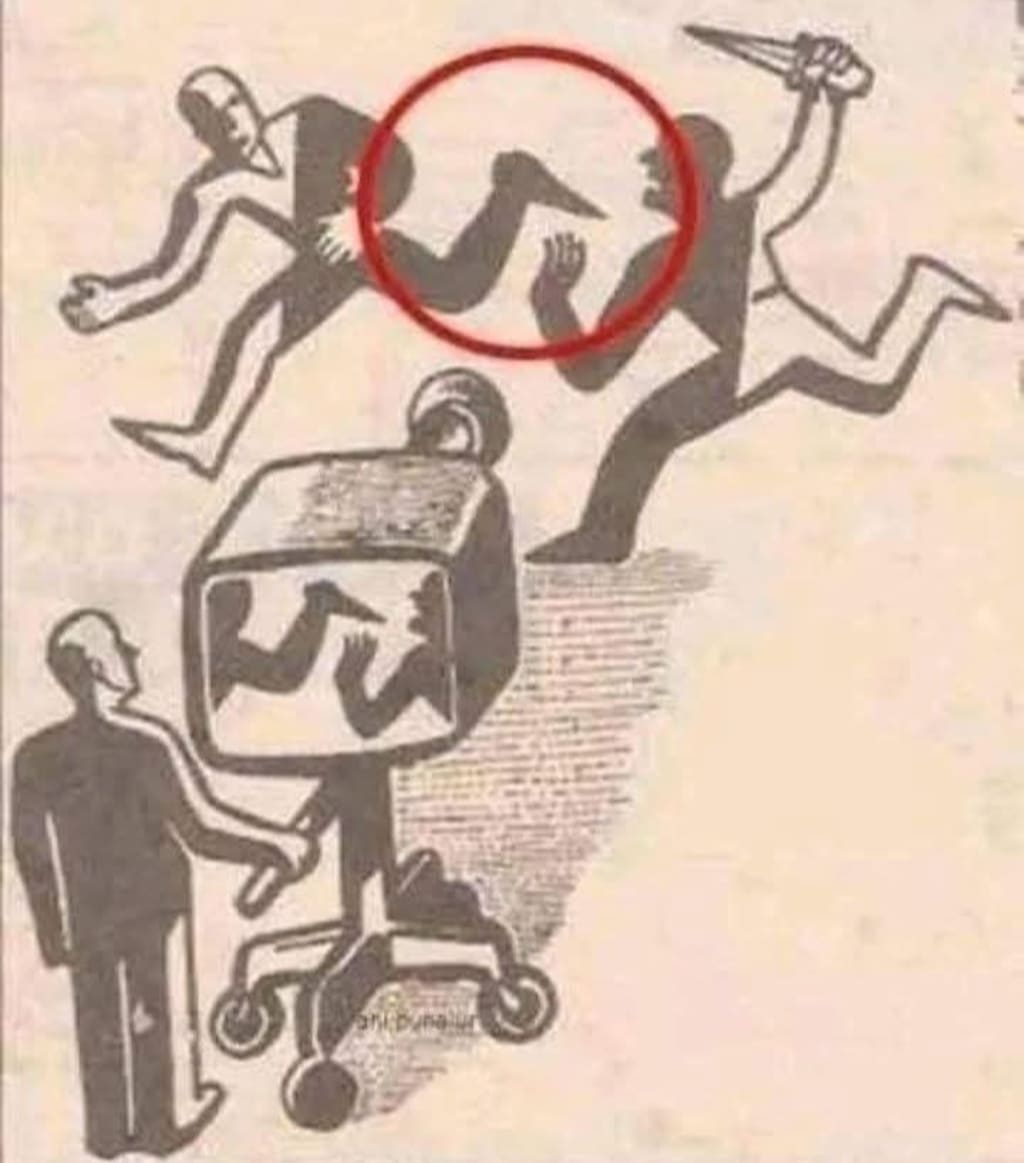
The image above may be just a sketch, but it speaks volumes. It’s a chilling reflection of how narratives are shaped, twisted, and delivered to us. The person standing in front of the screen, calmly observing what seems to be a violent act, is not seeing the truth. They’re seeing a version of the truth—packaged, edited, and carefully framed.
And that’s exactly the point.
---
The Power of the Frame
In filmmaking and journalism, there’s a term called "framing." It refers to how a scene or story is structured to guide the viewer’s perception. But in the broader sense, framing is everything. It can turn a hero into a villain or a criminal into a saint. It’s not always about lying outright—it’s about showing only part of the story.
Show a protest without showing the peaceful side? It’s a riot.
Show a self-defense act without the context? It’s an assault.
Show a nation defending its borders without showing the history? It’s oppression.
And once it's broadcast, especially with visual media, it sticks. That’s the danger.
---
The Viewer’s Dilemma
The figure in the image watching the TV represents all of us—consumers of news, entertainment, and social media. Most of us don’t witness events firsthand. We rely on screens, headlines, reels, and viral clips. And that means we’re often seeing what someone else wants us to see.
In today’s fast-paced, attention-driven world, speed often trumps accuracy. Emotion overrules truth. And algorithms ensure we only see stories that confirm our existing beliefs.
This is how misinformation spreads—not just by lies, but by incomplete truths.
---
Why This Matters Now More Than Ever
Elections are swayed by narratives.
Wars are justified through carefully chosen images.
Public opinion is manipulated to serve agendas.
Social media has amplified this issue. Now, everyone is a broadcaster, but not everyone is trained in ethics or truth. A viral clip, stripped of context, can ruin lives, destroy movements, or ignite violence.
We live in an age where the image is king, and perception is power.
---
So What Can We Do?
The answer isn’t to reject all media—but to become more conscious consumers of it. Here’s how:
1. Ask critical questions. Who’s telling this story? What’s their interest?
2. Look for context. Don’t trust a 15-second clip to explain a complex issue.
3. Diversify your sources. Read, watch, and listen to different perspectives.
4. Beware of emotional manipulation. If a story seems designed to make you angry, pause and investigate before reacting.
5. Teach others. Media literacy is as important today as reading and writing.
---
Conclusion: The Truth Needs Defenders
The simple illustration you saw isn’t just art—it’s a mirror. It shows us what happens when we stop questioning and start blindly watching.
In an era where everyone has a screen in their hand and truth is edited in real-time, we must all become defenders of context, nuance, and reality. Because if we don’t…
The victim will always look like the villain.
---
Liked this post? Share your thoughts below. Have you ever seen a story twisted by the media? Let’s discuss.
---
Welcome to the world of media manipulation.
The image above may be just a sketch, but it speaks volumes. It’s a chilling reflection of how narratives are shaped, twisted, and delivered to us. The person standing in front of the screen, calmly observing what seems to be a violent act, is not seeing the truth. They’re seeing a version of the truth—packaged, edited, and carefully framed.
And that’s exactly the point.
---
The Power of the Frame
In filmmaking and journalism, there’s a term called "framing." It refers to how a scene or story is structured to guide the viewer’s perception. But in the broader sense, framing is everything. It can turn a hero into a villain or a criminal into a saint. It’s not always about lying outright—it’s about showing only part of the story.
Show a protest without showing the peaceful side? It’s a riot.
Show a self-defense act without the context? It’s an assault.
Show a nation defending its borders without showing the history? It’s oppression.
And once it's broadcast, especially with visual media, it sticks. That’s the danger.
---
The Viewer’s Dilemma
The figure in the image watching the TV represents all of us—consumers of news, entertainment, and social media. Most of us don’t witness events firsthand. We rely on screens, headlines, reels, and viral clips. And that means we’re often seeing what someone else wants us to see.
In today’s fast-paced, attention-driven world, speed often trumps accuracy. Emotion overrules truth. And algorithms ensure we only see stories that confirm our existing beliefs.
This is how misinformation spreads—not just by lies, but by incomplete truths.
---
Why This Matters Now More Than Ever
Elections are swayed by narratives.
Wars are justified through carefully chosen images.
Public opinion is manipulated to serve agendas.
Social media has amplified this issue. Now, everyone is a broadcaster, but not everyone is trained in ethics or truth. A viral clip, stripped of context, can ruin lives, destroy movements, or ignite violence.
We live in an age where the image is king, and perception is power.
---
So What Can We Do?
The answer isn’t to reject all media—but to become more conscious consumers of it. Here’s how:
1. Ask critical questions. Who’s telling this story? What’s their interest?
2. Look for context. Don’t trust a 15-second clip to explain a complex issue.
3. Diversify your sources. Read, watch, and listen to different perspectives.
4. Beware of emotional manipulation. If a story seems designed to make you angry, pause and investigate before reacting.
5. Teach others. Media literacy is as important today as reading and writing.
---
Conclusion: The Truth Needs Defenders
The simple illustration you saw isn’t just art—it’s a mirror. It shows us what happens when we stop questioning and start blindly watching.
In an era where everyone has a screen in their hand and truth is edited in real-time, we must all become defenders of context, nuance, and reality. Because if we don’t…
The victim will always look like the villain.
---
Liked this post? Share your thoughts below. Have you ever seen a story twisted by the media? Let’s discuss.
---
About the Creator
Keep reading
More stories from Umair Khan and writers in Proof and other communities.
The Town That Burned Beneath: Centralia’s Eternal Flame
The Town That Vanished Overnight: The Forgotten Mystery of Centralia, Pennsylvania On a sunny spring morning in 1962, the residents of Centralia, Pennsylvania, went about their day like any other. Children played in the yards, shopkeepers opened their businesses, and the faint smell of coal drifted through the air—a common scent in this small mining town. No one suspected that beneath their feet, a fire had begun that would eventually consume their homes, their history, and their entire town.
By Umair Khan8 months ago in Proof
Nature Inspired Drinks: Cocktails That Capture the Outdoors
When you think of nature-inspired drinks, imagine cocktails that celebrate the fresh, earthy, and botanical flavors of the great outdoors. These drinks often highlight herbs, flowers, fruits, and natural elements that bring a refreshing vibe and a little wild magic to your glass. Whether you're sipping by a campfire or just want a taste of nature in your city apartment, these cocktails connect you with the earth in the most delicious way.
By Ethan Chen6 days ago in Proof
Cultivating Calm Focus for Study
Studying can sometimes feel overwhelming. Thoughts race, distractions pull you away, and focus drifts like a leaf on the wind. Yet, with a gentle practice of calm focus, you can create a steady mind that welcomes learning with ease.
By Victoria Marse6 days ago in Proof




Comments
There are no comments for this story
Be the first to respond and start the conversation.