
The Vanishing Village
A place that lived, thrived, and then disappeared without a trace

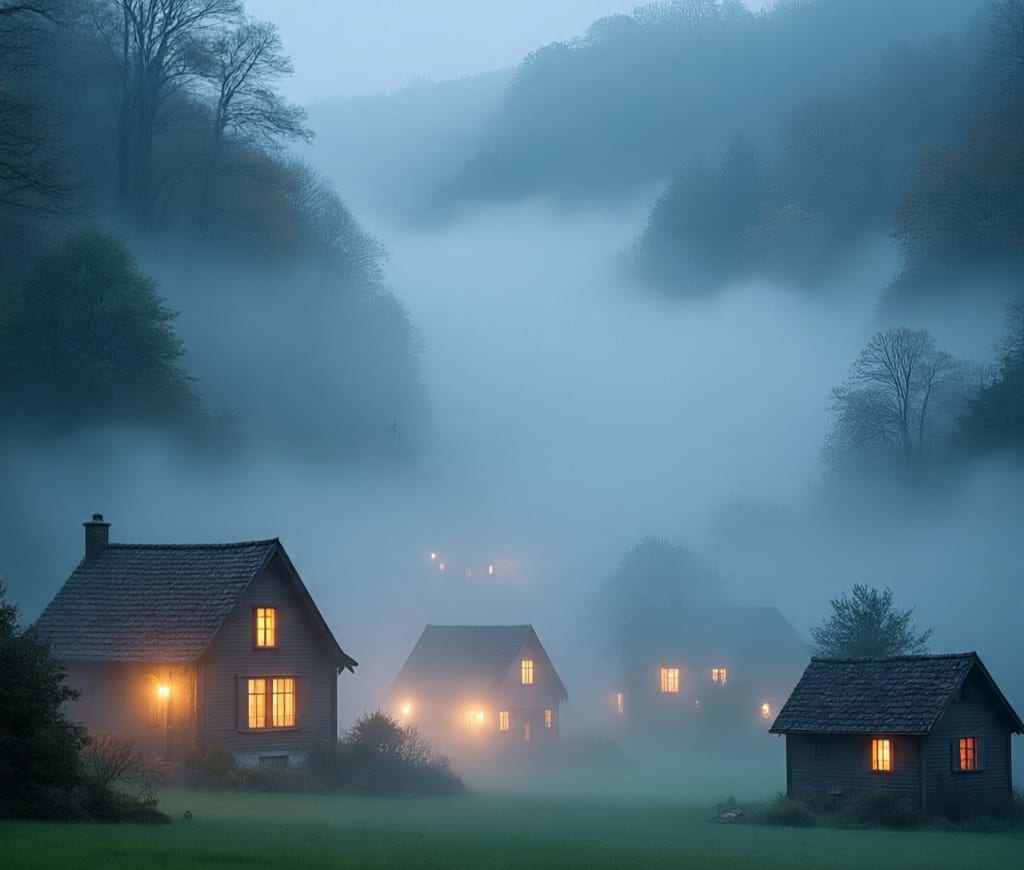
In the rolling hills of Europe there once stood a village known as Grevenmoor. Records from the early eighteen hundreds describe it as a modest but thriving place with farms, a small market, and a chapel whose bells could be heard across the valley. Letters written by travelers spoke of its warm inn, its stone cottages, and its friendly people. Yet today no map marks its location, and no trace of it can be found. The village simply vanished after the year eighteen twelve.
Historians first noticed the mystery when examining old documents stored in a regional archive. A set of letters dated between seventeen ninety and eighteen ten mentioned Grevenmoor by name. Merchants described selling goods there, soldiers wrote of passing through, and a schoolteacher penned notes about her pupils from the village. All accounts spoke of a real community, ordinary yet vibrant.
Then came silence. After eighteen twelve, not a single document referenced the village again. Maps that once marked its place in the valley quietly omitted it. Census records did not list its people. Postal routes skipped over it as though it had never existed.
The puzzle deepened when researchers tried to visit the valley itself. The landscape matched the old descriptions of the surrounding region, with forests, hills, and a river bending just as drawn in early sketches. But the land where Grevenmoor should have stood was empty. No ruins, no stones, no foundations hidden under moss. It was as if the earth had swallowed the village whole.
How does a village with families, livestock, and a chapel bell disappear without a single trace. Some suggest natural disaster, perhaps a flood or landslide that destroyed everything. Yet such events leave scars on the land, and no geological evidence supports them. Others whisper of war, of villages burned or abandoned during conflict. But again, no record exists of such destruction in that valley.
The strangest part remains the letters. Dozens survive in private collections, each written by different hands, each describing Grevenmoor as though it were as real as any other place. One traveler wrote of the taste of bread baked by the village baker. Another recalled the laughter of children chasing geese through the square. These are not vague references but detailed memories. And yet, if one looks for the village today, it is gone.
Some historians argue that Grevenmoor was a clerical ghost, a name mistakenly passed between documents until people believed it existed. But this fails to explain the personal letters filled with detail. Others wonder if the village changed its name after eighteen twelve, though no successor town has been found.
Then there are the theories that border on the supernatural. Some say the village slipped out of time, a place caught in a fold of history that vanished like smoke. Others believe the villagers left deliberately, erasing themselves from maps and records for reasons unknown. Secret faith, political exile, or perhaps a pact to live hidden from the world.
Legends now cling to the valley. Locals tell stories of faint music drifting on certain nights, of bells ringing where no tower stands. A shepherd once claimed he saw lights in the mist, shapes of houses flickering for a moment before fading again. Whether these are echoes of memory or tricks of the imagination, no one can say.
What is clear is that Grevenmoor once lived. People ate bread there, prayed in its chapel, and sent their children to school. The letters prove it. The absence of it proves something stranger still, a reminder that history does not always stay fixed. Villages, like people, can be forgotten, erased, or perhaps moved into shadows we cannot reach.
The vanishing village remains one of Europes quiet mysteries, a gap in the map where lives once unfolded. It teaches us that the past is never as secure as we think, and that even entire communities can slip from memory if time wishes it so.
About the Creator
LUNA EDITH
Writer, storyteller, and lifelong learner. I share thoughts on life, creativity, and everything in between. Here to connect, inspire, and grow — one story at a time.
Keep reading
More stories from LUNA EDITH and writers in Proof and other communities.
The Anonymous Tip
My name is Clara Edith and I had always thought my life was ordinary. I worked in a small office, kept to myself, and spent most evenings reading or walking through the quiet streets near my apartment. I liked the predictability, the simple routine, and the small sense of control it gave me. Then one rainy afternoon, everything changed with a single email.
By LUNA EDITH7 months ago in Humans
Irresistible Chocolate Cocktails: Sweet Treats for Dessert Lovers
Chocolate and cocktails are a match made in heaven. When the rich, velvety taste of cocoa meets the spirited kick of alcohol, magic happens. Whether you want to impress guests or just treat yourself after dinner, chocolate cocktails offer that perfect blend of sweetness and indulgence. These drinks are dessert in a glass, smooth and luscious, with enough complexity to keep your palate intrigued.
By Marcus Petrov3 days ago in Proof
Seasonal Fruit Cocktails: Fresh, Natural, and Healthy Mixology
When the sun shines bright and the days grow longer, nothing beats a cocktail that celebrates the vibrant flavors of seasonal fruit. Seasonal fruit cocktails are the ultimate expression of fresh, natural ingredients paired with the art of healthy mixology. These drinks don’t just taste amazing—they’re a feast for your senses and a boost for your wellbeing.
By Stella Rossi5 days ago in Proof
Tatt~Master
— Assembly Line Tatt Machine ~ Impressions to Impress — As I begin to understand more about the Tattoo Phenomenon. I've written silly, yet verbatim, dating site anecdotes in 'Frazzled.' So let me ask you: Would you be More attracted to someone slathered with tattoos, or Less?
By Jay Kantorabout 9 hours ago in Humor




Comments
There are no comments for this story
Be the first to respond and start the conversation.