
The Search for Meaning
One boy, Many Questions, Infinite Possibilities

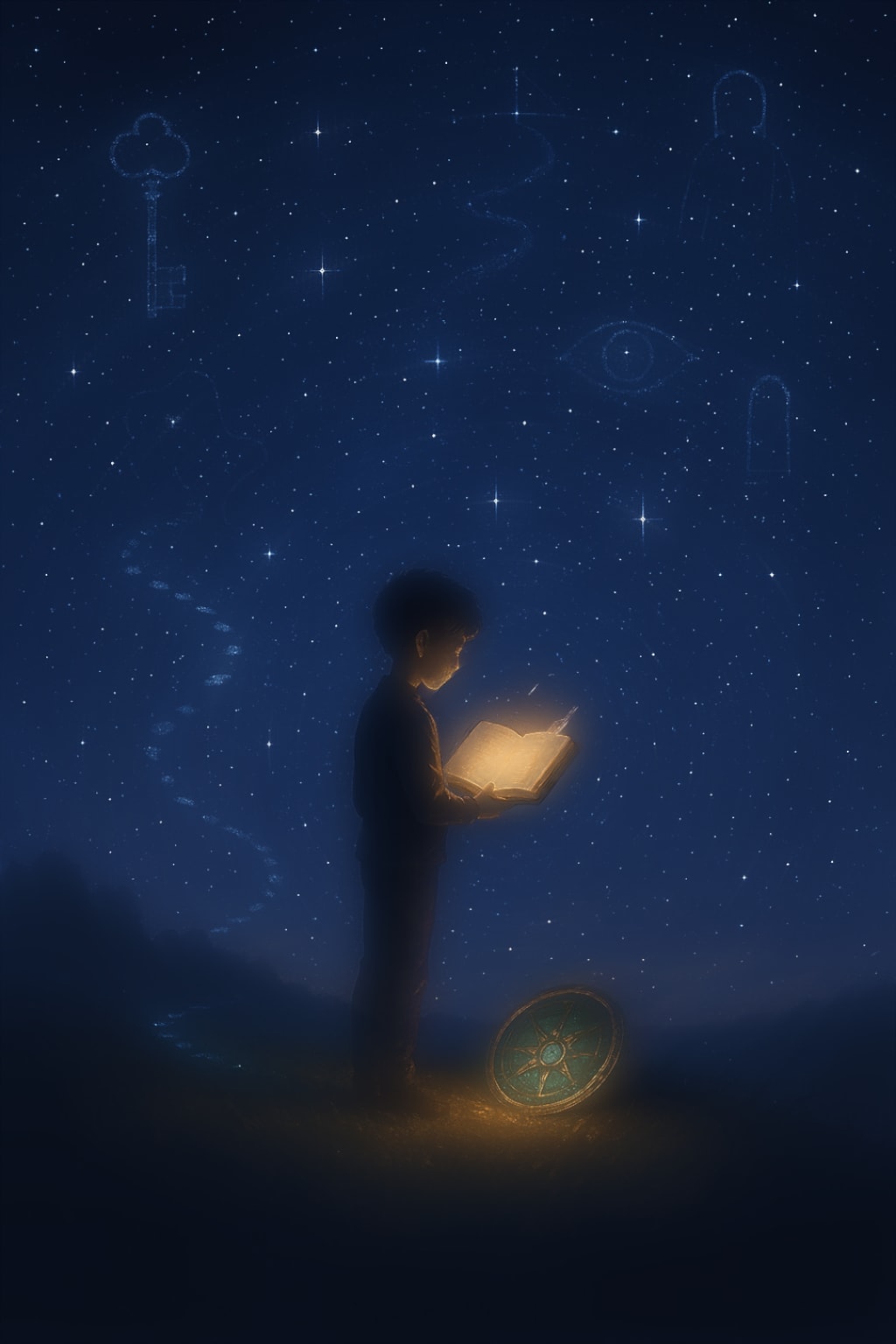
In the quiet town of Calbridge, nestled between whispering forests and endless hills, lived a boy named Kian. He was known not for his strength or speed or school grades, but for something far less measurable—his questions.
From the moment he could talk, Kian asked things most people never thought about.
“Why does time go forward but not back?”
“Can silence be louder than noise?”
“Do stars know we’re watching them?”
At first, people humored him. His parents answered what they could, his teachers redirected him to science books, and the other children... well, they simply didn’t get it. Most of them were busy chasing soccer balls or trading cards. But Kian was always looking up.
He often lay in the grass behind his house, notebook open, staring at the sky. Not just at the stars, but into the space between them. He believed the sky held answers—not just to his questions, but to who he was supposed to be.
Everyone told him to focus on what was real. “Get your head out of the clouds,” his uncle would mutter. “The sky doesn’t feed you.” But the more they dismissed him, the more Kian felt drawn to it.
One night, everything changed.
The sky was unusually clear, velvet-black and dusted with stars so bright they seemed almost alive. Kian was on the hill outside town, notebook in hand, when a flicker of blue light appeared overhead. It wasn’t a star. It moved—darting, circling, then suddenly falling, fast, toward the old forest beyond the ridge.
He ran.
Branches scraped his arms, and the night grew thicker the deeper he went. But his feet moved on instinct, drawn to the light like a moth to a flame. Then he saw it—a glowing orb resting in the grass of a small clearing. It pulsed softly, like a heartbeat.
As he stepped closer, the orb shifted and opened. Inside was a strange device—like a compass, but without directions. Its surface glowed when he touched it, forming words:
“One boy. Many questions. Infinite possibilities.”
Kian’s breath caught in his throat.
The compass spun, then stopped, and suddenly the world around him rippled like water. Trees stretched taller. The stars overhead shifted positions. The ground felt... alive. And in the distance, a path formed—a trail of soft-blue stones, glowing beneath his feet.
The device pulsed again, revealing another line:
“Every question is a key. Walk forward, and they shall open doors.”
With barely a second thought, Kian followed.
✦
The path led him to a strange realm—not quite a dream, but not fully real either. Here, clouds floated low to the ground, and mountains shimmered with glass-like surfaces that reflected not his face, but moments from his past.
He wandered for what felt like hours—or perhaps days. Time didn’t move normally here.
At one stop, he found a river where the water whispered his doubts back to him:
“You’ll never understand.”
“No one else thinks like you.”
“You should be normal.”
He nearly turned back. But then he remembered something his mother once told him: "The world may not understand you, Kian, but that doesn’t mean your voice doesn’t matter."
So he stepped forward.
He entered valleys shaped like the questions from his notebook—“What if every person is a piece of a larger thought?” became a world of floating beings connected by glowing threads. “Where does an idea go when it’s forgotten?” brought him to a library filled with drifting books no one remembered writing.
In each place, he left something behind—a fear, a doubt, a belief that he had to be like everyone else. And in return, he received a gift: a truth, a memory, a glowing thought that warmed his chest and made his mind feel wider.
Finally, he came to a hill—a mirror of the one back home. At the top stood a figure cloaked in light, faceless but familiar. It held the compass, now dim.
“Who are you?” Kian asked.
“I am what you could become,” the figure replied. “Not an answer. Not a destination. But a possibility.”
Kian looked down at the compass. “Why me?”
“Because you asked.”
The figure touched his forehead gently. “Most people want certainty. But you were brave enough to live in the questions. And that, Kian, is where all futures begin.”
✦
When he awoke, he was back on the hill near his town. The stars still glowed above, but faintly now—like they were smiling.
The compass was gone. But his notebook was still there, only now, the last page had changed. In neat, glowing letters, it read:
“Your questions will not always lead to answers. But they will always lead you forward.”
He closed the notebook and stood.
From that day on, Kian didn’t stop asking questions—but he stopped needing everyone else to answer them. He explored, created, imagined. He grew up to become a scientist, yes—but also a poet, a teacher, a sky-mapper, and eventually, the author of a book called One Boy, Many Questions, Infinite Possibilities.
And in classrooms and libraries, when children read his story, some of them felt a spark. Some looked to the sky and whispered their own strange, wonderful questions.
Because Kian had shown them what no one had shown him:
That the sky isn’t just up there to be watched.
It’s there to be wondered.
Moral of the Story:
Asking questions is not a weakness—it’s a strength. The journey to understanding yourself and the world begins with curiosity. The more you're willing to explore the unknown, the more possibilities you'll discover.
About the Creator
Abdul Hameed
"Passionate about sharing fresh ideas, insights, and inspiration. Let’s connect, explore, and spark meaningful conversations together. Dive in and discover something new today!"
Keep reading
More stories from Abdul Hameed and writers in Proof and other communities.
The Weight of Remembering
The house hadn’t changed, not really. The paint was still that sun-washed blue that flaked in places like old skin. The wind chimes still hung above the porch, rusted now, but chiming faintly in the autumn wind like a voice too soft to name. Nora stood on the cracked walkway, suitcase in hand, and stared at the screen door. Behind it, memory waited like an old dog—still loyal, still watching.
By Abdul Hameed8 months ago in Humans
Why Digital Identity Verification Is Rising in the UAE & Gulf
The verification of digital identities is turning out to be part of business processes, and daily transactions in the UAE and the rest of the Gulf world. With the growing digital-first economy and the growth in the cross-border mobility, there has never been a time when the need to verify who someone is within the shortest time possible and in the safest and most legal way has been as high as it is now.
By Aliya Khan6 days ago in Proof
Healing Meditation Journey: A Path to Inner Renewal
Healing meditation is a gentle way to restore balance and peace within your mind and body. It invites you to slow down, listen deeply, and open to the subtle energies that support your well-being. This journey can help soothe emotional wounds, release tension, and renew your spirit.
By Garold One7 days ago in Proof
Smart phones, Humans and Aliens.
WARNING. I will be tapping into one of your favorite creative tensions: The absurdity of humans worshipping their glowing rectangles as if they were tiny oracles. There’s something deliciously poetic about that contradiction, and it lends itself beautifully to an instructive proviso.
By Novel Allen4 days ago in Poets



Comments (1)