
The Matter That Makes Up the Universe
A World No One Can See

The Matter That Makes Up the Universe
Have you ever looked up at the night sky and wondered what it’s all made of? Those twinkling stars, the vast black space between them, and even the invisible air around us—what are they, really? Most of us grow up learning about atoms in school: tiny particles made of protons, neutrons, and electrons. But the truth is, that’s only the beginning of the story. The real building blocks of the universe are even smaller, stranger, and far more fascinating. They belong to something scientists call the Standard Model of Particle Physics—a scientific map of the tiniest known pieces of reality.
My First Encounter with the Invisible World
I still remember the first time I read about the Standard Model. I was a teenager, sitting in my room with a science magazine that had a colorful chart full of boxes labeled with strange names: quarks, leptons, bosons. I didn’t understand most of it, but something about it felt magical—like I had just found the secret manual of the universe. Years later, I discovered that this “manual” isn’t just a bunch of random names—it’s the blueprint that explains everything we see (and everything we don’t see).
The Basics: What Is the Standard Model?
Think of the Standard Model as a kind of periodic table for the universe’s smallest parts. While the periodic table tells us about chemical elements like hydrogen, oxygen, and gold, the Standard Model goes deeper. It explains the fundamental particles—the ones that can’t be broken down into anything smaller. These particles combine in countless ways to make everything: you, me, stars, planets, and even light itself.
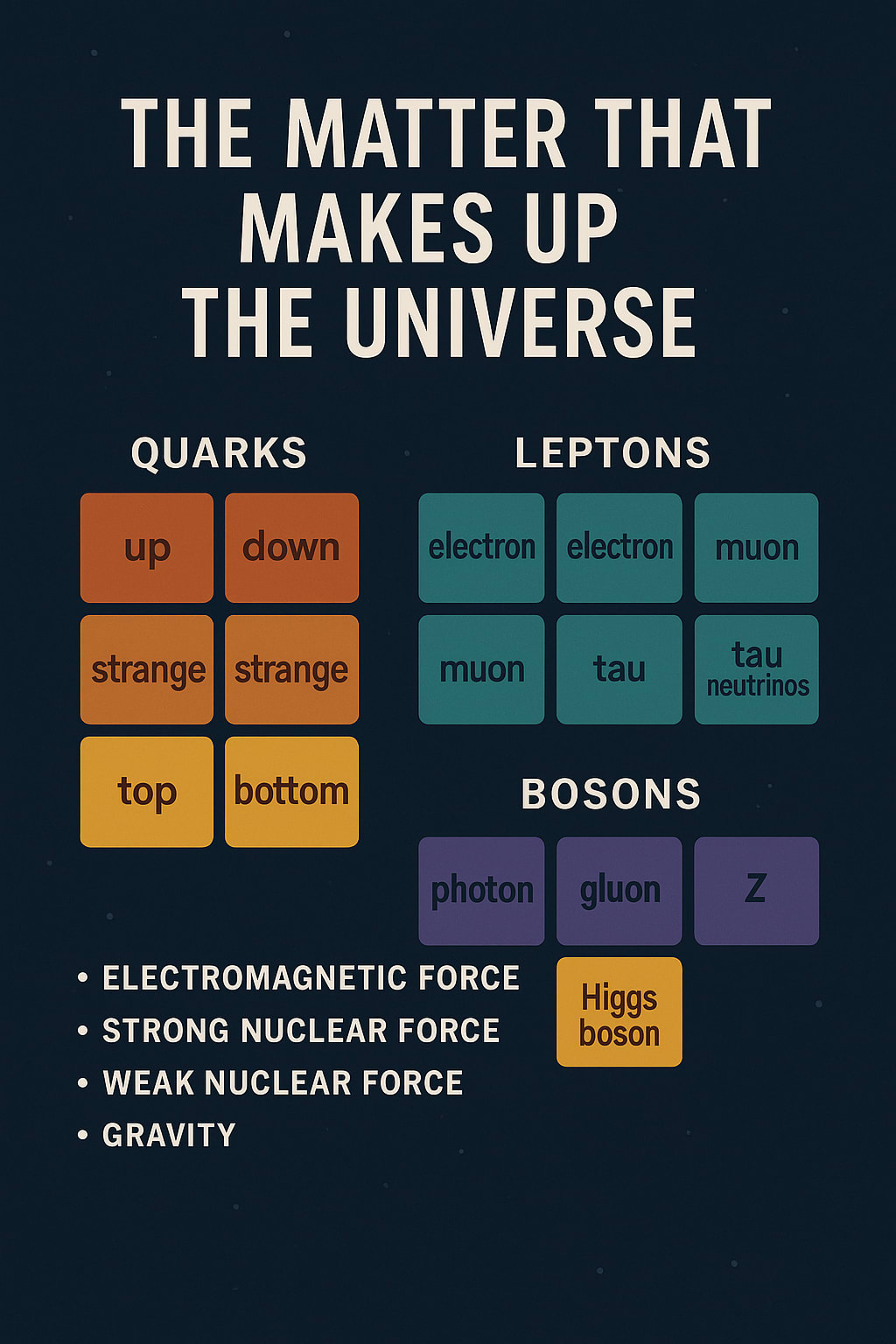
The Standard Model divides these particles into three main families:
Quarks – These are the particles that make up protons and neutrons, which in turn form the nucleus of atoms. There are six types (or “flavors”) of quarks, with playful names like “up,” “down,” “charm,” “strange,” “top,” and “bottom.”
Leptons – The most famous lepton is the electron, the tiny particle that orbits around an atom’s nucleus. There are also neutrinos, ghost-like particles that pass through your body by the trillions every second without you even noticing.
Bosons – These are the “force carriers.” They’re like messengers that tell other particles how to interact. For example, photons (particles of light) carry the electromagnetic force, while gluons hold quarks together inside protons and neutrons. The most famous boson is the Higgs boson, sometimes nicknamed “the God particle,” which gives particles their mass.
How the Forces Fit In
The Standard Model doesn’t just list particles—it also explains how they interact. In our everyday world, we know about forces like gravity and magnetism. But in particle physics, there are four fundamental forces that govern everything:
Electromagnetic Force – Responsible for electricity, magnetism, and light.
Strong Nuclear Force – The glue that holds atomic nuclei together.
Weak Nuclear Force – Responsible for certain types of radioactive decay.
Gravity – The force of attraction between masses.
The strange thing? The Standard Model explains the first three forces perfectly—but not gravity. That’s one of its biggest mysteries, and why scientists believe there’s still more to discover.
Why Should We Care About This Invisible World?
You might be thinking: “Okay, cool—but why does this matter to my life?”
Well, for one, every single object you’ve ever touched, every meal you’ve eaten, every breath you’ve taken is built from these particles. Understanding them isn’t just about physics—it’s about understanding yourself and your place in the universe.
Plus, research into particle physics has led to incredible inventions. The World Wide Web was originally developed at CERN, the European particle physics laboratory, to help scientists share data. Medical technologies like PET scans also rely on principles discovered through studying particles.
The Hunt for the Higgs Boson
In 2012, scientists at CERN’s Large Hadron Collider (LHC) announced something historic: they had finally detected the Higgs boson, a particle that had been predicted decades earlier but never seen. This was like finding the missing piece of a puzzle that had been frustrating scientists for half a century. Without the Higgs, particles would have no mass—and our universe as we know it wouldn’t exist.
The discovery didn’t just confirm the Standard Model—it proved that our understanding of the universe’s foundation was on the right track.
What the Standard Model Can’t Explain
As brilliant as it is, the Standard Model isn’t perfect. It doesn’t account for dark matter—the mysterious invisible stuff that makes up about 27% of the universe—or dark energy, which is pushing the universe to expand faster and faster. It also can’t explain why gravity is so weak compared to other forces, or why there’s more matter than antimatter in the universe.
In other words, it’s like having a detailed map of your hometown, but knowing there’s a whole world out there you haven’t explored yet.
A Personal Reflection
When I think about the Standard Model, I’m reminded of how much there is we still don’t know. Even though scientists have been studying particles for decades, we’ve only scratched the surface. There’s a certain beauty in that—the idea that the universe still holds secrets waiting to be uncovered.
Sometimes I imagine that, in the future, students will look at our current understanding the way we look at ancient maps of the Earth: impressive for its time, but incomplete. And that’s exciting. Science is never “finished”—it’s a journey.
Seeing the Unseen
The Standard Model may describe a world we can’t see with our eyes, but its effects are everywhere. The next time you hold a cup of coffee, remember: it’s made of atoms, which are made of quarks and leptons, held together by bosons, all playing their part in an invisible cosmic dance.
In the end, learning about the Standard Model isn’t just about physics—it’s about curiosity. It’s about looking at the universe and asking, What’s really going on here? And that question, I believe, is what makes us human.
Standard Model, particle physics, Higgs boson, quarks, leptons, bosons, CERN, dark matter, physics explained
About the Creator
Mohamed hgazy
Fiction and science writer focused on physics and astronomy. Exploring the human experience through imagination, curiosity, and the language of the cosmos.
Keep reading
More stories from Mohamed hgazy and writers in Proof and other communities.
From Maser to Laser
How a Quiet Invention in 1955 Changed Physics and Everyday Life On August 15, 1955, three scientists—Charles Townes, James Gordon, and H. J. Zeiger—published a paper that might have seemed obscure to the general public at the time. Its title was long and technical: “The Maser—New Type of Microwave Amplifier, Frequency Standard, and Spectrometer.” Yet hidden in those words was the seed of a technological revolution. Their invention, the maser, would become the direct forerunner of the laser, and eventually transform not only physics but also medicine, communication, and the way we interact with the world.
By Mohamed hgazy7 months ago in Proof
At Will
Section 1 Pollen and the bright sun anesthetized color - muting almost every color to its equivalent shade in pastels. James stood by the window of his apartment at Bayside Village, adjusting his tie and checking the time - it was 8:30 AM. On his phone, a message from the Recruiting Agency, Eastridge. Cassie assured him that the partners at Sidley Austin, a corporate law firm, had asked for him by name - which never happened so he should be excited. It was a request that had never occurred in his ten years as a paralegal, a sudden, specific gravity pulling him into their orbit.
By James Royer2 days ago in Proof
The Bottle I Was Afraid to Open
I am not a whiskey person. In fact, I’m barely an alcohol person at all. I might have a drink once or twice a year—usually at a wedding, a holiday dinner, or when someone insists I “at least try it.” Even then, I’m the person who nurses the same glass for an hour while everyone else orders a second round.
By Jhon smith4 days ago in Proof


Comments
There are no comments for this story
Be the first to respond and start the conversation.