
The Lost Colony of Roanoke: America’s Oldest Mystery
Unraveling the Mystery Behind America's Oldest Unsolved Disappearance
The Lost Colony of Roanoke: America’s Oldest Mystery
Long before Bigfoot footprints and UFO sightings, America’s first great mystery was carved into the bark of a tree. The story of the Lost Colony of Roanoke is a tale of ambition, survival, and an enduring enigma that has baffled historians for centuries. What happened to over 100 men, women, and children who vanished without a trace in 1590? Let’s dive into the historical fog and sift through the theories, from the mundane to the fantastical.
Setting the Stage: A Bold New World
In 1587, a group of English settlers led by John White arrived on Roanoke Island, off the coast of modern-day North Carolina. They were the second attempt at establishing a colony there, the first having failed miserably due to starvation, conflict with local tribes, and, presumably, a general lack of survival skills.
This second expedition had high hopes. Among the settlers were women and children, signaling an intention to establish a permanent community. One of these women, White’s daughter Eleanor Dare, gave birth to Virginia Dare, the first English child born in the New World. It was all shaping up to be a colonial success story—until John White sailed back to England for supplies.
The Disappearance
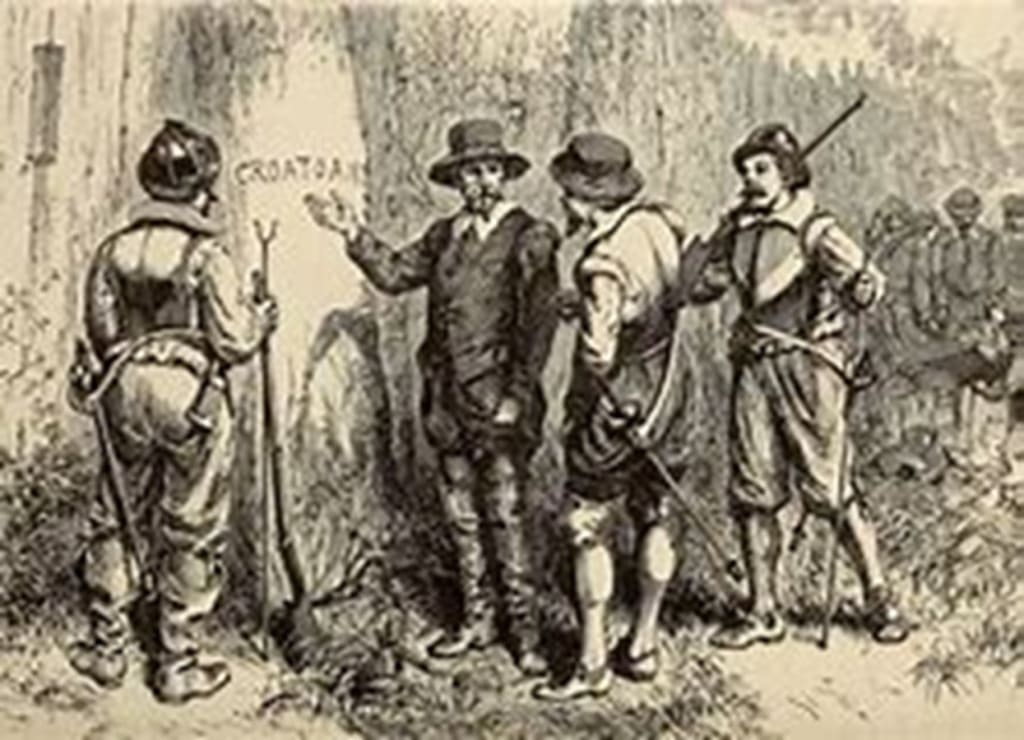
White’s supply run was supposed to be quick, but England had other ideas. With the Spanish Armada threatening invasion, every available ship was commandeered for defense, and White couldn’t return to Roanoke until three years later, in 1590. When he finally arrived, he found… nothing. The colony was deserted. No people, no bodies, no signs of struggle. Only two cryptic clues remained: the word “CROATOAN” carved into a wooden post and the letters “CRO” etched into a nearby tree.
The settlers were gone, and the mystery of their fate was born.
The Theories: What Really Happened?
The Roanoke disappearance has fueled centuries of speculation. Here are the most prominent theories:
1. They Integrated with Native Tribes
The most plausible explanation is that the colonists sought refuge with nearby Native American tribes, such as the Croatoan (now known as the Hatteras) or the Secotan. Given the harsh conditions on Roanoke, joining forces with locals who knew how to live off the land seems like a solid Plan B. Supporting this theory are later reports from Jamestown settlers who claimed to encounter Native Americans with European features, suggesting intermarriage.
2. Starvation and Death
Life on Roanoke wasn’t exactly a picnic. Between the lack of supplies, hostile relations with some tribes, and the challenges of an unfamiliar environment, it’s possible the colonists simply succumbed to starvation and disease. Their bodies may have been buried or scattered, leaving no trace.
3. They Tried to Sail Home
Perhaps the settlers, desperate after White’s prolonged absence, built a makeshift boat and attempted to return to England. If so, they likely met a watery grave. The Atlantic Ocean is no place for an amateur-built dinghy.
4. Spanish Involvement
At the time, Spain and England were bitter rivals. Some historians speculate that Spanish forces, eager to eliminate English settlements, might have wiped out the colony. However, there’s little evidence to support this, and Spain didn’t exactly keep it a secret when they defeated enemies.
5. Supernatural Causes
No historical mystery would be complete without a supernatural twist. Were the colonists victims of a curse, alien abduction, or some otherworldly phenomenon? These theories are more entertaining than plausible but add to Roanoke’s enduring allure.
The Legacy of Roanoke
Despite centuries of searching, the fate of the Roanoke colonists remains unknown. Archaeologists and historians continue to investigate, uncovering tantalizing clues but no definitive answers. Recent digs on Hatteras Island and mainland North Carolina have unearthed artifacts that may have belonged to the settlers, hinting at assimilation with Native tribes. But the mystery endures.
Why Roanoke Captures Our Imagination
The Lost Colony of Roanoke isn’t just a historical puzzle; it’s a mirror reflecting our fears and hopes. It’s the story of human ambition meeting the unknown, of people risking everything for a better future only to vanish into history’s shadows. The mystery invites us to speculate, to imagine, and to search for answers, even when they remain tantalizingly out of reach.
So the next time you’re walking through the woods and stumble upon a carved word or symbol, pause for a moment. Maybe it’s just a teenager practicing graffiti… or maybe it’s the ghostly whisper of a colony that disappeared, leaving behind only questions and the word "CROATOAN."
About the Creator
Keep reading
More stories from Albert Acromond and writers in Proof and other communities.
The Mary Celeste: The Ghost Ship that Sailed Alone
The Mary Celeste: The Ghost Ship that Sailed Alone Of all the high seas legends, few are as mystifying as the tale of the Mary Celeste, the so-called ghost ship found drifting aimlessly in the Atlantic in 1872. It’s a story that has captured imaginations for over a century and spawned countless theories, from the plausible to the utterly bizarre. What makes this tale so gripping is that while the ship’s crew had vanished without a trace, the vessel itself was remarkably intact. So, let’s set sail into the murky waters of maritime mystery to uncover what we know—and still don’t know—about this enduring enigma.
By Albert Acromondabout a year ago in Proof
Nature Inspired Drinks: Cocktails That Capture the Outdoors
When you think of nature-inspired drinks, imagine cocktails that celebrate the fresh, earthy, and botanical flavors of the great outdoors. These drinks often highlight herbs, flowers, fruits, and natural elements that bring a refreshing vibe and a little wild magic to your glass. Whether you're sipping by a campfire or just want a taste of nature in your city apartment, these cocktails connect you with the earth in the most delicious way.
By Ethan Chen5 days ago in Proof
Cultivating Calm Focus for Study
Studying can sometimes feel overwhelming. Thoughts race, distractions pull you away, and focus drifts like a leaf on the wind. Yet, with a gentle practice of calm focus, you can create a steady mind that welcomes learning with ease.
By Victoria Marse6 days ago in Proof



Comments (2)
I've always been interested in history, and the Lost Colony was no exception. You've written a wonderful article on the subject.
I was so intrigued by your piece that I featured it in my article, 'The Unofficial Vocal Honors.' reminded me that even the oldest stories can hold new perspectives when told with curiosity and care. Thank you for such an engaging read ✨ https://shopping-feedback.today/writers/l-k-s-unofficial-vocal-awards%3C/span%3E%3C/span%3E%3C/span%3E%3C/a%3E%3C/p%3E%3C/div%3E%3C/div%3E%3C/div%3E%3Cdiv class="css-w4qknv-Replies">