
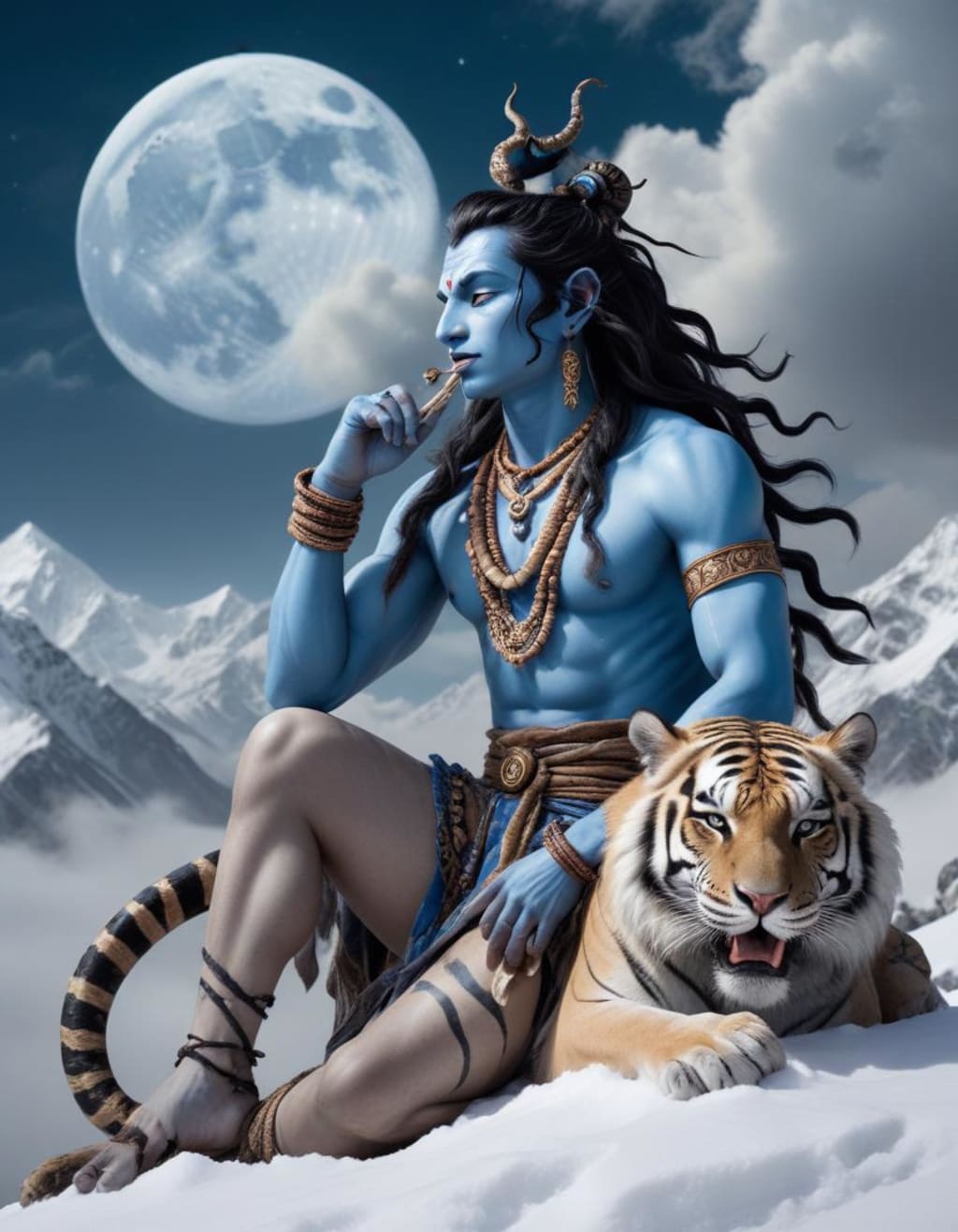
Shiva, often called "Mahadeva" (the great god), is one of the principal deities in Hinduism. He represents the cosmic force of transformation and is often depicted as the god of destruction and regeneration. His story is complex, interwoven with myths and tales from various Hindu scriptures, but here is a summary of his life and significance in around 800 words.
### Birth and Origins
Shiva is considered both a creator and destroyer, and his origin story varies across texts. In some traditions, he is seen as a self-born deity, emerging from the formless and eternal realm of the universe. According to the *Rigveda*, one of the oldest Hindu texts, he is associated with the Rudra, the god of storms, wind, and hunt, who symbolizes destruction and death. Over time, Rudra evolved into the more complex figure of Shiva, embracing both destruction and the divine power of transformation.
One of the most popular legends tells of his marriage to Parvati, the daughter of the mountain king Himavan and queen Mena. Parvati's devotion to Shiva is said to have been so intense that, after years of penance, she won his love. Their union is celebrated in various myths, which showcase Shiva's ascetic nature and Parvati’s determination.
### Shiva's Appearance and Symbols
Shiva is often depicted in a meditative state, his body smeared with ash, sitting cross-legged on Mount Kailash, his Himalayan abode. His iconic appearance includes a third eye, which represents the power of perception beyond ordinary vision. His hair is matted and holds the river Ganga, symbolizing the sacred river that descends from the heavens.
Shiva is frequently shown wearing a serpent around his neck and a crescent moon on his head. The serpent represents the control over ego and fear, while the crescent moon signifies the passage of time. He carries a trident (Trishula), a symbol of creation, preservation, and destruction, representing the three primary aspects of the universe. His mount, Nandi the bull, is also a key symbol of strength and devotion.
### The Tandava Dance
Shiva is known for his cosmic dance called the Tandava, a dance that symbolizes the creation, preservation, and destruction of the universe. According to legend, Shiva performed the Tandava after the death of his beloved wife, Sati. Her tragic self-immolation during a sacrificial fire, caused by her father Daksha's disrespect toward Shiva, left him devastated. In his grief, Shiva danced in fury, creating and destroying worlds with each step. The dance represents the cyclical nature of life—birth, death, and rebirth.
### The Destruction and Rebirth of the Universe
Shiva is often called "Mahakal" (the great time) because of his role in the destruction of the universe. Destruction in Hindu cosmology is not seen negatively but as a necessary process of clearing the old to make way for the new. Shiva’s destruction is an act of cosmic regeneration. Without destruction, creation would not be possible. This cyclical process of creation, preservation, and destruction governs the entire universe.
One of the significant myths concerning Shiva's destructive power is the legend of his battle with the demon king, Tripurasura. Tripurasura had created three impenetrable cities that were ruled by him and his brothers. The gods, unable to defeat them, sought Shiva’s help. Shiva, using his mighty bow and a single arrow, destroyed the three cities in one shot, restoring balance to the universe.
### Shiva's Compassion and Devotion
Despite his fierce role as a destroyer, Shiva is also known for his immense compassion and kindness. He is revered as a loving husband and a doting father. His devotion to his followers is evident in numerous stories. One of the most well-known is the story of his granting boons. The story of Lord Shiva's blessing to his devotees like Ravana, Markandeya, and others highlights his kindness and how he grants boons even to those with desires that may seem destructive.
Shiva’s compassion is also reflected in his role as a teacher. He is regarded as the "Adiyogi" (the first yogi), and many of his teachings on yoga, meditation, and spiritual awakening have shaped spiritual practices worldwide. The teachings he imparted to his wife, Parvati, are considered the roots of the philosophy of yoga, which involves discipline, meditation, and living in harmony with the universe.
### The Birth of Lord Ganesha
One of the most famous tales involving Shiva is that of the birth of his son, Ganesha. Parvati, desiring to bathe, created a child from the sandalwood paste she had used to scrub herself. She placed Ganesha at the door to guard her privacy. When Shiva returned home, he did not recognize the boy and, in his fury, severed his head. Parvati was devastated. To calm her, Shiva ordered that the head of the first creature they could find be placed on the child. The first creature was an elephant, and so Ganesha was reborn with the head of an elephant. Ganesha is now one of the most beloved deities in Hinduism, known as the remover of obstacles and the god of wisdom and beginnings.
### The Significance of Lord Shiva
Shiva’s role is vast. He embodies paradoxes—being both an ascetic and a householder, both a destroyer and a creator. His significance lies in his ability to bring balance and order to the universe through his actions, whether they be destructive or creative. His followers, known as Shaivites, see him as the supreme god who transcends all other deities, embodying the highest consciousness and the ultimate reality.
Shiva is also closely associated with the concept of "Shakti," the feminine divine energy, personified by Parvati. Together, they represent the perfect balance of masculine and feminine energies in the universe. Shiva’s story continues to inspire millions around the world, showing that destruction can lead to transformation, and through devotion and meditation, one can achieve ultimate peace and liberation.
In conclusion, Lord Shiva's story is one of deep spiritual significance, filled with lessons about life's transience, the importance of meditation, and the constant cycle of creation and destruction. His devotees believe that through him, they can find divine wisdom, inner peace, and ultimate liberation from the cycle of life and death.
About the Creator
Keep reading
More stories from Ranjeet Prakash Banaudha and writers in Proof and other communities.
The Story of Lord Hanuman
Lord Hanuman, also known as Bajrang Bali and Pawanputra, is one of the most revered deities in Hindu mythology. He is celebrated for his unwavering devotion, extraordinary strength, and selfless service. Hanuman’s life is a tale of courage, humility, and dedication, making him a timeless symbol of faith and righteousness.
By Ranjeet Prakash Banaudhaabout a year ago in Proof
Cultivating Calm Focus for Study
Studying can sometimes feel overwhelming. Thoughts race, distractions pull you away, and focus drifts like a leaf on the wind. Yet, with a gentle practice of calm focus, you can create a steady mind that welcomes learning with ease.
By Victoria Marse3 days ago in Proof




Comments
There are no comments for this story
Be the first to respond and start the conversation.