
The Gap.
There is a 66-mile stretch of jungle between North and South America so dangerous that no road has ever crossed it. It is ruled by smugglers and rebel groups. This is the story of the people who try to cross it.

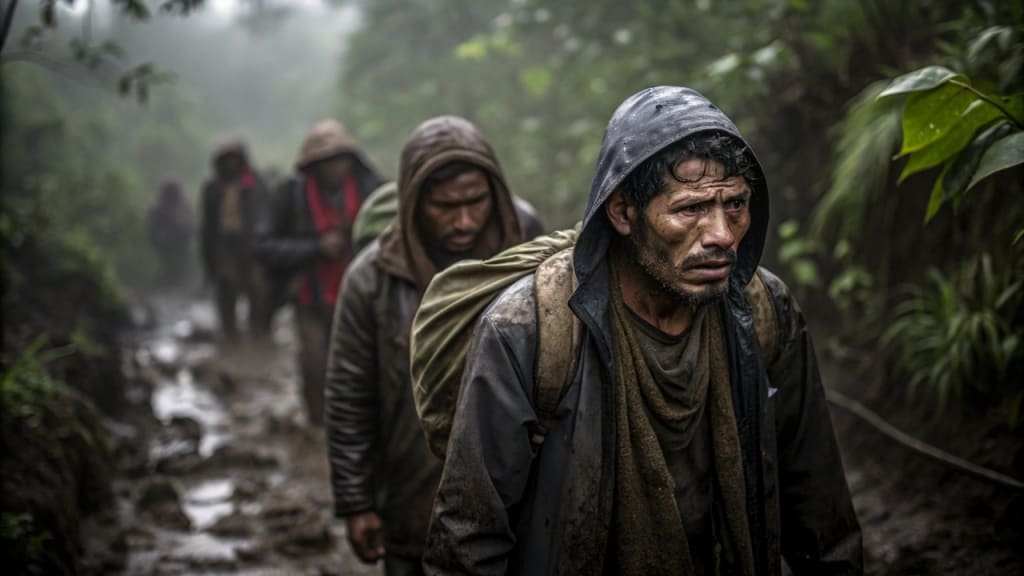
The Pan-American Highway is one of humanity’s greatest triumphs of will. It is a ribbon of asphalt stretching over 19,000 miles, a nearly unbroken line connecting the frozen tundras of Alaska to the windswept plains of Argentina. I say *nearly* unbroken, because there is one place where the asphalt crumbles to dirt, the road signs vanish, and civilization itself gives up. This place is a 66-mile stretch of raw, primordial wilderness separating Colombia from Panama. It has a name spoken in whispers by travelers, a name that has become synonymous with a very specific kind of hell: the Darién Gap.
There is no road here. There are no laws. The Gap is a world unto itself, a green, breathing labyrinth of swamps, mountains, and near-impenetrable jungle. It is ruled by its own brutal kings: venomous snakes, hungry jaguars, disease-carrying insects, and, most dangerous of all, the armed cartels and rebel groups who control the footpaths. Yet, every single day, hundreds of people walk into it. They are not adventurers. They are migrants—doctors, engineers, farmers, and families—fleeing a collapsed world behind them, gambling on the dream of a new one ahead. This is the story of that gamble.
It begins in Necoclí, a dusty port town in Colombia, the last outpost before the abyss. Here, a man I will call Javier holds his daughter’s small hand. He was a carpenter in Venezuela, but his tools now lie useless in a country with no work. He sold everything he owned for this chance. His price of admission is $400, paid to a silent, stone-faced man they call a "coyote," who promises safe passage. Javier joins a group of fifty other souls, a mosaic of desperation from Haiti, Cuba, and across South America. They share nothing but a common, terrifying goal: to cross The Gap.
The first day is a brutal awakening. The jungle does not welcome you; it consumes you. The humidity is a physical weight, pressing down, soaking your clothes in sweat until they feel like a second skin. The path is not a path; it is a suggestion, a trail of sucking mud that steals shoes and resolve with equal viciousness. The air is never silent. It is filled with the deafening, high-pitched scream of insects, a constant, maddening chorus. They cross rivers with water up to their chests, clutching a fraying rope as the current threatens to pull them into oblivion. This is the jungle’s opening salvo, its test of physical endurance.
The true test, however, is human. On the third day, they emerge into a small clearing, only to be met by a group of five men holding AK-47s. These are not government soldiers. They are the enforcers of the Gaitanista Self-Defense Forces, the cartel that owns this jungle. They don't want lives; they want a tax, a *vacuna*. The coyote negotiates. Money and phones are collected. The men’s faces are impassive, their eyes cold. There is no argument. There is no appeal to mercy. In The Gap, strength is the only currency, and they hold all of it. The group is left shaken, poorer, but alive. They are the lucky ones. Further along the path, discarded backpacks and tattered clothing serve as grim monuments to those who were not so fortunate.
The journey grinds on, measured not in miles but in suffering. Javier sees a woman from Haiti collapse from exhaustion, unable to go on. Her family weeps but is forced to leave her behind. The jungle has no room for the weak. He sees a young man bitten by a Fer-de-Lance, one of the world's deadliest snakes, his leg swelling to a grotesque size within minutes. There is no help. There is only the quiet, communal horror as the group moves on.
Javier’s own breaking point comes on a treacherous, muddy incline known to migrants as "The Hill of Death." The rain falls in blinding sheets. He slips, his pack pulling him down, his face pressed into the cold, wet earth. Every muscle screams. His hope, once a burning fire, is now a dim, flickering ember. He thinks of his wife, of the promise he made to his daughter. *Just one more step*, he tells himself, the words becoming a silent mantra. He pushes himself up, mud-caked and trembling, and takes that step. And then another.
After seven days that feel like a lifetime, they see it. A glimpse of something man-made through the trees. It is a tent, part of the Lajas Blancas refugee camp on the Panamanian side. They stumble out of the green hell, no longer a group of fifty, but a haggard band of thirty-two. They are gaunt, their eyes hollow, their bodies covered in sores and insect bites. They are the survivors. They have crossed The Gap.
Javier sits on a cot, a bowl of warm soup in his shaking hands. He has nothing. No money, no phone, only the clothes on his back and a small, laminated photo of his daughter he kept hidden in his shoe. He has survived the most dangerous jungle on Earth. But his journey is not over; it has just begun. He looks out from the camp, not towards the jungle behind him, but towards the long, uncertain road to the north.
The Darién Gap remains a scar on the map, a place too wild for concrete and steel. But it is more than that. It is a brutal, unforgiving filter between two worlds, a testament to the fact that for some, the dream of a better life is worth a walk through hell. It is a reminder that the most impassable borders on this planet are not the ones made of walls or fences, but the ones made of desperation, and the incredible, terrifying, human will to cross them.
About the Creator
MUHAMMAD FARHAN
Muhammad Farhan: content writer with 5 years' expertise crafting engaging stories, newsletters & persuasive copy. I transform complex ideas into clear, compelling content that ranks well and connects with audiences.
Keep reading
More stories from MUHAMMAD FARHAN and writers in Proof and other communities.
The Margin.
In the autumn of 1941, London was a city holding its breath. By day, we swept up the glass and brick from the previous night’s terror. By night, we huddled in shelters, listening to the symphony of death from above—the mournful drone of bombers, the sharp bark of anti-aircraft guns, and the deafening roar as another piece of our world was torn away. My sanctuary in this chaos was the library. I was a librarian, a guardian of stories in a world that seemed intent on erasing them. My job, I thought, was to protect our books from the bombs.
By MUHAMMAD FARHAN6 months ago in Proof
The Silent Drink Experience: Savoring Cocktails in Quietude
Imagine stepping into a dimly lit bar where the usual clinks, chatter, and music fade into a serene hush. This is the silent drink experience—a unique way to savor cocktails that heightens your senses beyond taste. By removing the noise, you tune into the subtle aromas, textures, and flavors of your drink like never before. It’s a mindful moment, a break from the sensory overload of modern life.
By Aisha Patel2 days ago in Proof
Sunrise Drink Ideas to Brighten Your Day
When you think of a sunrise drink, you probably picture the classic Tequila Sunrise — that gorgeous gradient of orange, red, and gold swirling in your glass like the morning sky. But there’s more to sunrise drinks than just tequila and grenadine. These cocktails capture the essence of dawn with vibrant colors and fresh, fruity flavors that wake up your senses and set a cheerful tone.
By Ethan Chen2 days ago in Proof


Comments
There are no comments for this story
Be the first to respond and start the conversation.