
How Western Promises Turn Nations into Battlefields
A Warning to Iran Drawn from the Ruins of Libya, Iraq, Syria, Afghanistan, and Pakistan
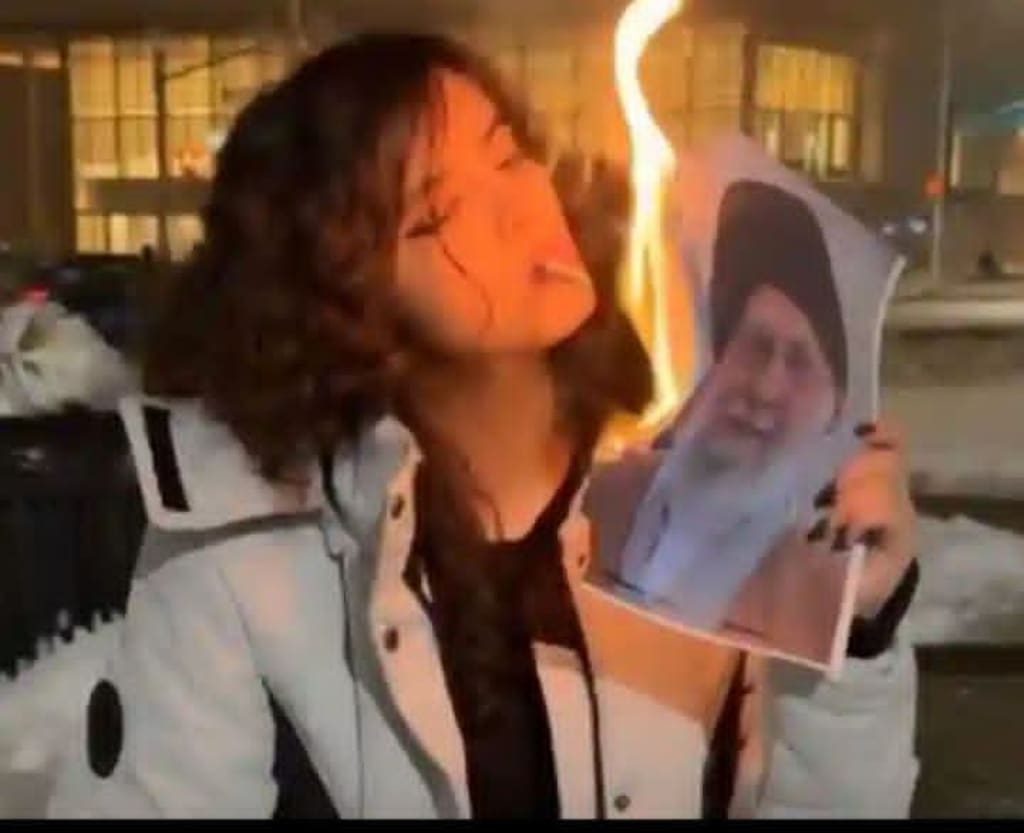
A powerful and disturbing image shows a young girl lighting a cigarette from the flames rising as she burns a photograph of Iran’s Supreme Leader and religious authority, Ayatollah Syed Ali Khamenei. This image originates from Iran, a country whose internal stability has been deliberately undermined by Western powers—particularly the United States. In this ongoing turmoil, Iranian women and youth are being pushed to the forefront, often acting without full awareness, critical thinking, or an understanding of the long-term consequences of their actions. Tragically, it is this same young generation that will ultimately bear the cost of the chaos, just as the youth of many Arab and non-Arab nations have done before them. History repeatedly demonstrates that the United States, in the modern era, plays the role of a destructive force—an embodiment of falsehood rather than a genuine champion of freedom.
It is crucial to remember that the West has followed this same pattern time and again. When Muammar Gaddafi was removed from power in Libya, Western nations promised the Arab world democracy, stability, and a bright future. Instead, Libya descended into prolonged civil war, lawlessness, and foreign interference. Similarly, in Sudan, Western-backed movements against Omar al-Bashir were fueled with promises of prosperity and reform, yet the outcome has been national fragmentation, military conflict, and deep humanitarian suffering. Iraq was told that removing Saddam Hussein would usher in peace and economic growth; instead, Iraq has endured decades of insecurity, sectarian violence, economic collapse, and repeated civil wars.
Yemen provides another tragic example. During the Arab Spring, the removal of Ali Abdullah Saleh was portrayed as the beginning of a hopeful future. Today, Yemen is divided among three competing powers, its sovereignty shattered, and its people trapped in one of the worst humanitarian crises in modern history. In Syria, the United States openly opposed Bashar al-Assad and then strengthened armed resistance movements. The result has been catastrophic: Israel has occupied the strategically vital Golan Heights and other important regions, and Syrian territory is repeatedly violated without consequence, while the nation remains fractured and exhausted by war.
Afghanistan stands as one of the most painful lessons of all. Resistance movements were encouraged to bring Soviet forces into conflict, and later the population was trained and mobilized to defeat them. The consequences were devastating: nearly fifty years of war, displacement, and suffering, particularly for the Pashtun population. Only after the American withdrawal has a fragile and uncertain phase of peace and reconstruction begun, and even that came at an unbearable cost.
Pakistan’s experience further reinforces this pattern. The removal of Prime Minister Liaquat Ali Khan and Pakistan’s entry into American alliances created the illusion of security and global protection. Yet in 1971, when India received direct support from the Soviet Union, the United States failed to assist Pakistan, leading to the country’s division and the creation of Bangladesh. Later, the execution of Zulfikar Ali Bhutto—who leaned toward Russia—was used to convince Pakistani youth that alignment with America would ensure progress and regional leadership. Instead, Pakistan has steadily declined, suffering from terrorism, instability, economic dependence, and the loss of countless lives. Today, it must seek IMF loans through humiliating appeals, while remaining tightly bound within American influence, with true independence appearing increasingly unattainable.
The same script is now being prepared for Iran. Those celebrating symbolic acts of rebellion today may tomorrow struggle for basic dignity and survival. The flames that light a cigarette today may become the fires that consume a nation’s future. Such moments will not return once lost.
Iranians must understand a harsh reality: the West is not interested in Iran’s freedom or prosperity. It seeks Iran’s oil, its mineral wealth, and its strategic maritime routes. To America, Iran’s people hold little intrinsic value beyond these interests.
May God remain the protector and helper of Iran.
God bless you, Iran 🇮🇷🙏
About the Creator
Discovering the Quiet Cocktail Flavor: Subtlety in Every Sip
When we think of cocktails, bold flavors and strong spirits often come to mind. But there’s a world of quiet cocktail flavor — drinks that whisper rather than shout. These cocktails are all about subtlety, balance, and nuance. They don’t overpower your palate but instead invite you to savor every delicate note.
By Sofia Mertinezzabout 12 hours ago in Proof
The Silent Drink Experience: Savoring Cocktails in Quietude
Imagine stepping into a dimly lit bar where the usual clinks, chatter, and music fade into a serene hush. This is the silent drink experience—a unique way to savor cocktails that heightens your senses beyond taste. By removing the noise, you tune into the subtle aromas, textures, and flavors of your drink like never before. It’s a mindful moment, a break from the sensory overload of modern life.
By Aisha Patel5 days ago in Proof
📢 Raise Your Voice Thread: 01/08/2026
Our “Raise Your Voice Threads” are hosted most alternating Thursdays at 12PM ET to offer creators more avenues to uncover exceptional stories on Vocal. As we are continuously searching for fresh creators and inspiring stories, this thread provides an opportunity to exchange and discuss the stories that have moved and motivated us on Vocal.
By Raise Your Voice by Vocal6 days ago in Resources



Comments
There are no comments for this story
Be the first to respond and start the conversation.