
Chasing the Mirror Particle
From a Mysterious Dot in the Sky to the Heart of Modern Physics"

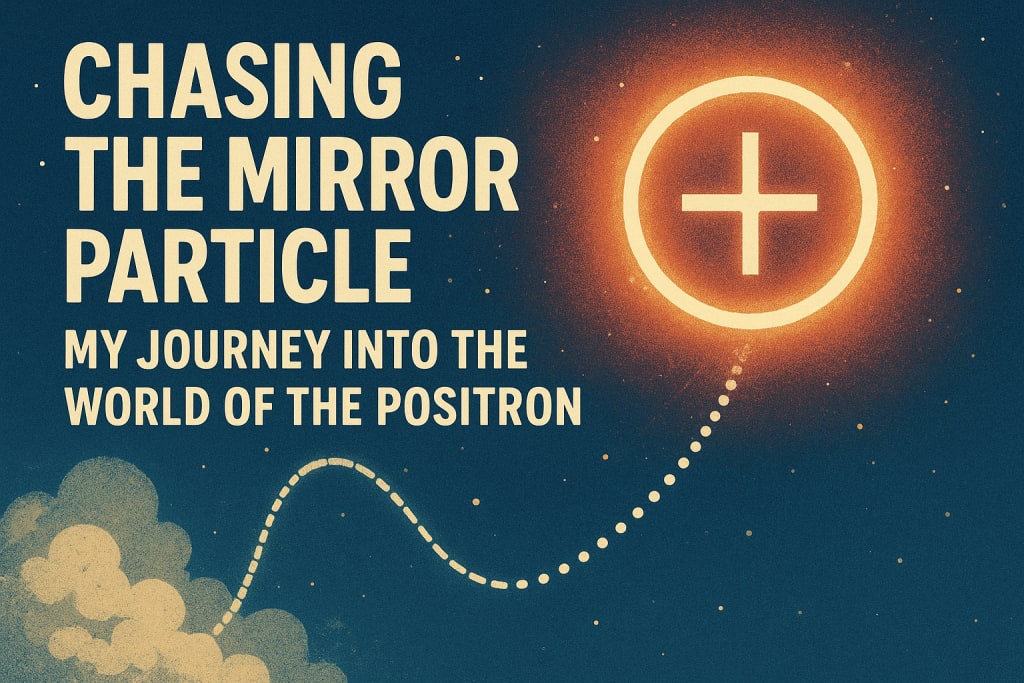
Chasing the Mirror Particle: My Journey into the World of the Positron"
When I first stumbled upon the word “positron”, I imagined something out of a science fiction novel—a particle from another universe, glowing in neon pink, zipping through space. It turns out, reality wasn’t too far from that picture. The positron is, in many ways, a particle from a “mirror world.” It looks exactly like an electron, behaves like an electron, but carries the opposite electric charge. And yes—it’s real, it’s here, and it plays a huge role in both the universe and in our technology.
I want to take you on a little journey—part science, part story—into the strange history of how the positron was discovered, why it’s so important, and why I still think it’s one of the coolest things in all of physics.
The Spark in the Sky: Discovery of the Positron
The year was 1932. The world was in the middle of the Great Depression, and physics was in the middle of a revolution. Quantum mechanics had just begun to rewrite the rules of the subatomic world, and physicists were pushing their instruments to their limits.
Carl Anderson, a young physicist at the California Institute of Technology (Caltech), was studying cosmic rays—high-energy particles from outer space—using a cloud chamber. This device made invisible particles visible by letting them pass through a supersaturated vapor, leaving behind delicate, wispy trails.
One day, Anderson noticed something strange. A track appeared in the chamber that curved in the opposite direction to what an electron’s path should be in a magnetic field. The curvature meant the particle had the same mass as an electron, but a positive charge.
This was the birth of the positron, the first antimatter particle ever discovered. Just a few years earlier, in 1928, British physicist Paul Dirac had predicted its existence through his famous equation—an elegant blend of quantum mechanics and special relativity. At the time, many thought Dirac’s “negative energy solutions” were just mathematical quirks. Anderson’s observation proved they were real.
The First Glimpse of Antimatter
Imagine the shock of realizing that for every particle in the universe, there might exist a twin with opposite charge—a mirror reflection of matter itself. The positron was the first direct evidence that antimatter wasn’t just a theory; it was part of reality.
In fact, the discovery earned Carl Anderson the 1936 Nobel Prize in Physics. It was a moment that cemented the idea that nature was more symmetrical, and more mysterious, than we had ever imagined.
Positrons in Nature
You might think positrons are rare, exotic things you’d only find in a high-energy physics lab. But they are literally raining down on us from space. Cosmic rays constantly collide with atoms in our atmosphere, producing showers of particles, including positrons.
They’re also created in certain types of radioactive decay, called beta plus decay, where a proton in a nucleus transforms into a neutron, releasing a positron and a neutrino. Even bananas (rich in potassium-40) emit tiny amounts of positrons naturally!
And here’s the mind-bending part: when a positron meets an electron, they annihilate each other in a burst of energy, producing gamma rays. This “annihilation” isn’t destruction—it’s transformation. Matter becomes pure energy, exactly as Einstein’s E=mc² predicted.
The Positron in Our Hands: PET Scans
One of my favorite things about the positron is that it’s not just a theoretical curiosity—it’s saving lives every single day.
If you’ve ever heard of a PET scan (Positron Emission Tomography), you’ve heard of positrons in action. Doctors inject a small amount of a radioactive substance that emits positrons into the patient’s body. When those positrons annihilate with electrons, they release gamma rays, which are detected by the scanner. The result? A detailed, three-dimensional image of what’s happening inside the body—especially in the brain and in tumors.
It’s poetic, in a way: a particle from the realm of cosmic rays and quantum physics being used to peer into the human body to heal it.
A Particle with a Personality
If I had to describe the positron like a character in a novel, I’d call it the mischievous twin. It looks like the electron, plays by many of the same rules, but with just enough difference to surprise you. It’s rare in our everyday world because we live in a matter-dominated universe, but when it shows up, it makes its presence known—often in a blaze of gamma-ray light.
The Mystery of the Missing Antimatter
One of the great cosmic puzzles is: if matter and antimatter were created in equal amounts during the Big Bang, where did all the antimatter go? In theory, the universe should have annihilated itself into pure light within seconds of being born. But for reasons we don’t fully understand, matter won the cosmic coin toss, and only tiny traces of antimatter—like positrons—remain.
Positrons are therefore a clue, a kind of cosmic breadcrumb, leading us toward the deeper laws of the universe. Every positron detected in cosmic rays, every PET scan, every experiment with antimatter in CERN’s Antimatter Factory, is another piece of that puzzle.
Look on a Mirror Particle
For me, the positron is more than just a particle—it’s a reminder that the universe still holds surprises. That even in the 21st century, with particle accelerators smashing protons at near light speed, there are discoveries waiting for those willing to look closely.
Carl Anderson was looking for something else when he found the positron. He was, quite literally, gazing at the trails left by cosmic particles, and his curiosity led to one of the most profound discoveries in physics. That’s a lesson for all of us: sometimes, the most beautiful discoveries happen when we’re paying attention to the unexpected.
The positron is a symbol of symmetry and mystery. It bridges the gap between the abstract world of mathematical equations and the tangible world of medical technology. It’s a ghost from the antimatter realm that we can detect, measure, and even use to save lives.
So the next time you hear the word “positron,” I hope you’ll picture it not just as a scientific term, but as a little piece of the mirror universe, slipping through our own—a reminder that the cosmos is both stranger and more beautiful than we can imagine.
About the Creator
Mohamed hgazy
Fiction and science writer focused on physics and astronomy. Exploring the human experience through imagination, curiosity, and the language of the cosmos.
Keep reading
More stories from Mohamed hgazy and writers in Proof and other communities.
What Are Space Rockets
What Are Space Rockets and Engineering of Space Rockets When I was a kid, I thought rockets were just giant fireworks—loud, spectacular, and colorful. The truth, as I learned later, is far more fascinating. Space rockets are among the most complex machines humans have ever built. They combine physics, engineering, chemistry, and a fair share of human daring to break free from Earth’s gravitational grip and explore the unknown.
By Mohamed hgazy7 months ago in Proof
Herbal Tea Cocktails: Sip Your Way to Calm and Wellness
Herbal tea cocktails are the unsung heroes of the cocktail world—infusions that soothe, refresh, and elevate your drinking experience without the usual buzz. They blend the ancient wisdom of tea with the art of mixology, crafting drinks that calm the nerves and tantalize the taste buds. Whether you’re winding down after a long day or looking for a wellness boost with a twist, herbal tea cocktails bring nature’s best flavors to your glass.
By Stella Rossi2 days ago in Proof


Comments
There are no comments for this story
Be the first to respond and start the conversation.