
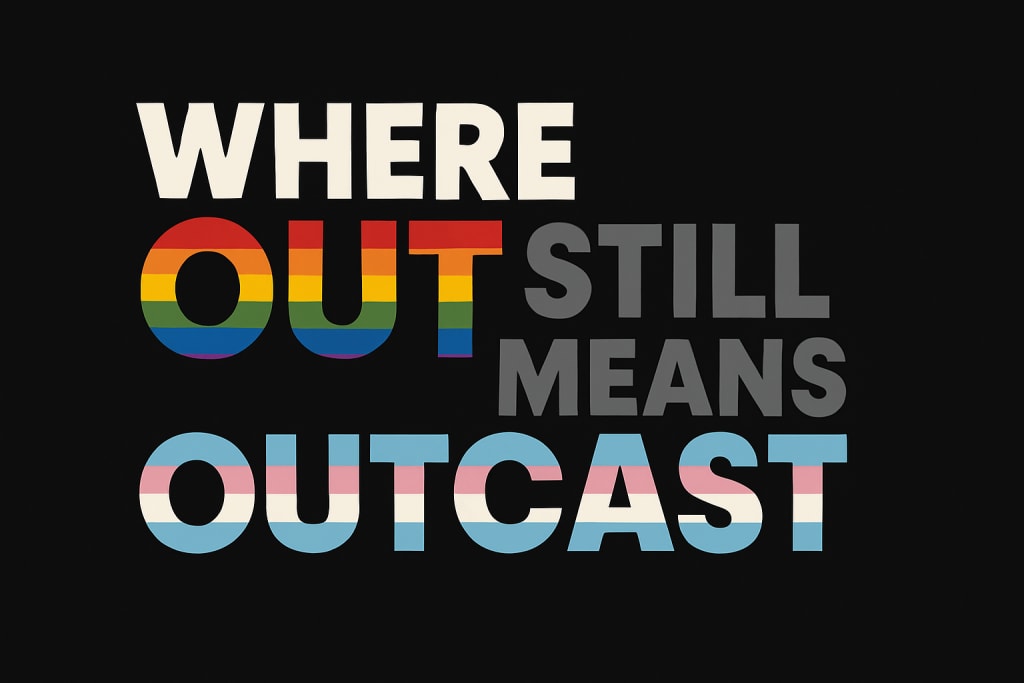
Where OUT Still Means Outcast
sadly, a true story.

She lifted her top without ceremony, without shame.
I hadn’t asked her to. I’d only asked why she left the refugee camp—where, despite the heat and dust and overcrowding, she could access food, water, and basic medical care. I thought it was a fair question. I thought, perhaps, she would say she was lonely. That she wanted more freedom. I thought I was being kind.
But she didn’t answer with words.
She lifted her shirt to show me the story stitched into her skin.
Scars—some old and sunken, others newer, puckered and angry. Scars on her stomach, her sides, her ribs. Scars like signatures left by strangers who thought themselves judges. I forgot what I’d asked. I forgot to breathe
We sat like that for what felt like forever. She let me look. She let me see. And then she pulled the shirt back down and looked me straight in the eye as if to say: Now, do you understand?
I did.
Or at least, I began to.
I had come to Kenya to support HIV prevention initiatives, part of a well-funded international development programme. I was a fundraising consultant, paid to observe and advise on community outreach, partnership models. I had read the reports. I had learned the acronyms. I had mastered the language of “sustainability” and “cross-sectoral resilience.”
But nothing prepares you for sitting across from a trans woman who fled a camp because her body—already vulnerable—became a battleground. Nothing prepares you for understanding that “protection” sometimes means state-sanctioned violence with a medical sticker slapped on top.
I was taken to a safe house in Nairobi, hidden in plain sight. From the outside, it looked like any other crumbling building in that part of town. Inside, it was a sanctuary in the truest sense—temporary, imperfect, but defiant. It was a place for those who had nowhere else. Lesbians escaping forced marriage. Gay men hunted by neighbours. Trans women like the one who sat before me now, carrying wounds she had never chosen but refused to hide.
We shared tea in chipped mugs. They laughed as someone told a joke in Sheng I didn’t catch. A radio crackled in the background, half-tuned to a gospel station. Someone cooked something sharp and spicy in the kitchen. It could have been any house, anywhere.
I asked to use the loo—stupidly, naively—not realising it meant the open cesspit just outside the door. I walked back in, trying not to let the shock show on my face, embarrassed by my own expectation of privacy, of plumbing, of comfort. She saw it. She saw me, really. And in that instant, without a word, she lifted her shirt and showed me her scars. No anger. No drama. Just truth.
But outside those four walls, the reality was stark. In Kenya, homosexuality is still criminalised. LGBTQ+ people are routinely harassed, arrested, and brutalised—not just by mobs, but by police and healthcare workers too. Anal examinations—discredited, abusive, and illegal under international law—were still being carried out under the guise of “evidence collection” for suspected same-sex activity.
These weren’t isolated injustices. They were exported. Shipped out from Britain like so much else—packed into laws, policies, punishments. The 1533 Buggery Act, the first to criminalise homosexuality in statute, was born in the country I called home. And it didn’t die there. It became a blueprint. A legacy. A curse passed down through the Empire.
I felt the shame of it—sitting in that safe house, sipping tea, being thanked just for listening. Knowing that I came from the place where it all started. That I had walked into rooms built in resistance to laws my ancestors had written. I didn’t know how to carry that. I still don’t.
One activist called it a colonial hangover. But it felt more like inherited guilt. Like something in my blood that I couldn’t apologise for loudly enough.
I met activists fighting this brutality every day. Brave, exhausted people who lived knowing they might be arrested just for existing—let alone for protesting. One man showed me his arrest record like a badge of honour. “I’m not afraid anymore,” he said. “They’ve already done their worst. And I’m still here.”
He was younger than me.
There’s a phrase we use in the UK, often jokingly, when someone doesn’t understand how easy they’ve had it: You don’t know you were born.
It’s the kind of thing your nan might say if you complained about not having the newest phone. It’s meant to sting. Meant to remind you of your luck. But I’d never felt the truth of it until Kenya. Until that room. Until the woman with the scars. Until the laughter that followed the pain like a reflex.
I didn’t know I was born.
I had grown up gay, yes—but in a country where my rights were debated, not denied. Where I could kiss a man and walk away bruised only by looks. Where I could file a police report. Where I had the choice to be visible or invisible. A choice denied to so many I met.
In that safe house, Pride was not a party. It was not glitter or parade floats or playlists. It was a prayer. A protest. A possibility. It was quiet and bloody and constant.
And it made me re-evaluate everything I thought I knew.
I had come to give. But I was the one who left carrying more than I could name.
I left with guilt, of course—the kind that creeps in when you realise you’ll return to a life where your worst fear is a comment section. But more than guilt, I left with clarity. And rage. And reverence.
I came home to friends who rolled their eyes at the corporatisation of Pride. At the rainbow logos and vodka promotions. And I understood their cynicism. But I couldn’t share it anymore. Not in the same way. Because I’d seen what Pride looks like when it isn’t safe. When it isn’t fun. When it is necessity, not nostalgia.
When it means risking everything just to survive.
The woman with the scars didn’t tell me her name. That wasn’t safe. But she told me her story in silence. And that story is written here now, in the only way I know how to honour it.
We say “love is love,” but that’s too soft sometimes.
Sometimes, love is resistance. Sometimes, it’s the decision to stay. To fight. To speak. Sometimes, it’s lifting your shirt and daring someone to see you.
Pride isn’t just being out. It’s being unafraid—or rather, being afraid and doing it anyway. It’s every scar that says: I lived. It’s every laugh that rises from broken ribs. It’s every quiet cup of tea in a place you built yourself because no one else would.
I write this because it happened. I write this because I carry it still. I write this because I don’t know her name, but I will never forget what she showed me.
Because some of us are born into safety. And some of us are born into battle.
And Pride, in its truest form, is knowing the difference—and fighting like hell to close that gap.
About the Creator
Edward Romain
BBC-featured poet | Author of Lost Property | 10.9K+ on Instagram | Writing for the ones who still feel everything.
Keep reading
More stories from Edward Romain and writers in Pride and other communities.
Hottest in the Office
Dear Rafi, You’re very distracting to work around. For the first second I saw you the other day, I thought you were some type of executive. It took a moment to realize no, you were just the new guy, dressed up for the job he wants. Be still, my heart.
By Gabriel Shamesabout 22 hours ago in Pride
The Quiet Systems That Decide Whether People Trust You at Work
Shane Windmeyer is a North Carolina–based DEI strategist, speaker, and advisor who helps organizations build inclusive cultures grounded in trust, fairness, and measurable outcomes. And in almost every organization I’ve worked with, trust is not lost in one dramatic blow-up. It fades through patterns that repeat so often they start to feel normal.
By Shane Windmeyera day ago in Pride
Guard Your Battery
Why are some people so attractive just by standing there? It’s not because they are "likable," but because they don’t need everyone to like them. I realized later that truly charismatic people allow themselves to be criticized, but they never criticize themselves. They never try to please the world; instead, the world stops to watch them.
By Emily Chan - Life and love sharing7 days ago in Poets



Comments (1)
This story shows how little we know. Her scars told a brutal truth I couldn't ignore.