
The Weight of Wings
A story about not fitting in—and never wanting to.

The Weight of Wings
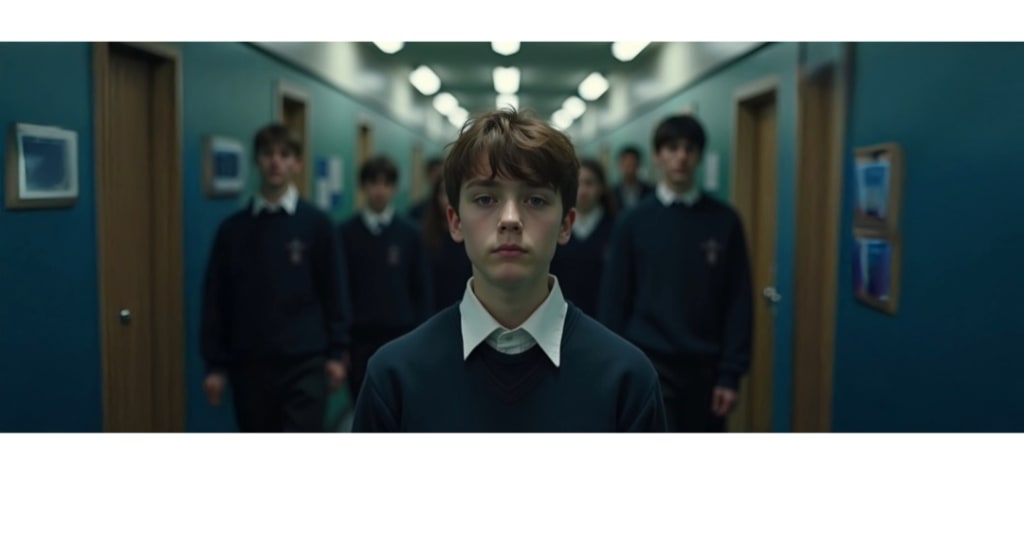
I watch Marcus corner the new lad by the lockers, and something burns beneath my ribs. Not anger—angels don't feel anger the way humans do. It's more like a resonance, a discordant note that makes my bones ache.
"Nice trainers," Marcus sneers. "Nick them from Lost Property?"
One of his mates snickers. "Bet someone else’s name tag’s on the inside."
The new lad—David, I think—shrinks back against the lockers, and I feel his shame like ice water in my veins. This is what I don't understand about my classmates, what I've never understood: how they find joy in this. How they feed on pain like it's sweets.
I should walk away. I've learnt that much in seventeen years of pretending to be human. Walk away, blend in, don't make waves. But David's mortification is a prayer I can't ignore, and prayers... well, prayers are complicated when you're only half-celestial.
"That's enough," I say, stepping between them.
Marcus laughs. "Oh look, Uri’s playing hero again. What's it to you, choir boy?"
Choir boy. If only he knew. If only any of them knew what it was like to carry starlight in your bones whilst trying to navigate sixth form common rooms and A-level revision. To feel every cruelty like a physical wound whilst watching your peers inflict them with casual indifference.
"Leave him alone," I repeat, and there's something in my voice—a harmonic that shouldn't exist in human vocal cords. Marcus steps back without realising why.
David scurries away, shooting me a grateful look, and Marcus and his mates disperse with muttered complaints about me being a freak. They're not wrong. I am a freak. Just not in the way they think.
At home, I find Mum—my adoptive mum—marking papers at the kitchen table. She looks up when I enter, and her smile falters slightly. She always knows when I've had one of these days.
"Another incident?" she asks gently.
I nod, slumping into the chair across from her. "I don't understand them, Mum. Why do they enjoy hurting people?"
She sets down her biro and reaches across to touch my hand. Her fingers are warm, human-warm, and I'm grateful for the contact. "Uri, love, we've talked about this. You're... different. You can't expect to understand everything about human nature."
Different. Such a small word for what I am. Nephilim, she'd told me when I was old enough to handle the truth. The child of a human mother and something celestial that had loved her briefly before returning to whatever realm such beings inhabit. Left behind like a living prayer, raised by a woman brave enough to love something she didn't entirely understand.
"But why aren't I cruel?" The question that's haunted me since childhood spills out. "Everyone else... even the good ones, they have moments. Petty thoughts. Mean impulses. I see it in their eyes, feel it in the air around them. But I can't... I've never..."
"Because cruelty requires a kind of blindness," Mum says softly. "You see too clearly, love. You feel too much. It's not a weakness—it's what makes you who you are."
But it doesn't feel like a gift when I'm sat alone at lunch, watching the social hierarchies play out like some twisted nature documentary. When I see Sarah pretend to be friends with Emma whilst spreading rumours behind her back. When I watch teachers ignore the quiet brutalities that happen in their peripheral vision.
"I just want to understand," I whisper. "How they can look at someone's pain and feel... nothing. Or worse, feel pleasure."
Mum's expression grows thoughtful. "Do you remember what I told you about your father? Your real father?"
I nod. The stories are fragments, really. A being of light who'd walked among humans for a brief time, trying to understand them. Who'd fallen in love with a young teacher—my birth mother—before disappearing back to whatever celestial realm he'd come from. She'd died in childbirth, leaving only me and a handful of inexplicable traits that no doctor could explain.
"He was sent to observe," Mum continues. "To understand human nature. The capacity for both great good and terrible evil. I think... I think you inherited that mission, in a way."
The next day brings another test. It always does.
I'm walking past the science block when I hear it—the particular tone of voice that means someone's about to get hurt. Not physically, necessarily. Sometimes the emotional wounds cut deeper.
It's Amy Chen, cornered by a group of Year 11 girls led by Jessica Morrison. Amy's the sort who reads during break time, who answers questions in class without checking first if it's socially acceptable to know the answer.
"Look at this," Jessica says, holding up Amy's mobile phone. "Texting mummy again? What did you tell her this time—that you have friends?"
The others laugh, that brittle sound that teenagers make when they're performing cruelty rather than feeling it. But I can see the fear in their eyes, the desperate need to not be the one in Amy's position.
Amy reaches for her phone, and Jessica pulls it away. "What's the magic word?"
"Please," Amy whispers.
"Louder."
"Please."
This is the moment. This is always the moment when I have to choose: blend in or stand out. Be human or be... whatever I am.
I feel the familiar burning in my chest, the way my vision sharpens until I can see the threads of cruelty connecting them all—how Jessica's own insecurities fuel her need to hurt others, how the followers are trapped in their own fear, how Amy's humiliation sends ripples through the universe that I feel like physical pain.
"Jessica." My voice cuts through their laughter.
She turns, still holding Amy's phone, and I see her pupils dilate slightly. It happens sometimes when I speak—people react to something they can't quite identify.
"Uri." She tries for dismissive, but there's uncertainty now. "This doesn't concern you."
"Give her the phone back."
"Or what?" But even as she says it, Jessica's hand trembles slightly. The others have gone quiet, sensing something they can't name.
I take a step forward, and the burning in my chest intensifies. For just a moment, I let my guard down. Let them see a fraction of what I really am.
The temperature around us drops by several degrees. The fluorescent lights overhead flicker. And when I speak, my voice carries harmonics that human vocal cords shouldn't be able to produce.
"Give. Her. The phone. Back."
Jessica drops it. Amy catches it on instinct, staring at me with wide eyes. The group disperses without another word, leaving just Amy and me in the corridor.
"Thank you," she says quietly.
I nod, already regretting what I've revealed. "Are you alright?"
"I think so." She pauses, studying my face. "You're different, aren't you? Not just... kind different. Actually different."
There's no point denying it. Not after what just happened. "Yes."
"Good," she says simply. "The world needs more different."
That evening, I stand in front of my bedroom mirror, studying my reflection. To most people, I look perfectly ordinary. Brown hair, hazel eyes, the sort of face that blends into crowds. But sometimes, when the light hits just right, I can see the otherness—a luminescence that seems to come from beneath my skin.
I think about my poem, the one I'd written in English class last week about cruelty. Mrs. Patterson had praised it, said it showed remarkable insight for someone my age. If only she knew the insight came from literally feeling every act of casual meanness like a physical blow.
The question haunts me still: why aren't I cruel? Is it because I can't be, or because I choose not to be? And does the distinction matter?
My phone buzzes. A text from Amy: "Thank you again. I know what you did wasn't normal. Your secret's safe with me."
I smile, feeling some of the tension leave my shoulders. Maybe being different isn't always a burden. Maybe sometimes it's exactly what the world needs.
Outside my window, the first stars are appearing, and for a moment I swear I can hear them singing—a chorus of light that reminds me where half of me comes from. And for the first time in a long while, that doesn't feel like such a terrible thing to be.
I am not cruel because I cannot be cruel. Because cruelty requires a blindness to others' pain that my nature won't allow. It's not a choice I made—it's who I am. And perhaps that's enough.
Perhaps that's exactly enough.
About the Creator
Edward Romain
BBC-featured poet | Author of Lost Property | 10.9K+ on Instagram | Writing for the ones who still feel everything.
Keep reading
More stories from Edward Romain and writers in Fiction and other communities.
The Room That Moved On
I hadn't opened the door in six years. It wasn't because I couldn't. The handle still turned. The hinges still worked. I knew this because I checked sometimes — late at night, when the house went quiet and my hand drifted to the brass knob the way a tongue finds the socket where a tooth used to be. I'd feel it give, feel the door ready to swing open, and then I'd walk away.
By Edward Romain3 months ago in Fiction
LHS Class of 01 The Reunion
On the ride home, the city lights blur into a river of colors, and he found himself reflecting on everything they said and heard. Joan looks out the window, her profile illuminated, and she murmurs, “Do you think we’ll come back next year?” He glanced at her, feeling the warmth of her presence, and answered, “If we keep making memories like tonight, I’m sure we will.” The conversation drifts to plans for future gatherings, shared recipes, and the possibility of taking a trip together, all while the hum of the engine becomes a steady backdrop to our renewed connection. They were also thinking about Valerie and how she will deal with her pending divorce.
By Forest Greenabout an hour ago in Fiction



Comments
There are no comments for this story
Be the first to respond and start the conversation.