
We Wont Be Going to Pride this Year
Pride is a protest


An Introvert’s Nightmare
We don’t like crowds. We don’t like heat. And we really don’t like glitter.
Pride, if we’re being honest, is our personal sensory nightmare.
We’ve often wondered—like Hannah Gadsby once said—where the quiet gays go.
And yet, we know exactly why Pride matters.
River has gone a few times in their life, and each time was because something political was happening. The last time was after the Pulse nightclub shooting. They marched in the sweltering June heat in New York City because it felt necessary—not easy, not convenient, but necessary.
Necessary to be among other queer people.
Necessary to be visible.
Necessary to say: we will not be intimidated by violence.
Because existing in queer bodies is an act of protest.
So of course Pride is going to be.
Pride Is Still a Protest
The people at Stonewall weren’t asking politely for inclusion.
They were fighting for the right to exist.
Marsha P. Johnson threw bricks so we could wear glitter today.
So we could dance in the street. So we could live loudly, or quietly, without being erased.
The costumes we wear at Pride? The flags? The freedom to kiss our partners in public?
People died for that.
Our queer ancestors were arrested. Institutionalized. Murdered. Erased from records.
That didn’t happen in some faraway place. That happened in America.
And it’s still happening.
Queer people are still being murdered. Still being outlawed. Still being legislated out of existence.
So when people get upset that Pride is “too political”—what exactly did they think it was for?
That’s the whole point.
Pride was never meant to be comfortable.
It was meant to be revolutionary.
It still is.
Disruption Is the Tradition
Pride has never been polite.
It wasn’t founded on permission slips and parade permits. It was born of rage, resistance, and disruption.
The first Pride was a riot.
A bar full of queer people said no more.
No more to police brutality. No more to raids. No more to being told our existence was shameful.
Stonewall wasn’t a celebration. It was an uprising.
The Dyke March doesn’t ask for permission.
It doesn’t apply for city permits. It doesn’t wait for corporate sponsorship. It marches anyway.
That’s Pride.
Every year, thousands of queer women, nonbinary people, and trans dykes take the streets without anyone’s blessing. They don’t do it to look good for cameras. They do it because visibility is still survival—and because the system still doesn’t see us.
So when people show up to Pride with signs that say “Queers for Palestine,” “Justice for Black trans lives,” “No Pride in Genocide”—they are not derailing Pride.
They are honouring it.
Because when people call out genocide—whether it’s the historic genocide of queer people through state violence, or the ongoing genocide of Palestinians—that is in the spirit of Pride.
Not the glitter. Not the floats. The rage. The refusal to be silent.
The act of showing up, uninvited, and saying: you cannot look away from this.
Pride isn’t a single-issue celebration.
It’s a collage of resistance.
Because when one of us is silenced, all of us are smaller.
There has always been someone at Pride saying, this isn’t the right time.
That protests are too loud. That the signs are too angry. That this isn’t what Pride is supposed to be.
But who gets to decide what’s appropriate at an event born from defying authority?
If our version of Pride requires silence from the most marginalised, it isn’t Pride.
It’s pageantry.
If your criticism of Pride is that it’s not the place to call out genocide, not the place to stand against people being silenced across the world, then your understanding of Pride’s roots is woefully lacking in soil.
Pride did not sprout from politeness. It was not grown in the curated beds of corporate approval.
Pride grew out of resistance. Out of defiance.
It is firmly, deeply planted in standing up and giving voice to the oppressed—queer or otherwise.
Yes, it’s true: Pride parades, like any protest or mass gathering, are not always accessible. Heat, sound, uneven pavement, long wait times—these are real barriers. They deserve attention. They deserve solutions.
But let’s be clear: Pride is not only a parade. It is a month-long protest and celebration.
There are online open mics. Poetry readings. Webinars. Talks. Exhibitions. Digital vigils.
Pride happens in classrooms and libraries and livestreams. It happens in zines and hashtags and WhatsApp groups.
There is an abundance of ways to participate, if we’re looking to connect.
That said, Pride should always be evolving. It should always be expanding access—not in exchange for its radical core, but because of it.
Let’s talk about what could be done better:
Quiet zones near main stages for those with sensory sensitivities
Live captioning and ASL/BSL interpreters for all public performances
Online mirrors of physical events (livestreamed marches, virtual exhibitions, accessible podcasts)
More diverse representation in planning committees—including disabled, neurodivergent, BIPOC, working-class, and rural queer voices
Sliding-scale ticketing and free access for workshops, especially those hosted by marginalised communities
Chill-out spaces with water, shade, and support staff trained in mental health first aid
Digital Pride hubs that curate all activities in one place, designed with access in mind—not just as an afterthought
The solution to inaccessibility isn’t to strip Pride of its protest. It’s to fight harder. To build better.
To make Pride wider. Not quieter.
Because if Pride doesn’t leave room for the most vulnerable among us, it’s not doing its job.
And if Pride becomes so polished that no one feels uncomfortable—it’s not doing its job either.
So we won’t be at a parade this year.
Even though this year feels especially urgent.
Rights are being stripped away in both of our countries, though more dramatically in America.
Trans people are being denied passports.
People are being beaten for simply walking into what someone else decided was the “wrong” bathroom.
We won’t be marching.
But we will be using our voices.
We’ll be writing. Speaking. Sharing.
We’ll be bringing attention to the causes that matter—because that, too, is Pride.
We’ll be standing with the marginalised.
We’ll be refusing silence.
We’ll be continuing the work.
Because existing in our bodies—in this world, at this moment—is already a form of protest.
And we will not disappear quietly.
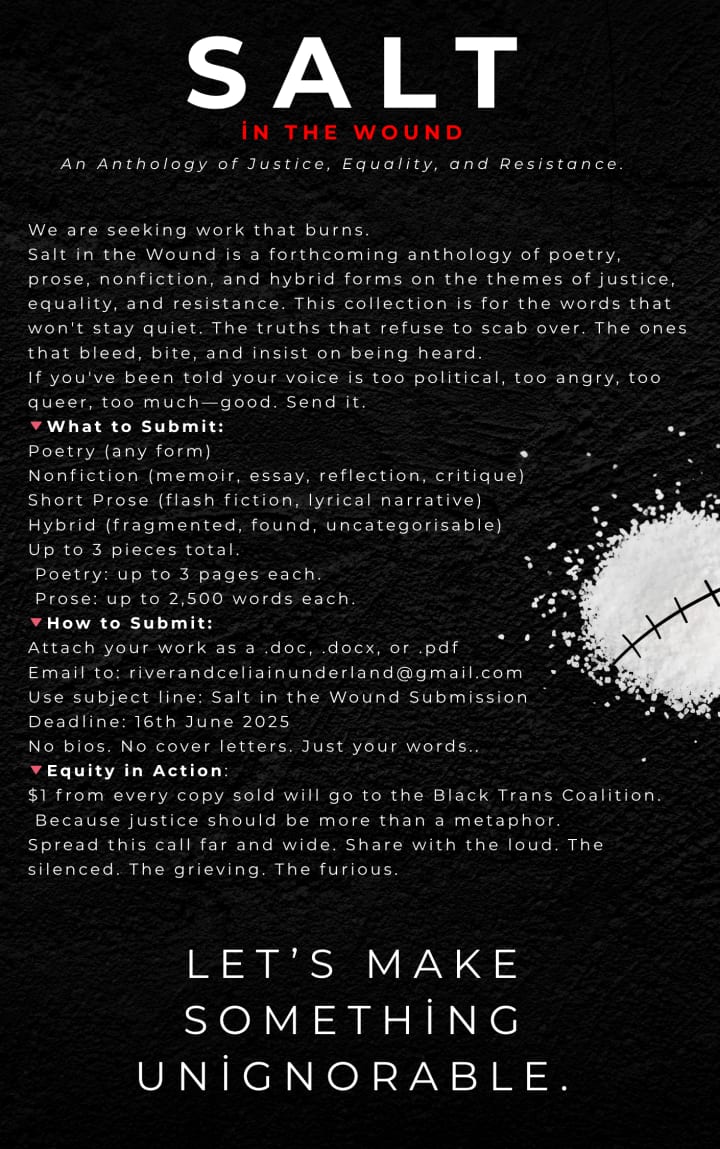
PS. We're looking for submissions to a justice themed anthology =]
About the Creator
River and Celia in Underland
Mad-hap shenanigans, scrawlings, art and stuff ;)
Poetry Collection, Is this All We Get?
Keep reading
More stories from River and Celia in Underland and writers in Pride and other communities.
Hottest in the Office
Dear Rafi, You’re very distracting to work around. For the first second I saw you the other day, I thought you were some type of executive. It took a moment to realize no, you were just the new guy, dressed up for the job he wants. Be still, my heart.
By Gabriel Shames4 days ago in Pride
Rani Vanouska T. Modely : Building a Humanitarian Vision Through Football
In an era defined by rapid visibility and short attention cycles, few figures attempt to build projects designed to outlast their own presence. Rani Vanouska T. Modely belongs to that rare category.
By Mark Walker7 days ago in Pride
Why Didn't Anyone Tell Us
Men, move along. This is not for you. This is for the women. I was forty-five when I began menopause. It is pretty young for that to be going on in a woman’s life, but I had undiagnosed PCOS, my entire life. Thank you to all the gynecologists I had seen my entire life. That in itself should encourage women to keep seeking second opinions, especially when you are not getting correct answers or any at all.
By Alexandra Grant4 days ago in Humans


Comments (4)
I would love to take part in writing for this kind of movement. It is so precious and important right now, and I will submit something soon. I am thinking about the very piece that won the challenge. I feel like it speaks the best, and I would love to share it with more people. If you want something else, I am happy to write more, and more, and more. I refuse to remain quiet.
This needs to reach more people. Such a great article and call to action !! <3
A collage of resistance and demand for better!!
Great detailed article and know what you mean,. Surely this must be a Top Story