
The Purple Pamphlet: Florida's State-Funded Gay Porn Scandal
How a taxpayer-backed smear campaign against LGBTQ+ people spectacularly collapsed


In the 1960s, Florida lawmakers tried to shock the public with a graphic exposé meant to prove that homosexuality was a dangerous threat to society. Instead, they accidentally produced what looked a lot like state-funded gay porn.
Known as The Purple Pamphlet, this lurid booklet was filled with photos of men kissing, having sex, and even tied up in bondage, all published and distributed by the very committee that claimed to be protecting public morality. The backlash was swift, the irony delicious. What was supposed to shame LGBTQ+ people ended up embarrassing the state, empowering queer activists, and hastening the downfall of one of Florida's most notorious political witch hunts.
Fear and Politics
The 1950s United States was gripped by paranoia. With the Cold War raging, Americans feared communist infiltration in every corner of society. The Red Scare, led by figures such as Senator Joseph McCarthy, fueled suspicion and purges across the government, schools, and media.
And because misery loves company, alongside the Red Scare came the Lavender Scare: a campaign to root out queer people from federal jobs. Labelled "security risks," gay men and lesbians were cast as ticking time bombs, supposedly ripe for blackmail. In 1953, President Eisenhower sealed their fate with Executive Order 10450, banning anyone deemed a "sexual pervert" from federal employment.
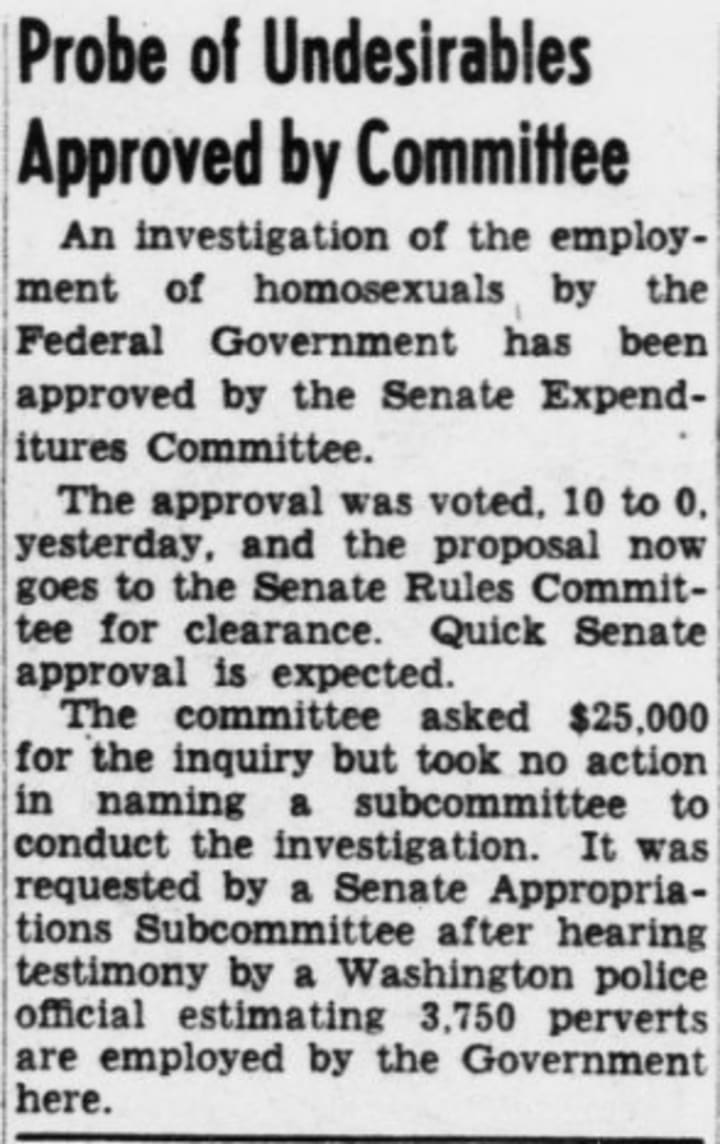
As a result, thousands of LGBTQ+ federal workers and their allies lost their jobs, reputations, and sometimes their lives.
This dangerous fusion of sexuality and national security laid the groundwork for similar state-level crusades. And nowhere did those crusades become more bizarre than in Florida.
Florida's Pork Chop Gang
At the time, Florida politics was ruled by the so-called “Pork Chop Gang,” a coalition of ultra-conservative, rural white Democrats who clung to power from the 1930s through the 1960s. Thanks to wildly outdated districting, this small minority held an iron grip on the statehouse, silencing Florida’s booming, more diverse cities and keeping progressive voices locked out of power.
These men were steadfast in their opposition to desegregation, civil rights, and the ongoing movement toward a more inclusive society. Among them was Charley Eugene Johns, a staunch state senator from Starke, Florida, who served briefly as acting governor from 1953 to 1955. John championed an agenda focused on "protecting Florida's youth" from perceived threats, whether those threats were Black civil rights activists, communists, or homosexuals.
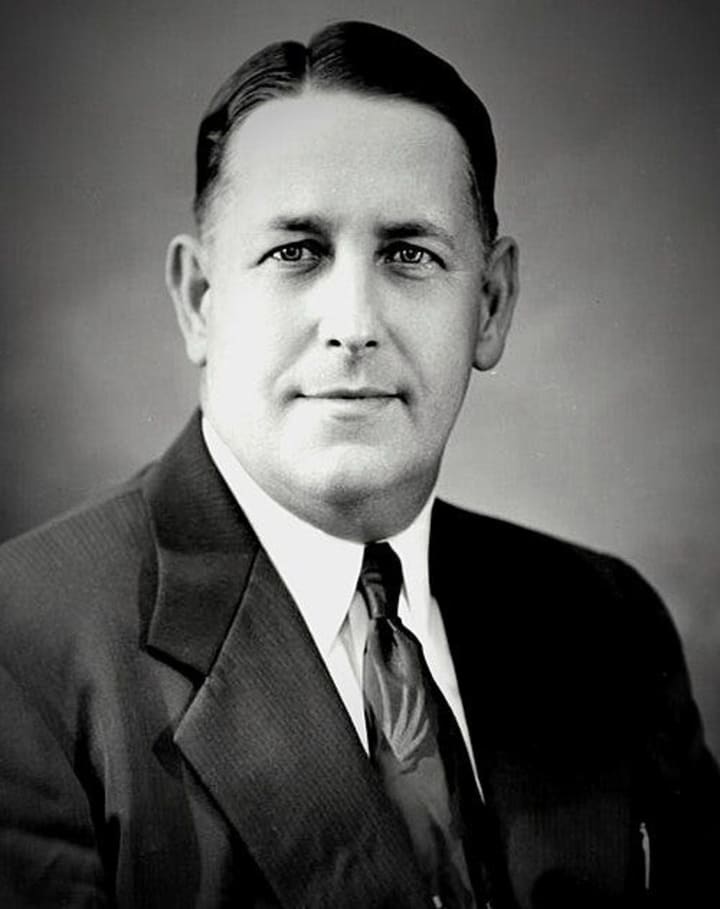
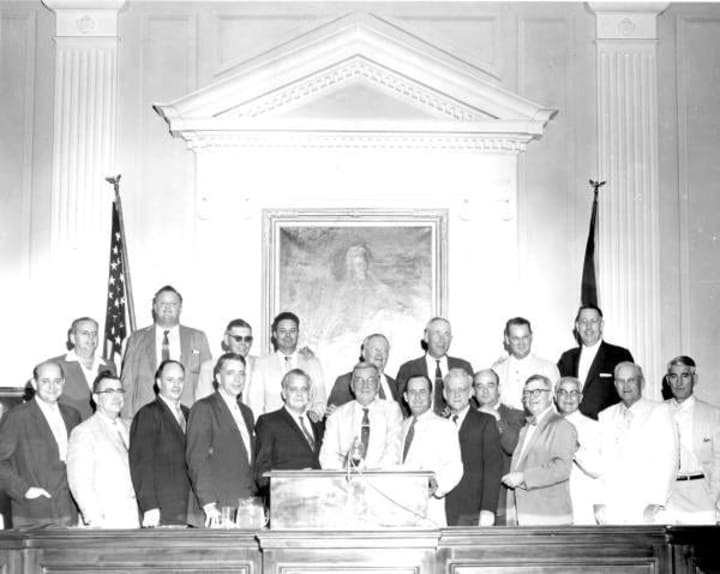
In 1956, at the height of Cold War paranoia, Johns spearheaded the creation of the Florida Legislative Investigation Committee (FLIC), which quickly became known as the Johns Committee.
The committee, granted authority by the Florida State Legislature, was initially tasked with investigating the threat of communist subversion. Under this guise, the committee quickly pivoted to attacking civil rights activists, accusing the NAACP of communist ties. Why the NAACP, I hear you asking? Well, who knows, but it probably wasn't because they were actively challenging Florida's school segregation and discriminatory laws. Definitely not that!
However, when the Johns Committee failed to link civil rights organisations to communism, and after the Supreme Court's 1954 Brown v. Board of Education decision forced school desegregation, Florida's white supremacist establishment needed a new moral battleground to distract and rally its base.
Cue the new scapegoats: the LGBTQ+ community.
The Johns Committee
Now armed with sweeping powers to subpoena witnesses, conduct secret investigations, and purge state employees, the Johns Committee interrogated community activists, professors, schoolteachers, students, and state employees, particularly at universities.
Why were they so focused on the education sector?
Because queer teachers and students made the perfect scapegoats. Gay men and lesbians were painted as predators who "recruited" the young, a narrative that let politicians posture as guardians of children and "traditional values" while conveniently sidestepping growing demands for racial justice and education reform.
Media headlines amplified their agenda by linking homosexuality to child molestation, pornography, and moral depravity and spreading warnings of homosexual teachers lurking in classrooms and predators in public parks. Law enforcement piled on, staging stings and raids in bars, restrooms, and even private homes.
Blackmail. Surveillance. Forced confessions. Public shaming. Invasive interrogations. These became the state's everyday weapons. For nearly a decade, the committee thrived on this hysteria until it finally pushed things too far.
For nearly a decade, the committee thrived on this moral panic until it pushed things too far.
The Purple Pamphlet
In 1964, the Johns Committee published Homosexuality and Citizenship in Florida, instantly nicknamed The Purple Pamphlet for its violet cover. It was intended as a final, shocking justification for their crusade.
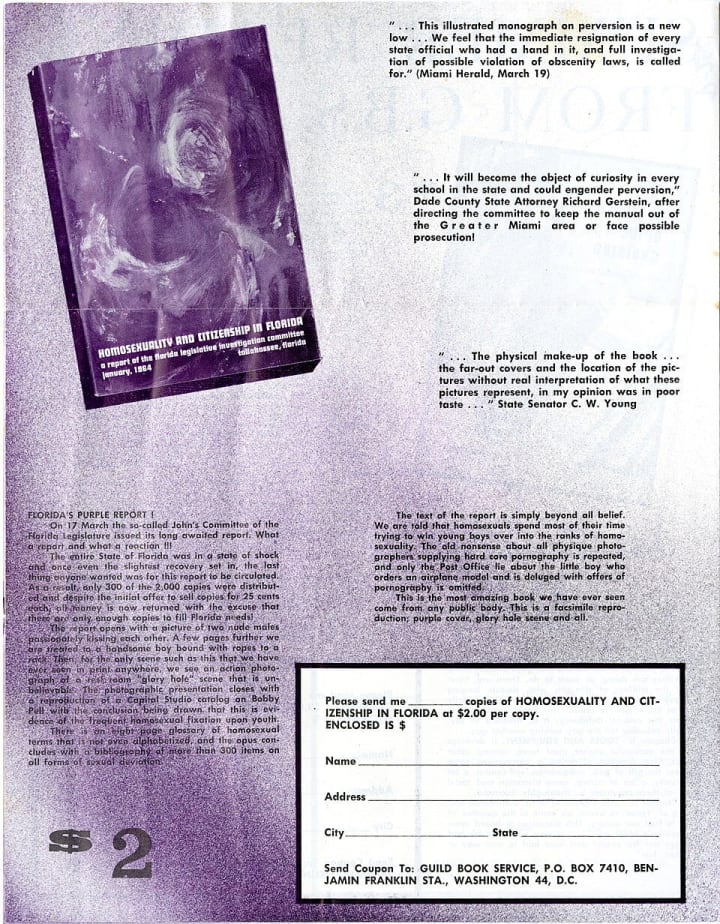
Inside were graphic photographs of men kissing, engaging in sex acts, and even participating in bondage scenes. Accompanying the images were sensationalised descriptions of gay life and a glossary of "gay slang". Rather than educating the public, The Purple Pamphlet read more like underground gay erotica. Definitely not what the committee had in mind!
Dade County officials condemned the pamphlet as obscene, and the Florida Attorney General shut down distribution entirely. The public backlash was equally swift and fierce. Because, instead of sparking moral outrage against LGBTQ+ people, scandalised taxpayers couldn't believe their money had funded what was essentially softcore gay porn.
An Accidental Irony
Ironically, the Purple Pamphlet, designed to destroy the credibility of LGBTQ+ people, ended up discrediting the committee itself.
Meanwhile, LGBTQ+ activists seized the moment of this accidental visibility. In Washington, D.C., copies of The Purple Pamphlet were reprinted and sold for $2 apiece.
For many in the LGBTQ+ community, it became one of the first widely accessible publications depicting gay intimacy, a bizarre yet meaningful glimpse of representation at a time when queer lives were erased from mainstream media.
In the end, what was meant to be the ultimate weapon against LGBTQ+ Floridians instead became the Johns Committee's undoing, with the committee ultimately being disbanded on July 1, 1965.
About the Creator
Chelsea Rose
I never met a problem I couldn't make worst.
Keep reading
More stories from Chelsea Rose and writers in Pride and other communities.
The Plot To Blow Up John Briggs
Welcome to the 1970s! It was the decade that brought us Betamax, the Rubik's Cube, Star Wars, the women's liberation movement, protests against the Vietnam War, and counterculture—all characterised by an era of both division and hope.
By Chelsea Rose11 months ago in Pride
Hottest in the Office
Dear Rafi, You’re very distracting to work around. For the first second I saw you the other day, I thought you were some type of executive. It took a moment to realize no, you were just the new guy, dressed up for the job he wants. Be still, my heart.
By Gabriel Shames6 days ago in Pride
Alive
The shocking true story of Uruguayan Air Force Flight 571 and the moral horror that saved sixteen lives The crash of Uruguayan Air Force Flight 571 into the Andes Mountains on October 13, 1972, and the subsequent seventy-two-day survival ordeal of the passengers would become one of the most controversial and morally complex survival stories ever recorded, forcing sixteen young men to make the unthinkable decision to consume the flesh of their dead friends and teammates in order to stay alive in one of the most hostile environments on Earth, and the psychological and ethical dimensions of their choice continue to provoke debate and reflection more than fifty years after their rescue shocked the world. The flight was carrying forty-five people including nineteen members of the Old Christians Club rugby team from Montevideo, Uruguay, along with their friends and family members, traveling to Chile for a tournament, and the passengers were young, healthy, optimistic people with their whole lives ahead of them, many of them students from wealthy families who had never experienced real hardship and who could not have imagined that their routine flight would turn into a nightmare of freezing temperatures, starvation, and impossible moral choices that would haunt them forever.
By The Curious Writerabout 12 hours ago in Pride



Comments
There are no comments for this story
Be the first to respond and start the conversation.