
The Dangers of Non-Transgender Affirming Health Care: A Microcosm of a Culturally Incompetent System
Or: The Importance of LGBTQ Health Care, As Written by An Angsty, Bisexual Individual.

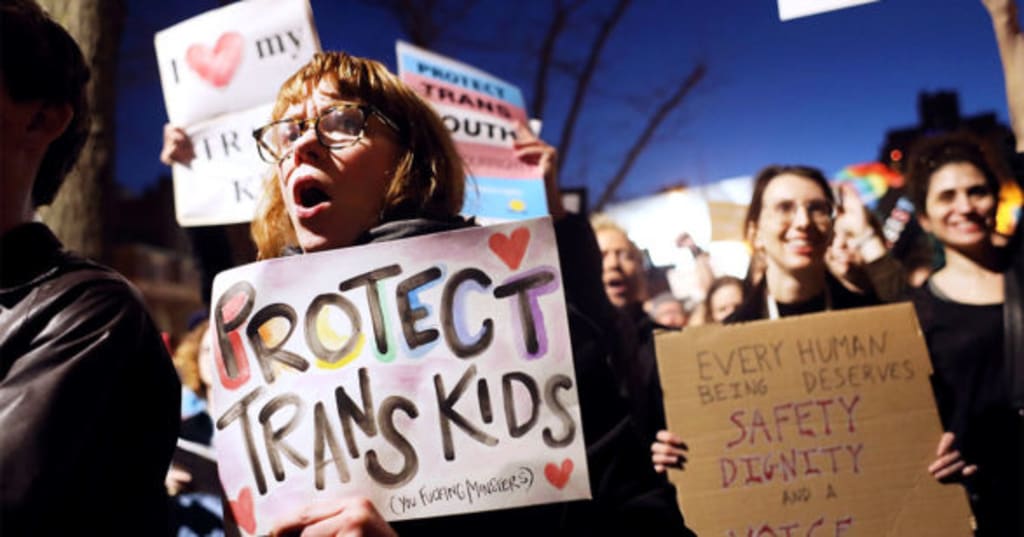
NOTE: The following information will be updated as more information presents itself. Additionally, the text below utilizes a slur that has been reclaimed by the LGBTQ+ community. With this publication, it my intention to elucidate the conversation of transgender welfare and the painful realities that persist within today's medical and political climates.
Introduction
Suicide rates among transgender individuals are disproportionately higher than those of their cishet counterparts, as postulated by several qualitative studies (e.g., medical journals and editorials). These figures are predicated by false narratives concerning queer youth/adults, including society’s tendency to subscribe to poorly founded, accusatory language. Of course, regardless of sexual orientation or gender identity, a lack of social support poses adverse effects to mental well-being. Unfortunately, trans and gender non-conforming youth are often deficient in this aspect, thus ameliorating risks of suicidal ideation, anxiety, and depression. Currently, there has been controversy regarding the right to advise gender-affirming healthcare: how much of a constitutional right does it pose, and how is enabling transgender youth not a moral failing? It is my understanding that this form of healthcare, though contentious, prescribes significant improvements in the well-being of transgender individuals, despite potential risks.
Disparities in Mental and Physiological Health
Cultural competency regarding the transgender community has always been insufficient. According to the Human Rights Campaign, legal protections for transgender persons are often scarce; “there is still no comprehensive federal non-discrimination law that includes gender identity.” Transgender individuals are not afforded the same protections as those who align with their birth gender (i.e., cishet, cisgender, straight). They risk discrimination when pursuing housing, dining services, et cetera, and lack legal recourse. Religious exemptions also enable business owners to openly discriminate against trans/queer people. As reported by the HRC, “only thirty percent of women’s shelters are willing to house trans women,” which brings us to the sensitive topic of healthcare. Transgender persons experience not only prejudice, but gender dysphoria (GD). The ACLU defines gender dysphoria as: “incongruence between a person’s gender identity and their sex assigned at birth where such incongruence results in clinically significant distress.” Gender dysphoria is intrinsically connected with social disinterest and withdrawal, as well as impaired cognitive functioning (e.g., academia), substance abuse disorders (e.g., alcoholism, recreational drug abuse, inhalants), self-harm (e.g., eating disorders, self-mutilation), and elevated levels of anxiety. The latter results in the individual perceiving themselves to be out of place within society; trans and gender non-conforming people constantly affirm their identities in interpersonal relationships and various areas of their lives which, understandably, is exhaustive in itself. To put it simply, a former partner described their dysphoria as the following: “You are not the main attraction, you are simply the vendor at the circus. Humanity is not interested in you, but in what you have” (i.e., the appendage you were born with or without).
Gender-affirming healthcare remedies this situation but is not easily accessible. Coverage for Gender-Affirming Care: Making Health Insurance Work for Transgender Americans, a report authored by William V. Padula, P.h.D and Kellan Baker, MPH, posits that despite medical necessity and economic benefits, health insurers in the U.S. systematically deny transgender persons from obtaining a variety of healthcare services. Gender affirmation begins with supporting the queer community to appropriately—and safely—acquire the supplies needed to exist comfortably. These supplies involve hormone therapy, mental health counseling, and reconstructive surgeries, as outlined by the World Professional Association for Transgender Health (WPATH). Surgical interventions contain vaginoplasty, phalloplasty, metoidoplasty, hysterectomy and salpingo-ooverectomy, orchidectomy, and chest augmentation. Despite this, those who manage to feasibly obtain gender-affirming care consistently face insurance discrimination.
“Transgender women who have a prostate may require screenings for prostate cancer. Similarly, a transgender man could retain a cervix after changing his legal sex to male. Like any other person with a cervix, he still needs regular Pap tests. Many transgender men, however, encounter coverage denials for Pap tests and other procedures typically coded as “female.” Given that regular Pap tests are widely considered a cost-effective means of preventing cervical cancer, this is a clear example of the economic consequences of insurance practices that fail to reflect the medical needs of transgender patients.”
Additionally, it is not uncommon for healthcare providers and personnel to misgender, deadname, or even challenge the identity of a transgender individual. Hence, the decision to disclose one’s identity to service providers is both emotionally draining and complex. Non-inclusive medical care prohibits the transgender community from actively seeking assistance. In turn, these individuals will opt for suicide to circumvent discrimination and suicidal thoughts. This rate, compared to the general cishet public, remains exponentially high. Not only does this play a significant factor in subjective well-being, but it illustrates a common aversion and unease experienced by healthcare professionals when assisting transgender patients.
Monitoring Potential Risks of Gender-Affirming Care
Although gender-affirming care prescribes an overall improvement in mental health, it has potential to elicit unwarranted, adverse effects. Personally, I know of several members of the queer community who have decided to de-transition upon discovering they were either gay or non-binary. Failing to de-transition results in aggravated gender dysphoria, as they are physically and emotionally discontent with the outcome of the change. An online source stipulates: “Detransition is more common in the earlier stages of transition, particularly before surgeries. It is estimated that the number of detransitioners ranges from less than one percent to as many as five percent.” However, this consequence is minute compared to the health risks associated with hormone injections. A particular risk, as expounded upon by Scientific American, concerns the usage of hormone blockers in prospective youth. Through trials for infertility, researchers recognized that these modes of puberty obstruction “reduced or eliminated the possibility of conception.” TransCare notes that: “The risk of things like blood clots, heart attacks, strokes, diabetes, and cancer as a result of hormone therapy are minimal, but may be elevated, especially for those with co-existing health conditions or starting hormone therapy after age fifty.” Moreover, the administering of hormones may cause users to experience deepened anxiety, uncontrollable mood swings, prolonged states of depression, and other varying psychological impairments.
While information regarding the risk of cancer in transgender women remains limited (due to a lack of substantial testing and data), previous studies have shown that hormone replacement therapy—otherwise known as HRT—increases the likelihood of breast cancer in postmenopausal women. Despite the ambiguity surrounding the probability of developing cancer, the carcinogenicity of hormonal therapy remains an area of concern. “Human papillomavirus (HPV) has been implicated in the etiology of anal, oropharyngeal, and penile cancers among non-transgender men and in cervical, anal, vulvar, and vaginal cancers among non-transgender women. Among over forty types of HPV, at least thirteen are considered high risk with respect to their carcinogenic potential.” Complications that may arise from gender-affirming procedures, such as vaginoplasty, are elevated risks of malignancy, chronic inflammation, and internal lacerations. Hormone-related maladies also include carcinomas of the breast and prostate, prolactinomas, and meningiomas. Transgender men experience cancers of the breast, ovaries, cervix, vagina, and endometrium. To reiterate, these outcomes are found in low percentages through transgender research. With these causations in mind, one can understand the uncertainty that arrives with an individual who wishes to transition.
Conclusion
The numerous challenges trans and gender non-conforming youth face in the healthcare system is a cause for reaction, not controversial debate. Providing medical care free from biases ensures that the transgender community maintains social capital and well-ness, while also making positive impacts in the world around them. Having considered both sides with scrutiny, my conclusion is this: yes, transgender healthcare is a right and not a crime. To criminalize this issue would be to propagate notions of discrimination/dehumanization and ignore the emotional trauma of gender dysphoria. While I am aware of the cons transitioning may offer, I am also aware of the pros and figures which outweigh them. The body of literature that seeks to discourage transition lacks the empirical data to do so, and gender-affirming hormone therapy has resulted in improvements of psychological disorders. In summation, the effects of hormones are reversible, allowing one who wishes to de-transition to easily do so without consequence. The desired effects of gender-affirming healthcare remain pervasive.
Original Completion Date: 2 December, 2021
About the Creator
Jalia Maléy Brodie
enigmatic, subversive fool • @headfirst4art via Twitter
Keep reading
More stories from Jalia Maléy Brodie and writers in Pride and other communities.
The Corkscrew Spine
I’ve gone irretrievably out of my head, they say. But it was I, and not them, who passed through corridors of well-wrought horrors, silently cursing the hands that bore them. These horrors—portraits of my ancestors—vilified me in confidence, watching every fiber of my being. The dead were not alone in their scrutiny, for at the end of the hall hung a monstrosity borne from my own hand, a token of drunken stupor.
By Jalia Maléy Brodie4 years ago in Horror
Punishment for greed
Dear children, this is a moral story about fairness, wisdom, and the importance of sharing. In a small village lived an old farmer with his two sons, Ahmed and Muhammad. Ahmed was clever and sharp-minded, while Muhammad was innocent, simple, and not very intelligent. The farmer owned only three things: a cow, a fruit-bearing tree, and a warm blanket. Though these possessions were few, they were very valuable for the family’s daily life.
By Sudais Zakwan2 days ago in Pride



Comments
There are no comments for this story
Be the first to respond and start the conversation.