
The Closet is Not a Sanctuary
The Closet is Not a Sanctuary
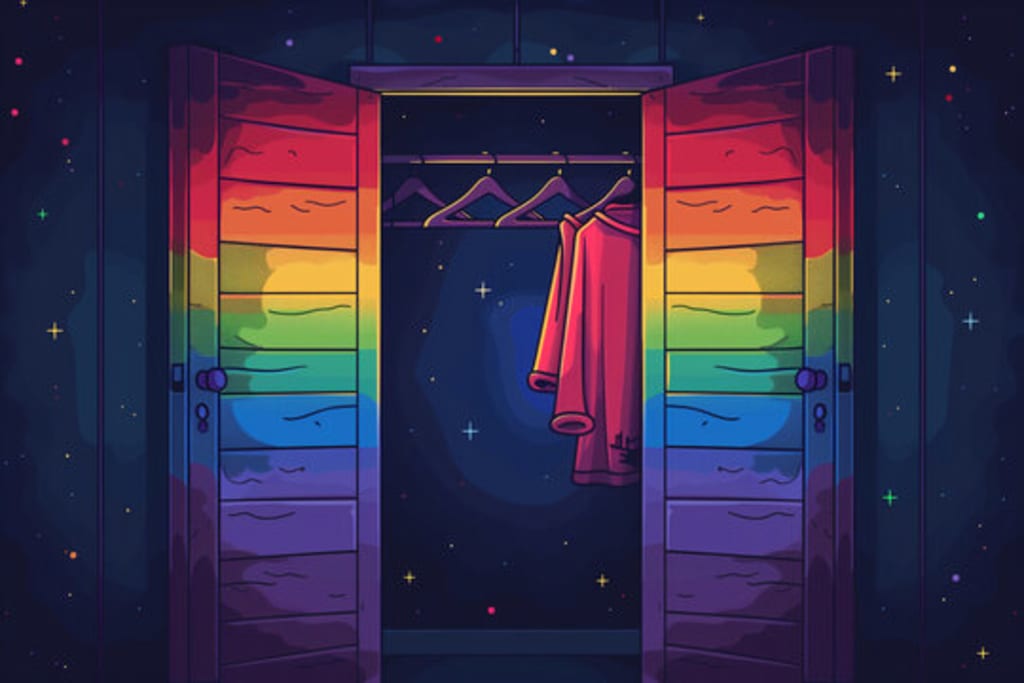
"The Closet is Not a Sanctuary"
In the summer of 2025, the flags came down. Not in a blaze, not in protest — they simply vanished.
First, it was the rainbow mural outside the old community center, quietly painted over during a “routine renovation.” Then the drag brunch that got canceled “for safety reasons.” And then, the laws — one by one, cloaked in language about “parental rights” and “community values.” Overnight, pride became a liability. Visibility a threat.
I lived in Florida then. Still do. I told myself I was staying to fight, but part of me stayed because I didn’t know where else to go. The roots were deep — even if the ground was poisoned.
I was twenty-eight, working as a middle school art teacher. I taught kids how to draw their joy — how to turn color into a language when words failed them. And I kept a picture of my partner, Eli, in the bottom drawer of my desk. Always out of sight.
Eli was fire and freedom — a poet who couldn’t help but love loudly. They weren’t afraid of being seen. I was.
We met at a queer writing workshop three years earlier. I fell for them like I’d been waiting my whole life. But where I moved in whispers, Eli moved in declarations. “Love is a protest,” they said once, their voice crackling like a lit fuse. I didn’t correct them, didn’t say I was tired of protesting — tired of checking over my shoulder before reaching for their hand in public.
But I loved them. God, I loved them.
And so we tried to build a life on a balance beam. Safe at home, invisible outside.
Then came the hearing.
Someone had reported me to the school board. Claimed I was “indoctrinating” kids. That I “promoted inappropriate values.” They found a sketch one of my students had drawn — two stick figures holding hands under a rainbow, with the words “Love is Love” scrawled underneath.
They called it “evidence.”
I sat there in the boardroom, sweating through my blazer as parents I’d never met screamed about “protecting their children” from people like me. One woman held up a Bible like a gavel. A man compared me to a predator. My principal sat stiffly beside me, offering no defense.
No one asked if I was a good teacher. No one asked about the kid who had been bullied until he found refuge in my classroom. Or the girl who finally came out to her parents after building the courage in one of our after-school clubs. No one asked about art or healing or truth.
They only asked if I was queer.
And I lied.
“No, I am not.”
The words tasted like ash.
Later that night, I told Eli. Their eyes went hard in a way I’d never seen before. “So what now?” they asked. “You hide forever?”
“I’m not hiding,” I said. “I’m surviving.”
“Do you think I don’t want to survive too?” they snapped. “But not like this. Not if surviving means erasing myself.”
We fought until our voices cracked. They left before midnight. Took a backpack and said they needed time.
I sat on the kitchen floor for hours, staring at the door they didn’t slam.
I didn’t sleep.
That week, I kept teaching — quieter now, more careful. I started wearing muted colors. I scrubbed my social media. I made myself smaller and smaller until I almost disappeared.
The students noticed. One of them — Malik, a soft-spoken eighth grader who had once whispered to me that he liked boys — stopped coming to class. I heard a rumor he’d transferred schools after a parent found our club flyer in his backpack.
And still, I stayed silent.
I wish I could tell you there was a single moment when I stood up. A clean, cinematic turning point. But the truth is, it happened in fragments.
It happened when I found Eli’s copy of Giovanni’s Room on the nightstand and remembered how they read passages out loud in bed, the words brushing against my skin like prayer.
It happened when I ran into Malik months later — at a bookstore miles away from the school — and he looked at me like I had betrayed him.
It happened on a Tuesday morning, when I looked in the mirror and didn’t recognize the person who stared back.
So I started small.
I wore a pin on my jacket — just a tiny triangle, barely visible.
I put Eli’s picture back on my desk.
I said “they” instead of “he” when someone asked about my partner.
I started an anonymous blog where I wrote about being a teacher, a queer person, a human being trying not to disappear.
The district never found the blog. Or maybe they did and didn’t care anymore. The wave had passed, the protests moved on, the media had turned its gaze to the next fire.
But I kept writing. Others started emailing me — other teachers, other queers — people holding on by threads. They thanked me for being visible, even just a little.
Eli came back in October. They said they’d read every post.
“I was angry,” they said. “But I never stopped hoping you’d come back to yourself.”
We sat on the porch and didn’t say much more. Just held hands in the open. It felt like a risk and a miracle.
Pride this year is quiet. No parade, not here. But Eli and I went to the beach. We wore shirts with rainbows so faded they looked like watermarks. No one said anything.
But when we kissed under the orange dusk sky, I saw an older woman smile at us. Just a little. Like maybe she’d been waiting to see someone love openly, even if it was just for a moment.
And maybe that’s the resistance.
Not the march or the fight — though those matter too — but the quiet refusal to disappear. The decision to live, to love, to speak, when silence is safer.
The closet is not a sanctuary.
But the world outside — even in its brokenness — is where we belong.
About the Creator
Emo femboy
The Emo Femboy: A Symphony of Contrast and Authentic Self-Expression In the vibrant, ever-evolving landscape of modern identity and subculture, a unique and compelling figure has emerged, weaving together threads of music, fashion, and gender expression into a poignant tapestry of self. This is the emo femboy not merely a trend or an aesthetic, but a heartfelt declaration of being that exists at the powerful intersection of emotional depth and the rejection of rigid gender norms. To understand this identity is to listen to a symphony played in a minor key, one where vulnerability is strength, softness is rebellion, and authenticity is the ultimate truth.
By David Femboy2 days ago in Pride


Comments
There are no comments for this story
Be the first to respond and start the conversation.