
My Name Is Still Elias: A Story of Identity, Belonging, and the Courage to Remember
A Greek immigrant trades his name to fit in — until a student reminds him of the quiet power of staying true to who you are.

I was seventeen when I moved to America. A suitcase full of prayers from my mother, a blue komboloi from my grandfather, and my name — Ηλίας — which no one could pronounce.
At first, I corrected people.
“No, it’s not Elijah. Not Ellis either. It’s Elias. Eh-lee-as.”
But after a few months, I gave up.
“Just call me Eli,” I said.
I told myself it was easier. Easier for them to remember. Easier to get the job, the apartment, the approval. Even easier to flirt. Eli was smooth, familiar — like store-bought bread. Elias had the flavor of wood fire and olives. And maybe that was too much for the world I was trying to enter.
I studied. I worked. I succeeded. My accent faded. My name shrank.
I started teaching high school English in a suburban district that loved the idea of “diversity” — as long as it came with neutral vowels and no loud food smells in the teacher’s lounge.
They liked Eli. He was relatable. Respectable. He blended in.
But sometimes, when I signed my name at the bottom of a student report or typed “Best regards, Eli Markos,” I would pause. It felt too short. Too neat. Like someone had trimmed off the parts of me that didn’t fit into their filing system.
Then came Rahim.
He was fourteen. Iranian-American. Quiet, but not shy. Thoughtful in the way teenagers rarely are. On the first day of class, I read off the roll:
“Ray…?”
He raised his hand.
“Actually, sir,” he said calmly, “my name is Rahim.”
There was a moment of silence — the kind that teenagers fill with invisible smirks. I nodded and smiled.
“Rahim it is.”
Later that evening, I called my mother.
“Remember how I told you everyone here calls me Eli?”
“Yes,” she said. “Don’t you like it?”
“I’m not sure,” I replied. “I think I’ve forgotten what it feels like to be Elias.”
She didn’t answer right away. Then, softly:
“You’ll always be Elias to me, παιδί μου.”
The truth is, I had been hiding behind Eli for years.
It was a name I wore like a suit — sharp, neutral, forgettable. It protected me from awkward questions. From mispronunciations. From standing out.
But it also hid my father’s stories. The scent of basil on my grandmother’s hands. The memory of lighting a candle on Easter night, whispering Christos Anesti into the dark.
It hid the boy who sat at his grandfather’s knee, learning how to twist worry beads not out of stress, but as a rhythm for the soul.
I remembered the day I got my first promotion. My name was printed on the door:
Eli Markos – Assistant Chair
I took a photo. Sent it to my friends. Smiled.
But that night, looking at the photo again, all I could think was:
“That’s not the name my father carved into the back of the olive tree.”
Weeks passed. Rahim stayed true to himself.
When substitute teachers stumbled over his name, he corrected them. Politely. Clearly. Without apology.
During a parent-teacher meeting, I praised his essays. His father shook my hand and said:
“We tell him, never be afraid to be who you are — even if they don’t know how to say it.”
That night, I opened a box I hadn’t touched in years. Inside, folded beneath a linen handkerchief, was an envelope with my grandfather’s handwriting:
“Για τον Ηλία μου. Όταν νιώσεις ότι σε ξεχνούν, να θυμάσαι ποιος είσαι.”
(For my Elias. When you feel forgotten, remember who you are.)
I held that letter in my hands for a long time. The ink had faded. But the message burned.
The following Monday, I stood before my class and paused before roll call.
“My name is Mr. Markos,” I began. “My full name is Elias. Some people call me Eli — and that’s fine — but I was born Elias. It’s a Greek name. It means ‘The Lord is my God.’”
A few students blinked. One nodded. Rahim smiled.
That afternoon, a girl named Ji-hye came up to me after class.
“Can I start going by Ji-hye again?” she asked. “Instead of Jess?”
“Of course,” I said. “It’s your name.”
And for the first time in years, I felt like a teacher.
Not just of grammar.
But of courage.
I didn’t make a dramatic announcement. I didn’t force anyone to change what they called me. But slowly, I started signing my name as Elias again. On feedback forms. On internal emails. In the little white box above my classroom door.
Some people noticed. Others didn’t. One colleague asked if I’d had “a rebranding.” I laughed.
“No,” I said. “Just a remembering.”
The truth is, it’s not just a name. It never was.
It’s the way my mother called me when I was late for dinner. The voice of my uncle shouting across the hills during olive harvest. It’s the name that was whispered in prayers, written in old letters, spoken with pride by people who had no need to shorten themselves for others’ comfort.
It’s also the name I nearly let go of.
Not because I hated it. But because I thought I had to trade it in for belonging.
Sometimes identity doesn’t collapse all at once. Sometimes it erodes quietly. Through small accommodations. Through polite silences. Through the act of saying “it’s okay” when it isn’t.
And sometimes, it takes the courage of a fourteen-year-old to remind you of who you were before the world asked you to simplify yourself.
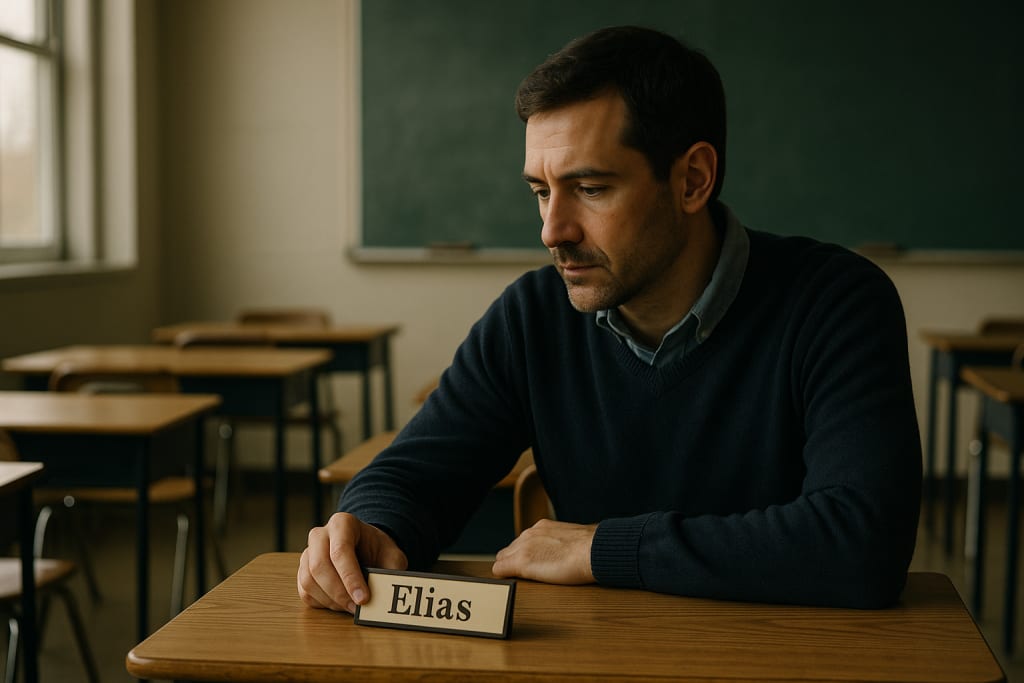
One Friday, Rahim brought me a small gift — a carved wooden nameplate.
He handed it to me, smiling shyly. I turned it over.
It said:
Mr. Elias Markos
I was quiet for a long moment.
“Thank you,” I said.
He nodded. “I figured… it felt more like you.”
He was right.
Now, at the start of every school year, I introduce myself the same way:
“My name is Elias. You’re welcome to call me Mr. Markos, or Mr. Elias — but know that this name is important to me. Just like yours is important to you.”
And then I ask each student: “What name would you like to be called?”
Some pick nicknames. Some reclaim their full names. Some say nothing. That’s okay.
The door is open.
I can’t make them hold onto their identity.
But I can be the mirror that reminds them they still have one.
About the Creator
Constandinos Olymbios
I write stories inspired by real life, exploring moments of quiet strength, kindness, and faith. You can find more of my work on my blog: zoisistories.blogspot.com
Keep reading
More stories from Constandinos Olymbios and writers in Pride and other communities.
The Stamps That Traveled Farther Than Ever Before
Once upon a stamp — or rather, once upon a collector — there was someone who loved to travel. Not through airports or highways, but through small, colorful bits of paper that stuck to envelopes and soared across borders, carried by postal pigeons… or rather, very slow postal snails, depending on the day!
By Constandinos Olymbios8 months ago in Motivation
Emo femboy
The Emo Femboy: A Symphony of Contrast and Authentic Self-Expression In the vibrant, ever-evolving landscape of modern identity and subculture, a unique and compelling figure has emerged, weaving together threads of music, fashion, and gender expression into a poignant tapestry of self. This is the emo femboy not merely a trend or an aesthetic, but a heartfelt declaration of being that exists at the powerful intersection of emotional depth and the rejection of rigid gender norms. To understand this identity is to listen to a symphony played in a minor key, one where vulnerability is strength, softness is rebellion, and authenticity is the ultimate truth.
By David Femboy2 days ago in Pride
Thoughts on Vocal and the way the world is
"Death cannot stop true love, only delay it." – Wesley in The Princess Bride. I decided to come back to Vocal on a very cold and dark night at the end of December. I had been, and still am, convalescing from a horrible staph infection that had gone misdiagnosed for months. This, paired with the increasing challenges of being healthy, making the best choices for my co-parented child, being a wife, and being a director at a new job, was a lot to manage.
By Jazzy 2 days ago in Confessions



Comments (1)
I can relate to changing names for ease. Rahim's story made me think about my own identity and the parts I've hidden.