
“Where the Silence Lives”
A sensory poem or short prose piece where the narrator explores a house of silence, with each room representing an emotion they’ve buried — grief in the attic, joy in the kitchen, anger in the basement. Can be metaphorical or surreal.

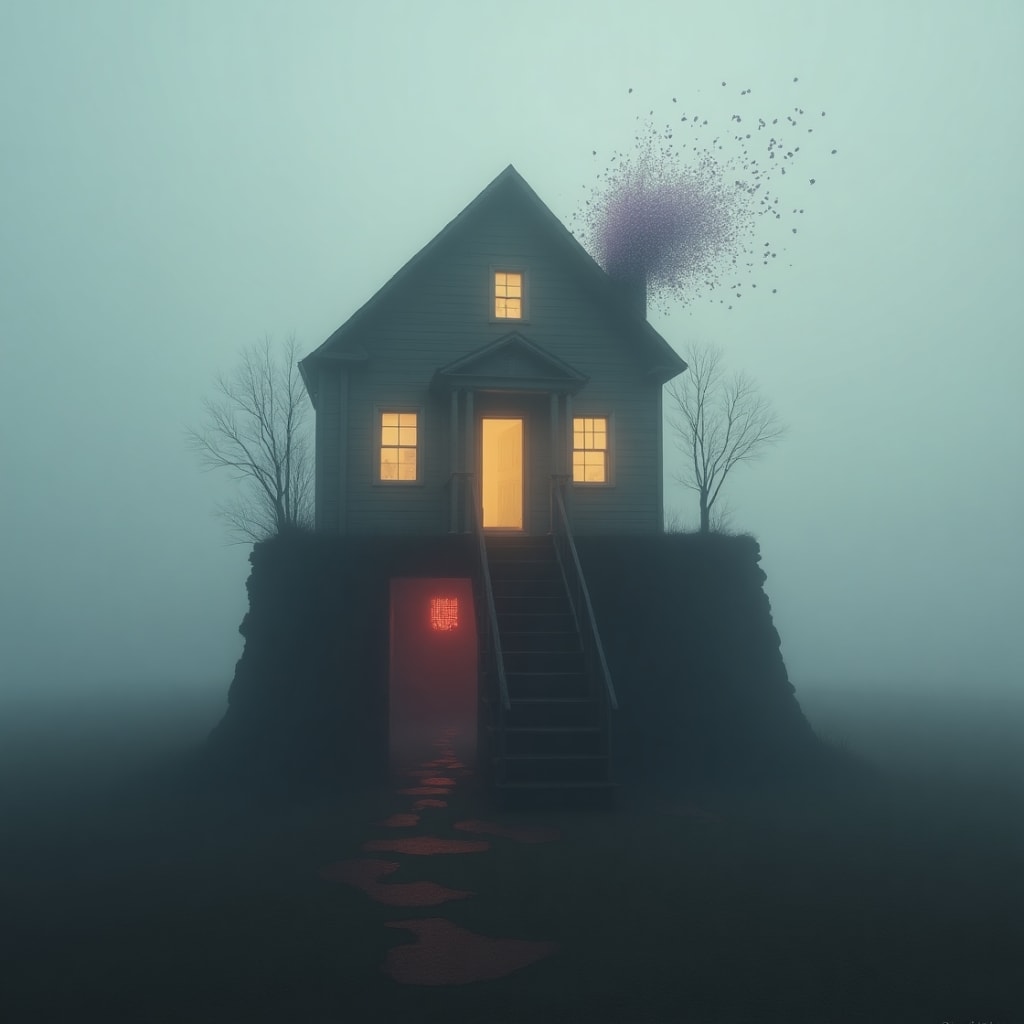
There is a house I return to in dreams. I don’t remember building it, yet each floorboard creaks with my weight like it’s waited a long time for me to come back. The house sits still in a field of nothing — no trees, no sky, just a soft gray wash in every direction. It has no doors, only entry. No windows, only walls that breathe.
This is where the silence lives.
It waits for me at the threshold, not with menace, but with memory. I step inside barefoot, and the hush soaks into my skin like cold water. The air is thick — not with dust or time, but with the weight of things unsaid. Each room here holds a piece of me I’ve tried to forget.
The Kitchen — Joy, Long Sealed
I begin in the kitchen. Light floods the space from nowhere, warm and golden. Everything is just as it was — lemon sunlight on white tile, a humming fridge, mismatched mugs beside the sink. Joy lives here, in the clutter. In the scent of cinnamon and burnt toast. She hums tunelessly from the corner, stirring nothing in a bowl that’s long been empty.
I sit at the small round table and watch her. Joy does not acknowledge me. She simply continues — dancing slightly as she moves, as if the act of existing is music enough. I remember this feeling. The simple mornings. Laughter without reason. The permission to be silly. I reach out to touch her hand, but my fingers pass through.
She is light. A memory that cannot be held.
I leave her there, not because I want to, but because joy, once caged, forgets how to open the door.
The Basement — Anger in Chains
The stairs to the basement groan underfoot. It’s colder here. The walls drip with condensation, and the light dies halfway down, surrendering to a darkness that knows my name.
Anger lives here. Not loud and flaring — not anymore. He sits, chained at the ankles, hunched over in the far corner like a wounded animal. His breath rasps in the silence. His eyes are burning coals under heavy lids.
I once feared him — his voice, his fire, the way he could scorch everything without lifting a hand. But now he’s withered. Not because he’s gone, but because I buried him in shame. I fed him apologies until he starved.
“Speak,” I whisper.
He looks up. His mouth opens, but no words come. Only heat. Only hurt. I feel it rise through the floorboards, reaching up toward the rooms above. I want to unchain him, but I fear what he’ll become if I do.
So I leave him, again. Not with cruelty, but caution.
The Living Room — A Hollow Pause
This is the room I avoid, though I always pass through. The couch remembers the shape of two bodies curled like commas. The television glows with static — a thousand channels of silence. There are photos on the wall, their faces turned inward, as if embarrassed to be seen.
Here, the silence is loud. Not peaceful, but sharp-edged. The kind that grows between words that should have been said. The air smells of unsent letters and swallowed truths.
I sit for a moment, but it presses in too hard. I rise before the weight becomes unbearable.
The Attic — Grief’s Garden
I climb the narrow steps to the attic last. They spiral, impossibly, like time itself. My breath catches as I reach the top — the air here is heavy with dust and lavender.
Grief waits, not as a specter, but a gardener. She tends rows of memories like flowers. Each one labeled with names I dare not speak aloud: my grandmother’s laugh, the dog I left behind, the friend who vanished into silence, the child I never held.
She looks at me, and her face is mine. Older. Wiser. Worn thin at the edges.
"You're early," she says gently.
"I never left," I reply.
Grief nods. “Most don’t.”
She hands me a trowel. “Help me, then. There’s always more to bury. And sometimes, something to grow.”
I kneel beside her, hands in soil that remembers. Together, we plant silence like seeds.
The Hallway — Echoes of Return
When I descend again, the house breathes easier. The silence no longer smothers; it stretches. I walk through each room once more — joy still humming, anger still watching, grief still sowing. But something is different. I am different.
The house is not my prison. It is my reflection. Each room a truth I dared to lock away. Here, silence is not absence — it is presence. It is the sound of feeling too much and not knowing how to say it.
I stand in the doorway. The field outside remains gray and empty.
But now I understand.
This house does not trap me.
It waits — with patient mercy — for me to return, whenever I am ready to feel again.
About the Creator
Keep reading
More stories from Ubaid Khan and writers in Poets and other communities.
The President’s Last Protester
The sky over District 9 was always gray now. Not from clouds, but from the haze of burnt air, ash of deleted history, and the slow decay of freedom. The “Era of Unity,” they called it—a slogan stamped onto every building, drone, and screen like a warning.
By Ubaid Khan6 months ago in Fiction
Smart phones, Humans and Aliens.
WARNING. I will be tapping into one of your favorite creative tensions: The absurdity of humans worshipping their glowing rectangles as if they were tiny oracles. There’s something deliciously poetic about that contradiction, and it lends itself beautifully to an instructive proviso.
By Novel Allen6 days ago in Poets
Miss Persephone's Manual to a Seemingly Ordinary Life
Miss Persephone was found at the dining table, her blue eyes swollen, her tears arriving and retreating like the tides of the ocean. Earlier that day, her family had visited her in the retirement home where she had lived for eight years. It was her eightieth birthday.
By Imola Tóth7 days ago in Fiction



Comments
There are no comments for this story
Be the first to respond and start the conversation.