
The Stranger on the Train
A fleeting encounter that changed the way I saw myself

The Stranger on the Train
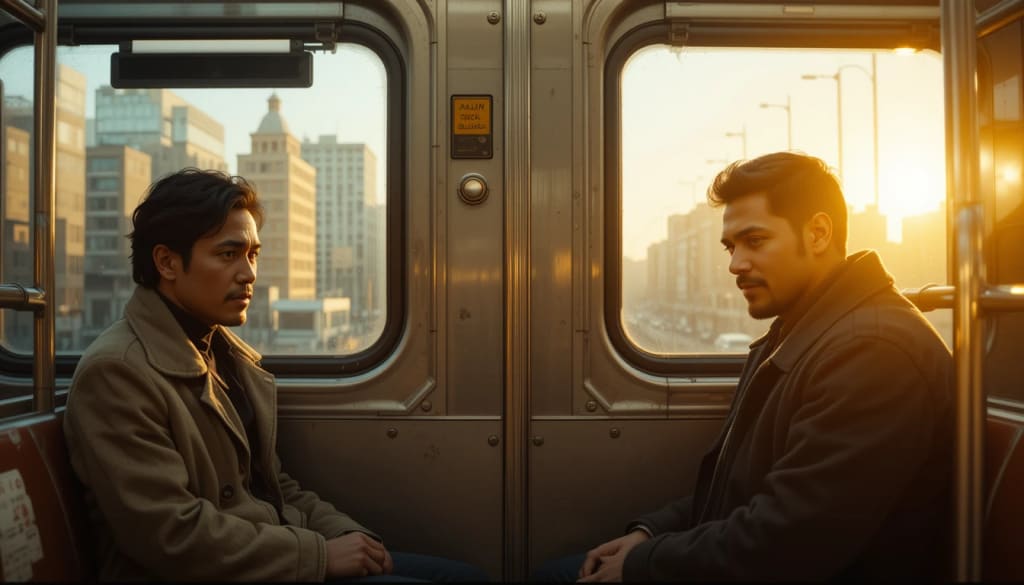
It was one of those evenings when the city felt like it was exhaling — not quite asleep, not fully alive. The 6:47 PM train groaned into the station just as I reached the platform, breathless, coat flapping behind me like a half-forgotten wing. I slid into an empty seat, grateful to have caught it. Another day survived.
I remember the clatter of the tracks, the low hum of tired commuters scrolling through their phones or dozing with heads against the windows. I was somewhere in between: scrolling out of habit, not focus. My mind was still tangled in an earlier conversation with my boss that had left me second-guessing everything — my work, my worth, my presence.
That’s when I noticed him.
Across from me sat a man probably in his late sixties. Silver hair swept neatly back, glasses slightly crooked, and a leather-bound notebook open in his lap. His pen moved with a rhythm that suggested he wasn’t just scribbling notes — he was writing something real. Poetry? Observations? A secret letter?
I’m not usually the kind of person who strikes up conversations with strangers. I’m the type who overthinks text messages for hours and still ends up not sending them. But something about him — the quiet confidence, the peaceful expression — made me curious.
He caught me glancing, and instead of looking away, he smiled.
“Writing helps pass the time,” he said, his voice calm, warm.
I smiled back, self-conscious. “What are you writing, if you don’t mind me asking?”
“Memories,” he replied, tapping the notebook. “Things I don’t want to forget. Things I should’ve paid more attention to when they were happening.”
That sentence hit me like a gentle punch to the gut.
He saw the reaction on my face and tilted his head. “That resonate?”
“I think I spend most of my time trying not to remember things,” I said, the words tumbling out before I could edit them. “Or pretending they don’t matter.”
He closed the notebook slowly, as if to signal that this was worth discussing.
“I used to do that too,” he said. “For years. Until I realized the things I avoided were the things shaping me. I didn’t like who I was becoming — half-present, half-human.”
I nodded, too stunned to reply. Not because I hadn’t thought about this before, but because I had — obsessively. And here it was, voiced so simply by someone I’d never met.
We spoke for the next ten stops. He told me about his wife, gone ten years now, and how he still catches himself setting a second place at the table. About the dog they rescued together, the one who slept on her pillow the week after she died. About the novel he always meant to write but never did because, as he put it, “life has a way of feeling like it’s just about to start.”
I told him about my job — how I was good at it but never felt good enough. About my father, who thought success meant being constantly dissatisfied. About the relationships I ruined by refusing to be vulnerable. We were two strangers trading truths that felt too heavy to carry alone.
At one point, I asked, “Do you regret it? Waiting so long to live the way you wanted?”
He didn’t answer right away.
“No,” he said eventually. “Regret is only useful if it teaches you to live differently now. Otherwise, it’s just nostalgia for pain.”
That line stuck with me. Still does.
When his stop came, he stood up, notebook under one arm.
“Write things down,” he said. “Even the bad stuff. Especially the bad stuff. It deserves a place outside your head.”
He offered his hand. “Take care, kid.”
And then he was gone.
I never got his name.
The train lurched forward again, but something inside me had shifted. I felt oddly grounded, like I’d been walking in fog and someone had quietly lit a lantern behind me. Nothing major had changed — I still had the same job, same worries, same life waiting outside the subway station. But I carried a new kind of awareness.
That night, I found an old journal in my drawer. The first thing I wrote was: I met a man on the train who reminded me who I was trying to be before I got so scared.
Since then, I’ve been writing more. Not perfectly, not consistently, but honestly. I’ve been trying to remember more than I avoid. I’ve even started to let people in — just a little — trusting that maybe they won’t run away when I do.
Some stories don’t need closure to be complete. That man will probably never know what his words meant to me. He may never know that he nudged someone back toward herself with a few sentences and a warm smile.
But I know.
And maybe that’s enough.
About the Creator
Shohel Rana
As a professional article writer for Vocal Media, I craft engaging, high-quality content tailored to diverse audiences. My expertise ensures well-researched, compelling articles that inform, inspire, and captivate readers effectively.
Keep reading
More stories from Shohel Rana and writers in Poets and other communities.
Your Body, My Temple
Story: I never believed my body was anything sacred. It was just a thing I carried around, like a bag holding the important parts of me: my thoughts, my music, my dreams. I ignored its aches, dismissed its beauty, and silenced its voice whenever it cried for rest.
By Shohel Rana8 months ago in Poets
Rachel Reviews: The Spiral Archive by Pieter Hendrik
It's difficult for me to know where to start with a review of this book as it was, for me, an entirely unique experience and one that I'll probably never have again. I don't want that to be interpreted as unenjoyable but it has left me scratching my head a little and ruminating on its content, its themes and its characters.
By Rachel Deeminga day ago in BookClub


Comments
There are no comments for this story
Be the first to respond and start the conversation.