
The Reign of Hushang and Tahmuras
Shahnameh of Ferdowsi(The Book of Kings) – Part II
After the death of Kayumars, the throne passed to his grandson, Hushang.
He sat upon the throne of kingship and began to build and prosper his realm.
From the heart of the mountains, he brought forth iron from stone, teaching his people the craft of forging.
They learned to make axes, saws, and tools of steel, spreading knowledge throughout the land.
Then Hushang turned his attention to irrigation — he divided the rivers into channels and guided the waters toward distant lands so that all people might cultivate and harvest.
The people baked bread, wore garments woven from leaves and natural fibers, and worshiped the One God, as taught by their first king, Kayumars.
One day, while walking in the fields with his companions, a great black serpent suddenly appeared and attacked.
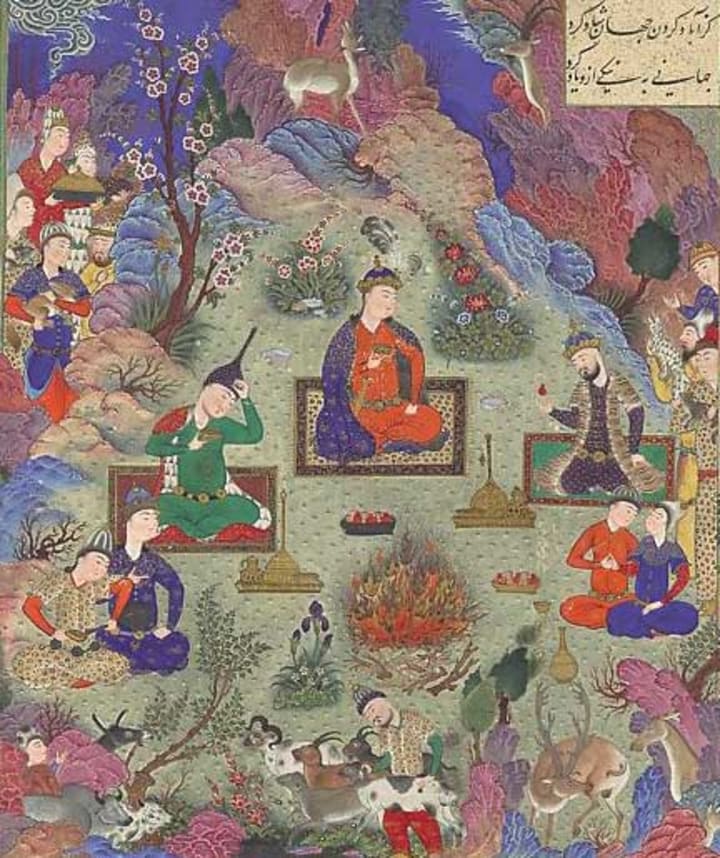
Hushang hurled a stone at the creature, but it missed and struck another stone of iron — and fire was born.
Seeing this, Hushang realized the divine gift before him.
He said to his people, “This is a blessing from the Almighty.”
They lit fires and celebrated around the flames, giving thanks to God.
That night became known as the Festival of Sadeh, a sacred celebration in the ancient Persian tradition.
Hushang also separated domesticated animals — sheep, donkeys, cows — from wild beasts, giving them to the people and teaching them to breed and use them for farming.
Under his rule, civilization flourished, and humankind took another great step forward.
Hushang made garments for his people from the furs of animals such as sables and squirrels.
After forty years of righteous rule, he departed this world and returned to the Great Creator.
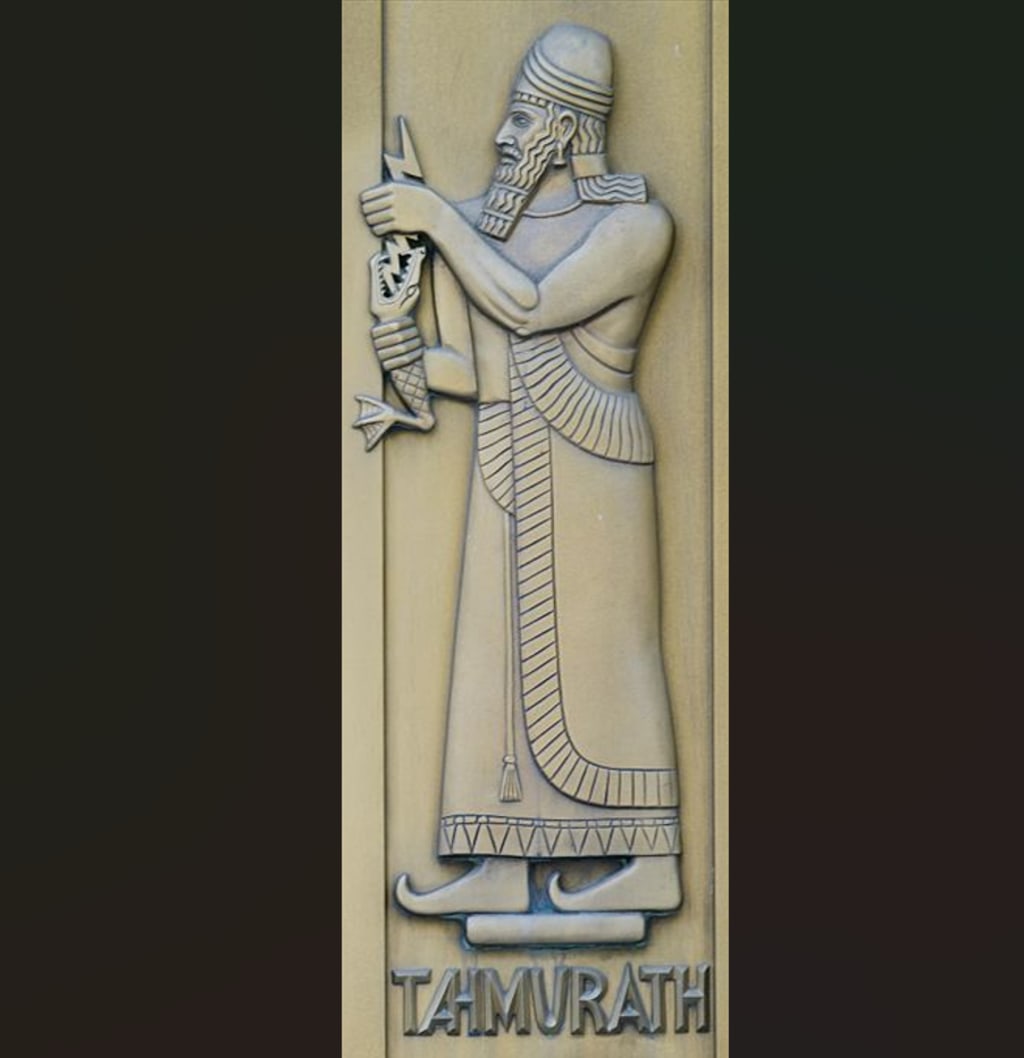
His son, Tahmuras, ascended the throne and declared:
“Now it is my duty to cleanse the world of evil and corruption, and rule in peace and harmony.”
He vowed to cut off the hands of the demons and devils who spread chaos across the earth.
Tahmuras gathered the sheep that had been raised during his father’s reign.
He sheared their wool and taught his people to spin yarn — from which they created beautiful garments and carpets.
The king had a wise and pious minister named Sheydasb, who was always in prayer.
Tahmuras often prayed with him, and through this devotion, he gained divine favor and celestial light within his soul.
Then Tahmuras decided to march against the demons (Divs) and evil spirits.
He confronted them with courage, capturing some and defeating others.
He commanded them:
“Submit to me and obey my rule — and tell your kind to do the same.”
Some demons resisted, but others bowed before him.
Those who submitted offered him a gift: the knowledge of writing.
They taught humans thirty ancient scripts, including Sogdian, Chinese, Pahlavi, and many others.
Tahmuras ruled wisely for thirty years, spreading peace and order across the world.
After his passing, he left his throne to his son — Jamshid, who would become one of the greatest kings of all time.

The Shahnameh of Shah Tahmasp, also known as the Shahnameh of Houghton, is a valuable manuscript of Ferdowsi’s Shahnameh dating back to the 10th century AH during the Safavid era.
This book contains approximately 760 folios and features 258 illustrated pages depicting Iranian mythology and history, created by the finest royal painters and calligraphers in nastaʿlīq script in Tabriz.
The production of the Shahnameh Tahmaspi was ordered by Shah Ismail I, the founder of the Safavid dynasty, likely around 928 AH — two years before his death — and took nearly two decades to complete.
After its completion, the manuscript was presented to Sultan Selim II and remained in the Ottoman court until the 19th century. From 1903 to 1959, the Rothschild family owned the manuscript. In 1959, Arthur Houghton purchased it from the Rothschilds. To settle a tax debt, Houghton donated 78 folios to the Metropolitan Museum of Art. Unable to reach an agreement with the Iranian government to sell the entire manuscript, he sold the remaining folios separately to different collections.
118 folios that remained in Houghton’s collection until his death were later exchanged for Willem de Kooning’s painting Woman III and are now housed in the Tehran Museum of Contemporary Art.
This version of the Shahnameh is considered one of the most expensive artistic manuscripts in the world, with a single illustrated folio selling for $13.8 million in 2019.
About the Creator
ALI ABBASI
“Here, the greatest and most authentic stories of history are written, turning into legends.”
Keep reading
More stories from ALI ABBASI and writers in Poets and other communities.



Comments
There are no comments for this story
Be the first to respond and start the conversation.