
The Poetry of Us: Understanding Human Behavior Through a Poet’s Eyes
A Gentle Exploration of Emotions, Actions, and the Artful Patterns That Make Us Human
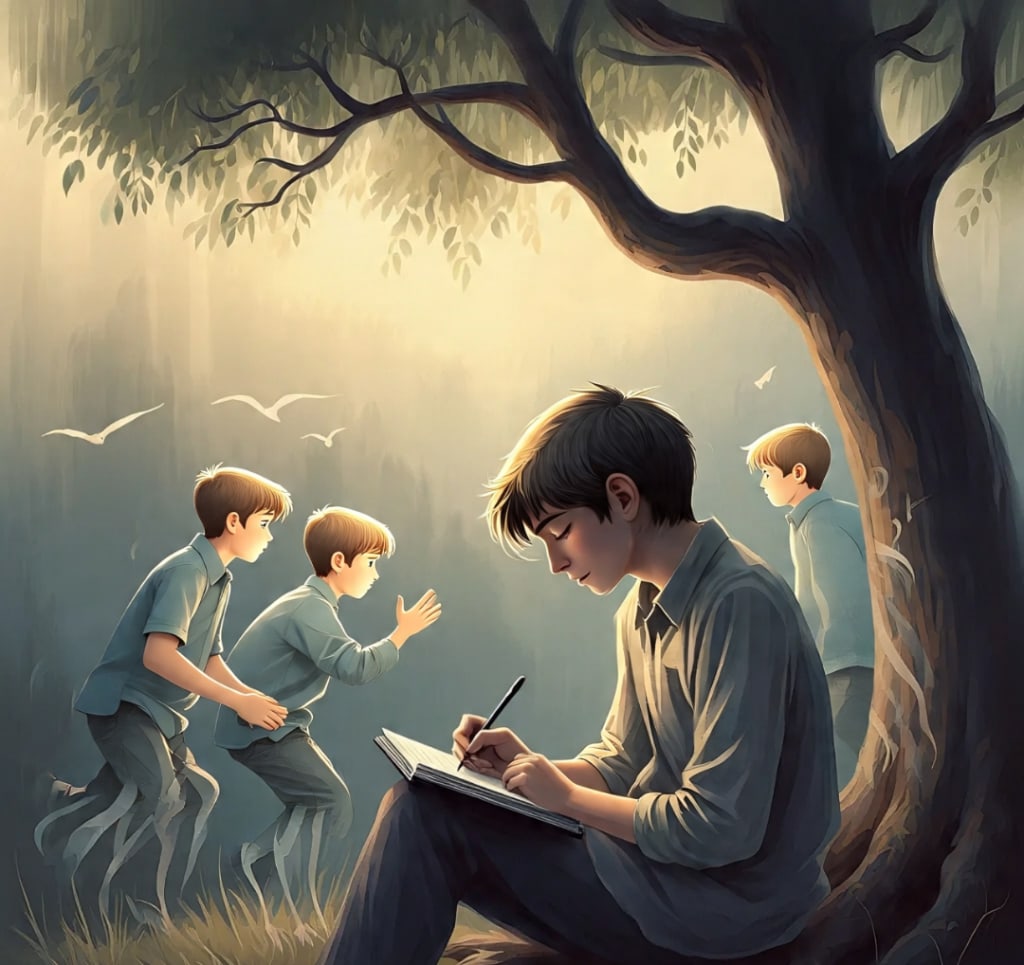
On a quiet park bench in the early blush of spring, an old poet named Elia watched the world unfold like a verse. Her fingers, long stained with ink and seasons, curled gently around a small leather-bound notebook. In it, she didn’t write about the stars or the sea anymore. She wrote about people. The way they laughed too loud to hide sorrow, how their hands twitched when they lied, how they leaned into one another without noticing.
To Elia, human behavior was poetry in motion—chaotic, imperfect, but undeniably artful.
Each morning, she came to the same spot, just beneath a flowering dogwood tree, and observed. She never judged. She simply noticed.
Today, a boy no older than ten sat across from her, furiously kicking a pinecone down the path. His brows were stitched in frustration, but when his little sister toddled over, wobbling like a windblown dandelion, his face softened. Without a word, he picked up the pinecone and handed it to her like a treasure.
Elia wrote one line: Anger melts quickest in the hands of innocence.
She had learned over the years that emotions weren’t linear. They looped and danced and collided. People said things they didn’t mean when fear took hold. They apologized not always with words but with coffee left on a desk, or a blanket pulled up higher over a shoulder in the night.
Her neighbor, Miriam, for instance, had never spoken about her husband who left. But every morning, she tended to her wilting geraniums with the kind of care reserved for things you’ve lost once and fear losing again. That, Elia thought, was love too—quiet, bruised, but persistent.
One afternoon, a teenager slumped beside her on the bench, headphones in, eyes scanning a cracked phone screen. He sighed, deep and theatrical. Elia didn’t speak. Eventually, he did.
“People suck.”
She smiled gently. “Some do. But most are just scared.”
He looked at her sideways. “Scared of what?”
“Of being misunderstood. Of needing too much. Of being too much.”
He stared ahead for a moment. “Yeah. That sounds about right.”
He came back the next day. And the next. He didn’t always talk, but when he did, he told her about the fight with his dad, the pressure at school, the way he missed his mom even though she was technically still around.
Elia didn’t offer advice. She offered lines.
“One day you’ll see that silence isn’t always emptiness,” she said once. “Sometimes it’s just a space waiting to be heard.”
He wrote that down in his Notes app.
As the seasons turned, Elia filled her notebook with these small human truths. Not grand theories or psychological models, just moments. A woman stroking the collar of her absent dog’s leash. A couple arguing with their backs still touching. A man rehearsing a proposal alone under the stars.
She noticed how we seek rhythm—in relationships, in daily rituals, in the repeated patterns of hurt and healing. We chase comfort in the familiar, even when it wounds us. And yet, we are also capable of great rewritings.
She once saw a man return every Sunday to the same tree, laying a single white lily on the ground. For months, he never missed a week. Then one day, he came with a woman by his side. They laid the lily together. When they walked away, they held hands.
Elia wrote: Grief does not leave us; it makes room.
Over time, people began to know her. Not in the way they knew friends, but in the way one knows a steady landmark—the lighthouse in the fog. They nodded, offered her pieces of their lives, small and broken and beautiful. A thank-you letter never sent. A fear confessed. A poem scribbled on the back of a grocery receipt.
And Elia collected it all—not to fix them, not to diagnose—but to understand. To witness.
Because to her, the poetry of us was not in the perfection of our actions but in the way we tried. The way we failed and forgave. The way we yearned to be seen and held, even when we didn’t know how to ask.
In her final days, the boy with the pinecone, the teenager with the heavy sighs, the grieving man and the couple, they all returned—one by one. They sat by her side and read aloud from her notebook. Her words, born from their lives, looped back to them.
In her final entry, scrawled in slightly shaking hands, Elia wrote:
We are stories pretending to be skin.
We are verses still unfinished.
We are the poetry of us.
And then she rested.
And still, beneath the flowering dogwood, the bench waits.
For someone else to notice.
About the Creator
Reader insights
Outstanding
Excellent work. Looking forward to reading more!
Top insights
Compelling and original writing
Creative use of language & vocab
Easy to read and follow
Well-structured & engaging content
Excellent storytelling
Original narrative & well developed characters
Eye opening
Niche topic & fresh perspectives
Heartfelt and relatable
The story invoked strong personal emotions
On-point and relevant
Writing reflected the title & theme
Keep reading
More stories from Muhammad Saad and writers in Poets and other communities.
Voices That Inspire: The Timeless Power of Poets
Voices That Inspire: The Timeless Power of Poets How Poets Shape Culture, Stir Emotions, and Illuminate the Human Experience Through Words In every corner of the world, across centuries and civilizations, poets have captured the essence of what it means to be human. With just a few lines of verse, they have expressed joy, heartbreak, protest, and peace. They have given voice to the silent, language to the inexpressible, and comfort to those who seek understanding. Poetry, though often soft-spoken, has proven to be one of the loudest forces in culture, thought, and emotional resilience. Consider a poet sitting by a rain-slicked window, a notebook open, words flowing as naturally as the weather outside. Or think of another, standing before a microphone at an open mic night, performing spoken word that electrifies the room with truth and rhythm. These moments are small, but the impact can be profound. Poets are often seen as dreamers—people with their heads in the clouds. But they are also observers, historians, and emotional translators. They notice what others might miss: the way a child smiles at a stranger, the silence in a crowded elevator, the feeling of coming home after being away too long. Poets turn these details into art, and in doing so, help others see the world more clearly. Throughout history, poetry has played a central role in shaping societies. In ancient Greece, poets like Homer passed down legends and moral lessons. In Persia, Rumi explored the depths of love and spirituality, creating verses that still resonate today. During the Harlem Renaissance, Langston Hughes and other Black poets used poetry to express identity, struggle, and hope. And in more recent times, poets like Amanda Gorman have brought poetry to global stages, reminding the world of its relevance and beauty. Why does poetry endure when so much else fades? Because it speaks directly to the heart. A well-crafted poem can say more in a few stanzas than some speeches say in hours. Poets have a unique ability to compress truth into beauty, to take complex emotions and render them in language that feels simple, yet profound. Poetry also offers a form of healing. Many people turn to poetry in difficult times—during loss, heartbreak, or uncertainty. Whether reading or writing, poetry allows for emotional release. It helps people find meaning in pain and celebrate moments of peace. For some, a single poem read at just the right time can change everything. Take Maya Angelou’s Still I Rise—a bold and uplifting anthem of perseverance and dignity. Or Mary Oliver’s The Summer Day, which ends with the unforgettable question: “Tell me, what is it you plan to do with your one wild and precious life?” These poems do more than entertain; they inspire action, reflection, and growth. Poets today are as vital as ever. In classrooms, they teach children the power of language. In communities, they lead workshops that encourage self-expression and healing. Online, they share their work with global audiences, sparking conversations across cultures. And in quiet corners, they continue to write—sometimes without applause, but always with purpose. Even if you’ve never considered yourself a poetry lover, chances are a poem has touched you. Maybe it was read at a wedding or a funeral, printed inside a greeting card, or shared in a social media post. Poetry shows up when words need to carry more weight, when emotions run deeper than everyday speech can handle. In a world that often moves too fast, poetry asks us to slow down. To listen. To feel. And to connect—not only with each other but with ourselves. So the next time you pass by a book of poetry or hear a poet speak, pause. Give it a moment. You might find that the words on the page say exactly what you needed to hear. Poets are not just writers. They are guides, guardians of memory, and quiet revolutionaries. Their voices remind us that beauty exists, that emotions matter, and that language—at its best—can change the world.
By Muhammad Saad 5 months ago in Poets



Comments (1)
I enjoyed every word. The simplicity of the everyday made the story relatable, but yet at the same time allowed the painful moments to be absorbed easily. There's a skill in the way the writer made the exprience unfold from the speaker view point so the reader was pulled into the story and gave it more affect. Such power in a story usually comes with more aggressive emotions but this was from a gentle pull. The poetry lines were masterful and dare I say, philosophical gems.