
The Mirror My Mother Left Me
A woman reflects on how looking into the same mirror her mother once used brings memories, both painful and empowering.

The Mirror My Mother Left Me
I didn’t want the mirror.
When my mother died, we boxed up her things with the efficiency of people trying not to feel too much. Grief makes organizers of us all. We labeled, divided, gave away. Old sweaters with her scent still folded into the arms. Recipe cards with ink smudged by flour and time. And then—there was the mirror.
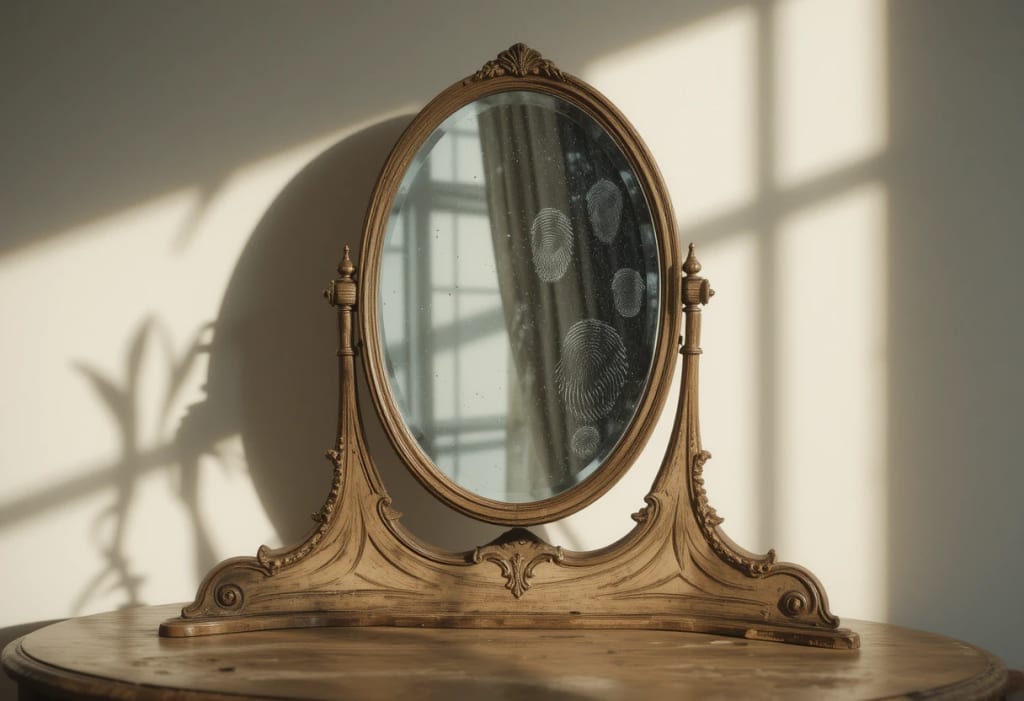
A tall oval glass framed in carved wood, honeyed with age. It had always sat in her bedroom beside the window, tilted just slightly as if watching the sun.
“Take it,” my aunt had said. “She always wanted you to have it.”
So I did. I brought it home, leaned it against my bedroom wall, and left it covered with a quilt for three months. I couldn’t bear to look into it.
Because I knew what I’d see.
My mother was the first person I ever watched get ready to leave the house. I remember the way she stood in front of that mirror each morning—brushing her hair, pinning it with purpose, smoothing her blouse. She didn’t look vain, just practiced. Ritualistic. Like the mirror was part confessional, part armor.
She would sometimes frown into the glass, tugging at the corners of her mouth. Then she’d catch me watching and soften her expression.
“Never let the mirror win,” she’d say with a wink. “It only shows you what you’ve been taught to see.”
At the time, I didn’t understand what she meant. I do now.
The day I finally uncovered the mirror, dust motes spun like ghosts in the morning light. The wood creaked as I adjusted it to stand properly, as if groaning from being seen again.
And then I looked.
At first, I saw only myself—hair messier than I remembered, shoulders tense, eyes hollow in the early sun. But the longer I stared, the more I began to see her.
Her reflection, not beside mine, but beneath it. Layered like a palimpsest. I could almost trace the lines of her jaw in mine. The way her chin used to tilt up when she didn’t want to cry. I mirrored it now, almost involuntarily.
Funny how grief doesn’t just live in the heart. It shows up in posture, in echoes of expressions, in inherited silences.
My mother wasn’t an easy woman.
She loved fiercely, but she was not soft. She came from a generation where silence was a skill, where pain was folded and tucked away like out-of-season clothes. She never taught me how to scream. She taught me how to survive.
The mirror saw all of it.
It watched her grow up in a house full of secrets.
It watched her scrub floors, iron shirts, carry babies on tired hips.
It saw the nights she stood still too long—
looking at her reflection like it might finally answer her questions.
And now it saw me.
I started using it, slowly.
Not just to glance at my outfit or fix my lipstick.
But to see myself—really, truly.
To watch the way my brow knits when I’m anxious.
The way my eyes soften when I think of someone I love.
To notice the fatigue I wear like a second skin.
To honor it instead of hide it.
It became a ritual—
morning check-ins, evening reflections.
The mirror became a witness.
It held space for me.
And maybe, somehow, for her too.
One night, after a particularly hard day, I stood in front of the mirror wrapped in a towel, hair damp, face bare. I looked older than I felt.
“I’m tired,” I whispered.
The mirror didn’t argue.
Didn’t tell me to smile.
Didn’t say “but you have so much to be grateful for.”
It just held me.
Without expectation. Without performance.
And I imagined her—my mother—doing the same, years ago. Saying nothing. Just standing still, seeing herself. Maybe tired, maybe lonely. Maybe whispering her own “I’m tired,” hoping the glass could carry it somewhere.
Sometimes I catch myself mimicking her.
The way she smoothed her eyebrows.
The soft sigh before applying lipstick.
The quick fix of a collar before walking out the door.
But I also do things she never did.
I smile without checking to see if it’s crooked.
I speak to myself in affirmations, even if I don’t always believe them.
I cry with the mirror, not away from it.
I let the tears fall freely now.
The mirror she left me is not magic.
It doesn’t flatter or lie.
It doesn’t offer wisdom.
But it has become a sacred kind of truth.
A reminder that we are reflections—
not just of our mothers,
but of the choices we make to become something new.
I look into it now and see both of us—
the woman who gave me life,
and the woman I am still becoming.
She used the mirror to make herself appear ready.
I use it to remind myself I don’t have to be.
In that way, I’ve made it mine.
Author’s Note:
My mother’s mirror didn’t just show me my face.
It showed me a lineage of survival, of resilience, of quiet power.
It taught me how to look—gently, honestly, and without fear.
And maybe that’s what she left me most of all:
A place to remember, to reflect,
and to reclaim.
About the Creator
Keep reading
More stories from waseem khan and writers in Poets and other communities.


Comments
There are no comments for this story
Be the first to respond and start the conversation.