
“The Little Path of Cornflowers” by Alessandro Calanca
“The Little Path of Cornflowers” by Alessandro Calanca is a poetry collection that unfolds as an inner and existential journey, where verses become instruments of memory, reflection, and narration of a restless soul deeply rooted in lived experience. Enriched by Barbara Miglio’s illustrations, this collection is not just a work of poetry but a true emotional diary in verse, where the author intertwines his life’s journey with great universal themes: love, nostalgia, belonging, solitude, and the sense of uprootedness.
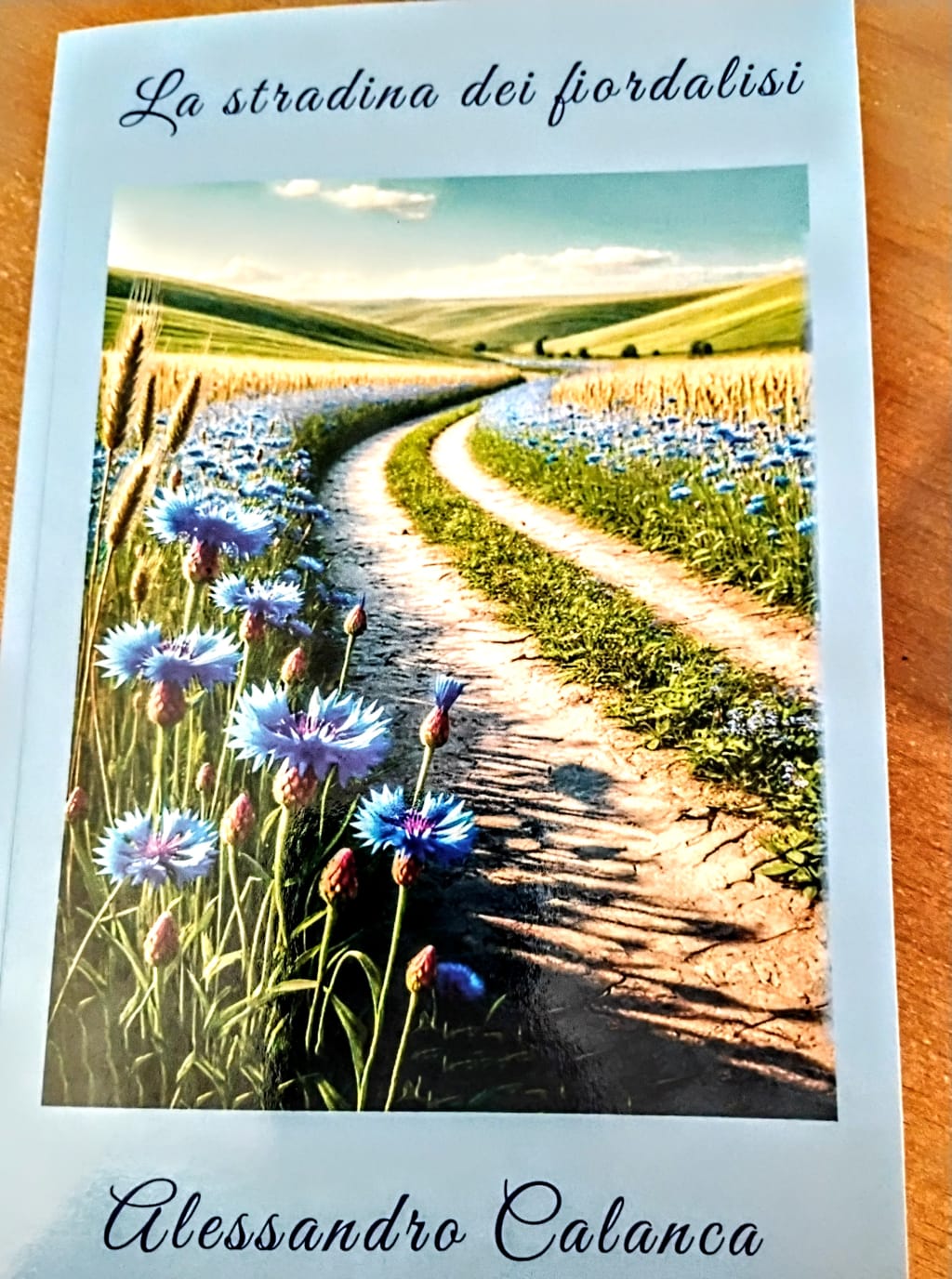
The title itself suggests a path, a flower-lined trail that can be interpreted as a metaphor for the author’s existence—an itinerary marked by encounters, separations, and deep reflections. The cornflower, a wildflower growing freely in the fields, becomes a symbol of fragile yet resilient beauty, much like the memories and emotions emerging in Calanca’s verses. His poetic style is rich in evocative imagery and linguistically diverse. The deliberate use of archaic and refined terms gives the compositions a classical aura, yet there is also a strong intimate component that makes the reader deeply involved in the emotions and stories being told.
Broken Roots and Nostalgia
One of the dominant themes in the collection is the sense of uprootedness. Throughout his life, the author has lived in various cities—Foligno, Rome, Milan, and Trieste—and this constant movement is reflected in his verses. There is a strong yearning for stability, for a place to belong, which, however, always seems just out of reach. A striking example is the poem "That Flagless Soul", in which Calanca describes his wandering through valleys, hills, and cities, ultimately concluding with a reflection on his existential condition:
"Have I ever taken root in barren lands / strong in my apparent life of gentle delight, / years spent with an ever-living illusion, / with roots instead dried up by the wind."
Here, the poet expresses the contrast between the beauty of lived experiences and the lack of a stable connection to any place or community. The image of roots dried up by the wind evokes the precariousness of belonging and the continuous search for an anchor that is never found.
Love and Regret
Calanca’s poetry is imbued with love, often concealed or unfulfilled. He speaks of a beloved woman whom he could not marry due to the circumstances of life, and this regret becomes a recurring thread throughout many compositions. Love, in his verses, is not only a romantic feeling but also a metaphor for choices, missed opportunities, and life paths that could have taken different directions.
In "That Flagless Soul", the image of the perpetually closed window under which the poet passed in silence seems to allude to an unreachable or unreciprocated love:
"Uneven glass streets / led me beneath that window / never aware of the timid yearning, / remaining in shadow, forever closed."
This fragment encapsulates the melancholy of an unspoken feeling, a futile waiting, a longing that never finds fulfillment.
Politics and Social Commitment
The author does not limit himself to intimate poetry but also addresses political and social themes, shaped by his experience as a secretary of the Italian Communist Party (PCI) and his training at the Frattocchie party school. This engaged perspective emerges in several poems reflecting on injustices, struggles, and hopes, revealing a poet who does not isolate himself in his inner world but engages with history and society.
Poetic Examples:
POOR OUR TIME (Better Not to Know!)
This poem harshly addresses the theme of contemporary indifference and collective distraction in the face of global injustices.
"Wounds left in the sun
to dry from the world’s plague.
Indifference triumphs among us,
still small innocent carcasses / in the waves.
A piece of news from the radio,
enough to sharpen the sorrow:
but we have a cinema to reopen,
no resources,
unemployment, pounds to shed,
obesity is harmful to the heart, breathing, sight.
Better not to know about the slave ships,
for the cotton of fashionable skirts
of respectable ladies,
the lithium for our cell phones
or the one from pharmacies that saves us.
Better not to know!
Volcanoes of burning problems / on the face of the world
but we pray every day / for our small troubles.
What more can we do?"
From the start, the image of "wounds left in the sun / to dry from the world’s plague" recalls the futile attempt to heal humanity’s wounds without addressing the root causes. It is an evocative image, reminiscent of Johan Galtung’s concept of structural violence, where suffering imposed by an unjust economic and political system is often invisible or normalized.
The poet highlights the contrast between pain and superficiality: while "still small innocent carcasses / in the waves" suggests the tragedy of victims (perhaps migrants drowning at sea), daily concerns revolve around trivial issues—"pounds to shed," "obesity is harmful to the heart." Here, Calanca seems to denounce a consumerism that numbs the conscience, echoing Pier Paolo Pasolini’s critique of cultural homogenization induced by mass consumption.
"Better not to know!" is the repeated cry that condemns collective self-absolution. The anaphora recalls Hannah Arendt’s concept of the banality of evil: people, though aware of injustices, choose ignorance for convenience. "The slave ships" and "the lithium for our cell phones" evoke the exploitation of the Global South, a recurring theme in postcolonial literature and Eduardo Galeano’s essays (Open Veins of Latin America). Finally, the closing lines are bitterly ironic: "but we pray every day / for our small troubles. / What more can we do?"—a denunciation of religious hypocrisy reminiscent of Bertolt Brecht, where prayer becomes an alibi for inaction.
A SWALLOW’S PRAYER
This poem is more intimate and lyrical but equally powerful in its ecological message.
"I heard the chirping
on a skyless night
from the flight of lands afar
of a swallow praying to its God,
desperately seeking
its nest destroyed by man,
hoping at least
to find the moon’s glow."
The opening line, "I heard the chirping / on a skyless night," conveys a sense of loss and deprivation: the skyless night is a world without hope, perhaps darkened by pollution and environmental destruction.
The swallow, "praying to its God" to find its nest destroyed by man, symbolizes all creatures victimized by human progress. This recalls Pablo Neruda’s vision, where natural beings are granted dignity equal to that of humans in his Elemental Odes. The image of "the moon’s glow" as the only hope is delicate and poignant, akin to Giuseppe Ungaretti’s poetry of light, where even in the darkest situations, a glimmer of hope remains.
Overall, this poem belongs to a long tradition of ecological protest, from Giacomo Leopardi (The Broom, where man destroys nature only to suffer its consequences) to Amitav Ghosh’s contemporary reflections on climate change and colonialism (The Great Derangement).
A distinctive element of the collection is the artistic contribution of Barbara Miglio, whose illustrations accompany and enrich the reading. These images are not mere embellishments but amplify the themes and atmospheres of the collection, creating a bridge between word and vision.
“The Little Path of Cornflowers” stands out for its authenticity and emotional depth. Alessandro Calanca masterfully transforms his personal experiences into a universal poetic narrative capable of striking a deep chord within the reader. His poetry is a mosaic of images, emotions, and reflections, inviting not just a journey through words but also a journey into oneself. A highly recommended read for those who appreciate poetry that is both intimate and universal, evocative yet concrete.
About the Creator
Keep reading
More stories from Maddalena Celano and writers in Poets and other communities.
The Goose Company
In the collection, the goose is not just an animal but a multifaceted symbol deeply rooted in Russian Orthodox tradition, representing a bridge to transcendence. Through this imagery, Stepanova crafts a poetic language that evokes the connection between the sacred and daily life, urging reflection on humanity’s detachment from nature and spiritual roots.
By Maddalena Celanoabout a year ago in Poets
Microsoft's Purposeful Marketing Deception About AI's Ability To Beat Physicians In Diagnosis
When you look at the world of scientific research... If you are not careful... You will be fooled into believing things that are not actually supported by the data.
By Dr. Cody Dakota Wooten, DFM, DHM, DAS (hc)a day ago in Longevity


Comments
There are no comments for this story
Be the first to respond and start the conversation.