
The Last Poem He Wrote Before the Bomb Fell
A haunting farewell from a soldier-poet whose final verses became his legacy in the ashes of war

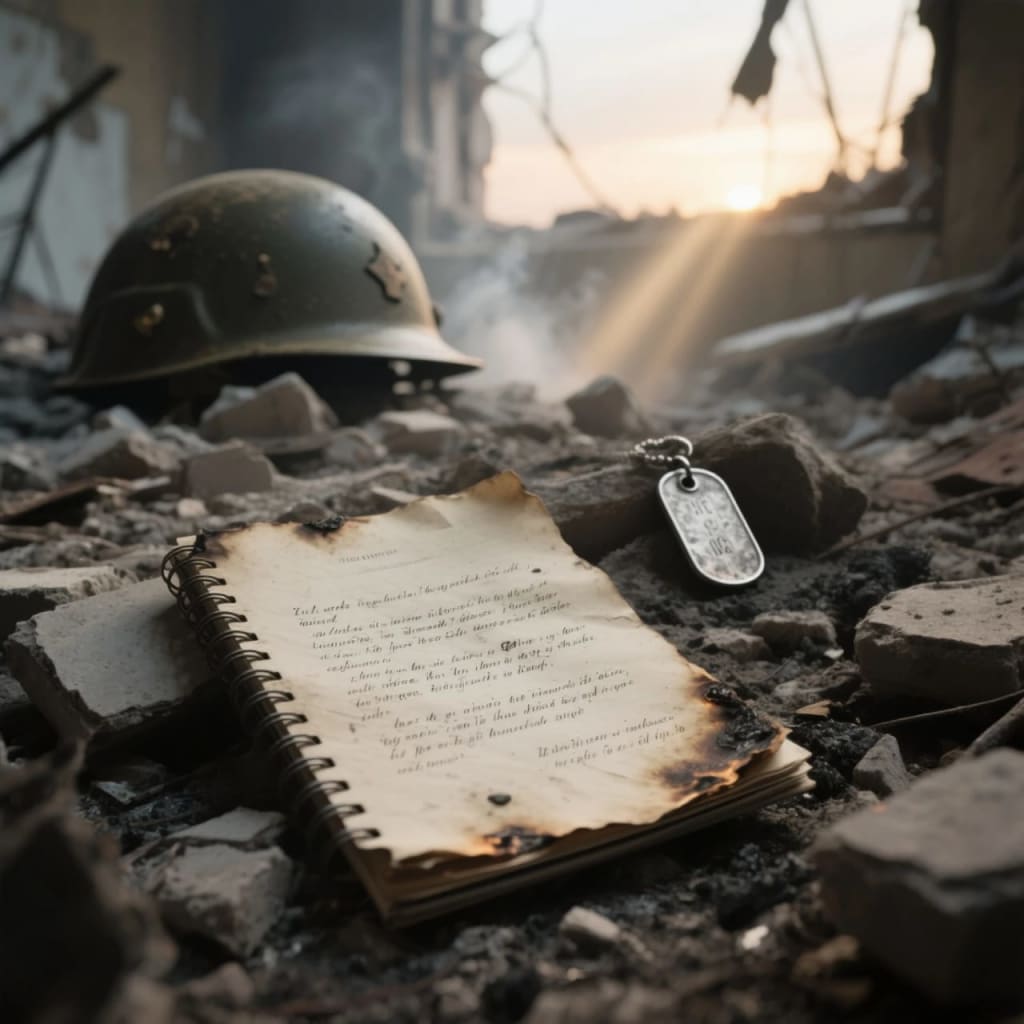
The poem was scribbled on the back of a ration box—folded three times, edges singed. When I found it in the tin footlocker buried beneath rubble, I didn't know it would change my life. All I knew was that the name in the corner, written in a bold, unshaken hand, was my grandfather's.
Corporal Elias Ward.
I'd heard stories about him—my mother’s whispered fragments of memory, her voice cracking like old film. She said he was a dreamer. A man of ink-stained fingers and quiet smiles, more in love with books than bullets. Yet when the war broke out, he didn’t hesitate. He traded his fountain pen for a rifle, his poems for silence.
But not entirely.
The footlocker had been stored away in my grandmother’s attic for decades. After she passed, we went through her things—finding photos, pressed flowers, and a pressed military uniform that still held the scent of smoke. That’s when I found the letter. That poem. His last.
It read:
"When the sky burns red and shadows dance,
And all I love is left to chance,
Know that my soul, though far it flies,
Will find your name beneath the skies."
Four stanzas. A soldier’s farewell, yet somehow a love letter too. As I traced the words, I imagined him in a bunker, the enemy closing in, writing not for glory but for remembrance.
What haunted me was the date: August 5th, 1945.
One day before the bomb.
My grandfather had been stationed on the outskirts of Hiroshima—not inside the city, but close enough. Close enough to see the cloud rise, to feel the earth tremble. He died in a makeshift hospital four days later. The cause wasn’t injuries—at least not the kind you see. It was radiation poisoning. They didn’t even have a name for it yet.
But before his death, he handed the poem to a nurse and asked her to mail it home. It never made it. Somehow it ended up back in the locker, among dog tags and a cracked compass.
And then it found me.
The words etched themselves into my mind. I couldn’t let them stay buried. I submitted the poem to a local literary magazine under my grandfather’s name, along with a brief explanation of its origin. I thought nothing of it. I assumed it would be a tribute, maybe one or two people would read it.
Instead, it caught fire.
The magazine called it “the most human artifact from a moment of inhumanity.” It was republished by newspapers. A filmmaker reached out for permission to use it in a documentary. Veterans' groups requested copies to read at memorials.
But more than the fame, it was the responses that moved me: Letters from widows who had lost their own soldier-poets. Messages from Japanese survivors who said the poem gave voice to grief too deep to name. A professor of history told me he read it to his students, not just as a poem—but as testimony.
I began digging deeper. I found more of Elias’s poems in archived letters—verses tucked into envelopes like secrets. Each one was a testament not to war, but to love. He wrote about the color of my grandmother’s eyes, the scent of rain on dirt roads back home, the sound of silence in a battlefield when even the birds had fled.
He wasn’t a soldier who happened to write. He was a poet who happened to serve.
And “The Last Poem” became his legacy.
It forced me to re-evaluate everything I thought I knew about heroism. Not all war stories are loud. Not all acts of bravery involve a trigger. Sometimes, courage is the act of creating beauty while everything around you crumbles to ash.
I organized his writings into a book: Verses from the Fire. It became a quiet success, taught in some schools, honored in small museums. But for me, the true reward was internal—the deep, resounding connection to a man I never met, but now felt I had always known.
And that poem?
It’s framed on my wall now.
Not for decoration, but as a reminder: Even in the darkest hour, a voice can rise. Not in protest, not in anger, but in truth.
Elias Ward didn’t live to see the world after the bomb. But his words did. They traveled through time, across generations, carrying not bitterness—but grace.
And sometimes, that’s the most powerful weapon of all.
About the Creator
Muhammad Sabeel
I write not for silence, but for the echo—where mystery lingers, hearts awaken, and every story dares to leave a mark
Keep reading
More stories from Muhammad Sabeel and writers in Poets and other communities.
My Poetry Went Viral—Here’s What I Didn’t Expect
I still remember the night my world changed. It was quiet—one of those still, sleepless hours when you either write or unravel. For me, it was both. I had written a poem, short and raw, titled “The Quiet Between Heartbeats.” Just 12 lines. I didn’t think much of it. It was about loneliness, about that space between loving someone and letting them go.
By Muhammad Sabeel10 months ago in Poets
From Newcastle To Whitby
Introduction I love going to Whitby and I used to drive but Whitby is not a place for cars, just park them and that's it. We usually stay at La Rosa (my favorite hotel ever) or Dillons (just a lovely welcoming place) and my stories about them are at the end of this.
By Mike Singleton 💜 Mikeydred 6 days ago in Poets



Comments
There are no comments for this story
Be the first to respond and start the conversation.