
The Last Arcadian
How a Forgotten Arcade Game Taught Me to Reclaim My Joy

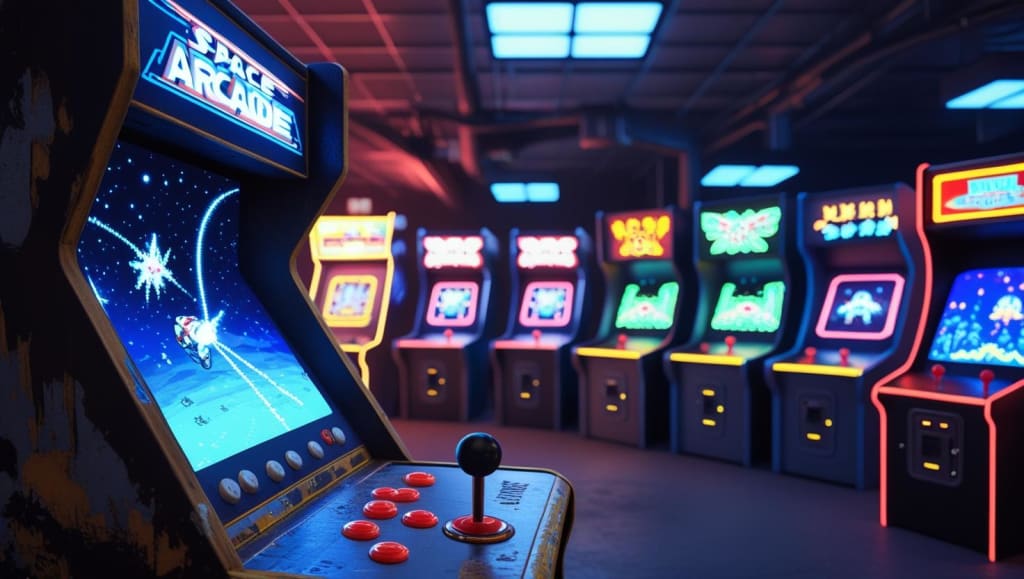
The summer of 2025 was when I found Arcadian’s Last Stand. It was tucked in the back corner of a crumbling arcade at the edge of town, a relic from the ‘80s that somehow survived the rise of VR and mobile gaming. The cabinet was scuffed, its paint chipped, but the screen glowed with a pixelated spaceship dodging waves of alien attackers. I was 29, burned out from a soul-crushing desk job, and hadn’t touched a joystick since I was a kid. But something about that game called to me, like a signal from a forgotten part of myself.
I grew up in the shadow of geek culture’s golden age—comic shops, Saturday morning cartoons, and arcades that smelled of popcorn and possibility. My older brother, Tim, was my guide. He’d drag me to the local arcade, plunk a quarter in my hand, and teach me how to weave through asteroid fields in games like Galaga. Those were the days when I felt invincible, when a high score meant I was king of the world. But life got in the way—college, bills, a job that drained my spark. By 2025, I’d forgotten what it felt like to play, to feel that rush of pure, unfiltered joy.
The arcade I stumbled into that summer was a time capsule. Most of the machines were broken, their screens dark, but Arcadian’s Last Stand was alive. I’d never heard of it—no Wikipedia page, no Reddit threads, just a cryptic “© 1983” on the title screen. The gameplay was simple: one ship, endless enemies, no continues. I dropped a quarter in, half-expecting it to eat my money. Instead, the speakers crackled with a chiptune anthem, and I was hooked.
At first, I was terrible. My reflexes were rusty, and the aliens were relentless. But I kept coming back, day after day, pouring quarters into that machine. Each defeat taught me something—their patterns, their weaknesses, the rhythm of the game. It wasn’t just about reflexes; it was about persistence. I started to notice parallels to my life. My job felt like an endless wave of deadlines, each one knocking me down. But in the arcade, I could fight back. I could learn. I could win.
One evening, after weeks of practice, I hit a flow state. My hands moved on instinct, dodging lasers, blasting enemies. The score ticked higher than I’d ever seen. A small crowd gathered—kids, a couple of older guys who looked like they’d lived in arcades too. When the final boss exploded in a shower of pixels, the machine let out a triumphant beep. My initials, J.M., sat at the top of the leaderboard. The kids cheered, and one of the old-timers clapped me on the shoulder. “You’re the last Arcadian,” he said, grinning. I laughed, but the words stuck with me.
I started researching Arcadian’s Last Stand, desperate to know its story. I found nothing online, but a local gaming forum led me to a retired programmer who’d worked for the developer, a small outfit that went bankrupt in the ‘80s. He told me the game was a passion project, made by a team who believed games could be art, not just entertainment. Only a few cabinets were ever produced. Mine might be the last one still running. That knowledge made every quarter I spent feel like preserving a piece of history.
The arcade closed a month later, sold to developers for condos. I begged the owner to sell me the Arcadian cabinet, but he refused—it was headed to storage, maybe a museum. I took a final photo of the screen, my initials still glowing. That machine gave me more than a high score. It reminded me who I was before life dulled my edges—a kid who loved the challenge, who found joy in the fight. I quit my job a week later, not to chase some grand dream, but to find work that didn’t make me feel like I was losing myself. I started collecting retro games, sharing their stories online, building a small community of geeks like me.
Arcadian’s Last Stand wasn’t just a game. It was a lifeline, a pixelated rebellion against giving up. If you’ve got a spark you’ve lost, find your own arcade, your own forgotten game. Play it. Fight for it. You might just rediscover the hero you used to be.
About the Creator
Shohel Rana
As a professional article writer for Vocal Media, I craft engaging, high-quality content tailored to diverse audiences. My expertise ensures well-researched, compelling articles that inform, inspire, and captivate readers effectively.
Keep reading
More stories from Shohel Rana and writers in Poets and other communities.
Harmony in Time
In the fall of 2025, as Vocal Media thrummed with trending stories of soulful connections and music-driven romance, Lila Harper, a 28-year-old violinist from New Orleans, felt her heartstrings out of tune. Her days were filled with teaching music to children, her nights with the ache of a love lost to time. A college romance had ended abruptly, leaving her skeptical of love in an era where connections often faded as quickly as a viral song. Yet, Vocal’s trending posts—tales of rekindled flames and melodies that bind—stirred a longing for a love that could endure. They promised that music, like love, could bridge even the widest gaps.
By Shohel Rana6 months ago in Poets


Comments
There are no comments for this story
Be the first to respond and start the conversation.