
“The Girl Who Sold Shadows” (a concept like you mentioned before)
A girl discovers she can trade people’s shadows for peace from their pain — but the more she takes, the darker her own world becomes.

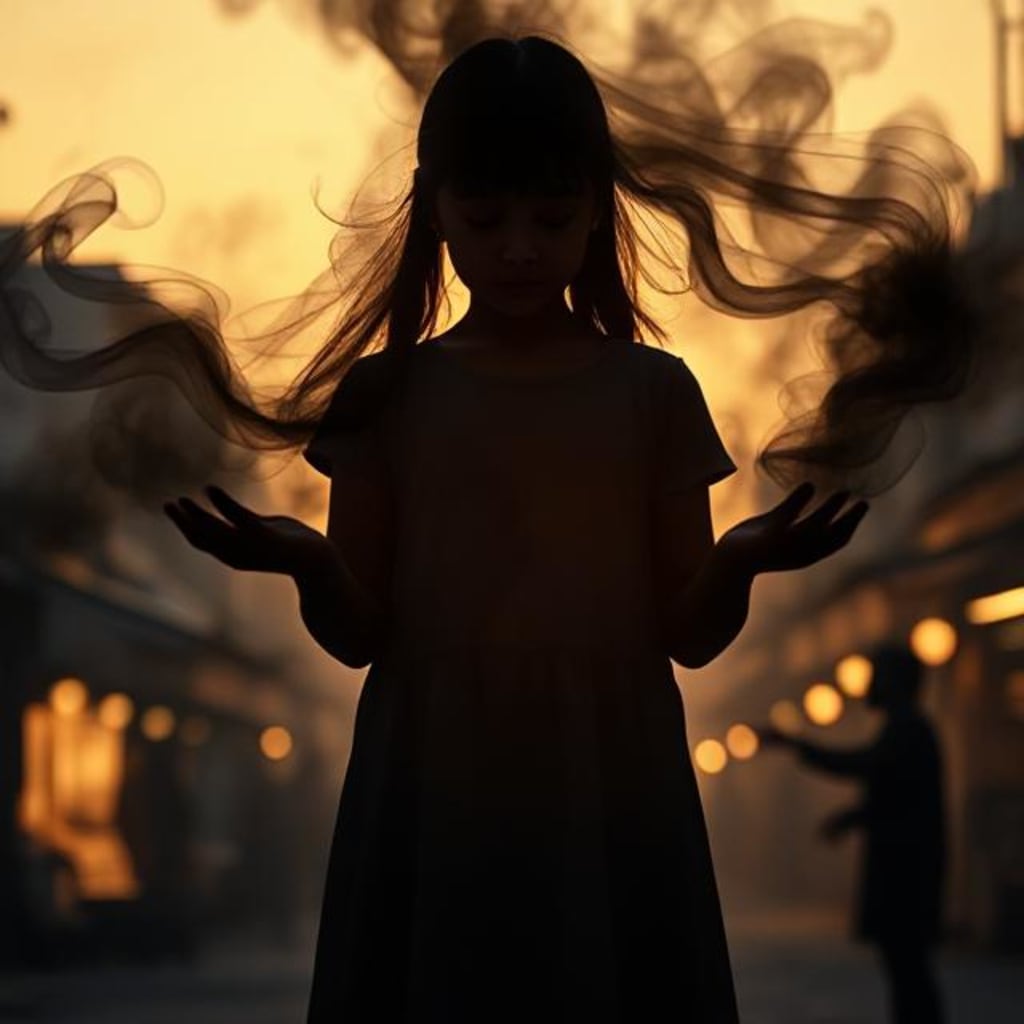
🌑 The Girl Who Sold Shadows
By [Ali Rehman]
There was once a girl who lived in a city where the sun never slept.
Every wall, every window, every face glowed with a brightness that left no corner untouched. But beneath that endless light, people walked heavy with something unseen — a quiet ache they carried in their bones, in their sighs, in the pauses between their smiles.
The girl’s name was Amira, though few remembered it. She worked at a small stall on the edge of the old market, where her wares were strange and unseen by most. Her sign was simple, hand-painted in silver letters that shimmered only at dusk:
“I Trade in Shadows.”
Most who passed by never noticed her. To them, her table looked empty — just a stretch of worn wood and dust. But to those whose hearts ached too deeply, her booth seemed to glow like a dark mirror.
They came quietly, their eyes searching hers, as if she could see something they couldn’t.
“What do you sell?” they would ask.
And she would answer softly, “Not what I sell — what I take.”
It had started years ago, the night Amira realized she could touch sorrow.
Her mother had been sick for months, fading in a room that smelled of medicine and wilted flowers. On the last night, Amira had sat by the bedside, her small hands folded over her mother’s. She had whispered, “Let me take it, Mama. Let me take your pain.”
And the air had shifted. The candles dimmed. The room bent inwards like a held breath — and suddenly, her mother had smiled. Not the weak, cracked smile of the dying, but a peaceful one. Her chest rose one last time, then fell. The pain was gone. So was the shadow on the wall — the one that had always followed her mother.
When Amira looked behind her, that shadow had taken shape beside her own.
From that night on, she was never without two shadows.
Word spread slowly, in the way sorrow always does.
People came to her — the broken, the grieving, the ones who could no longer bear their reflection. A man who lost his son. A woman who could not forget her lover’s last words. A boy who had seen too much of war.
They would step into her stall, trembling, desperate.
Amira would take their hands, whisper the old words she had taught herself — and when she let go, their faces would shine with strange relief.
They would walk away lightened. And she would watch as their shadows stayed behind, curling softly at her feet before following her home.
Each shadow whispered differently. Some wept. Some hummed broken songs. Some were silent, only shivering when the moon rose.
At first, she pitied them. She tried to comfort them, keeping her lanterns low, her voice gentle. But as the nights went on, the room began to darken. The shadows grew restless. They tangled and multiplied, whispering secrets she didn’t understand.
And the city began to change.
Wherever Amira went, the sunlight dimmed. The brightness that once kissed every wall began to falter. People started complaining about strange chills, about dreams where they saw their own shadows begging to be returned.
Still, they came to her — because pain is louder than fear.
“Take mine,” they’d plead. “Just for one night of peace.”
And she would, even when her own heart trembled.
One evening, a child no older than seven stood at her stall. His eyes were wide, his small fists clenched around a paper kite.
“Please,” he whispered. “My mother cries every night. Take her pain.”
Amira looked at him — at the innocence trembling before her — and she felt the old ache in her chest. But when she reached out, her hands were not her own anymore. They were black at the edges, smoky, like the shadows that clung to her.
“I can’t,” she said, stepping back.
But the boy didn’t move.
He looked at her shadow — and saw that it had grown into something monstrous, spreading like spilled ink across the cobblestones.
He dropped the kite and ran.
That night, the shadows turned against her.
They rose from the corners of her room like smoke given life, whispering with all the voices she had tried to silence — the grief she had borrowed, the pain she had stolen, the sorrow she had hidden.
“You took us,” they said. “But pain is meant to be felt, not buried.”
They reached for her. And as their fingers brushed her skin, she saw flashes — every face she’d helped, every tear she’d taken, every burden she’d claimed. None of it was gone. It had only found a new home inside her.
Amira screamed — not in fear, but in understanding.
When the dawn came, the people found her stall empty.
Only the old sign remained, faint and half-burned:
“I Trade in Shadows.”
And yet, the city felt lighter — as if the night had been scrubbed clean. The sunlight returned, gentle and warm. But in every reflection — in every puddle, every mirror, every window — one could see her face for just a moment, smiling faintly, as if from beneath the light.
Some say she still walks the borders between shadow and sun, searching for a way to return what she took.
Others say she became the night itself — the quiet space where pain can rest without shame.
But no one forgets her story.
The girl who sold shadows,
and in doing so, learned that even light can drown.
About the Creator
Ali Rehman
please read my articles and share.
Thank you
Keep reading
More stories from Ali Rehman and writers in Poets and other communities.
“Where the Silence Grows Flowers”
🌸 Where the Silence Grows Flowers By [Ali Rehman] There are some things the world can only say in silence. After my mother died, the world went quiet in a way I had never known before. Not the ordinary kind of quiet — not the pause between songs or the hush before rain — but the kind that hums beneath your ribs, heavy and wordless, like the air itself has forgotten how to breathe.
By Ali Rehman2 months ago in Poets



Comments (1)
Absolutely beautiful.