
The Geometry of Us (Explained)
A Journey Through Love’s Most Beautiful and Broken Patterns

Introduction
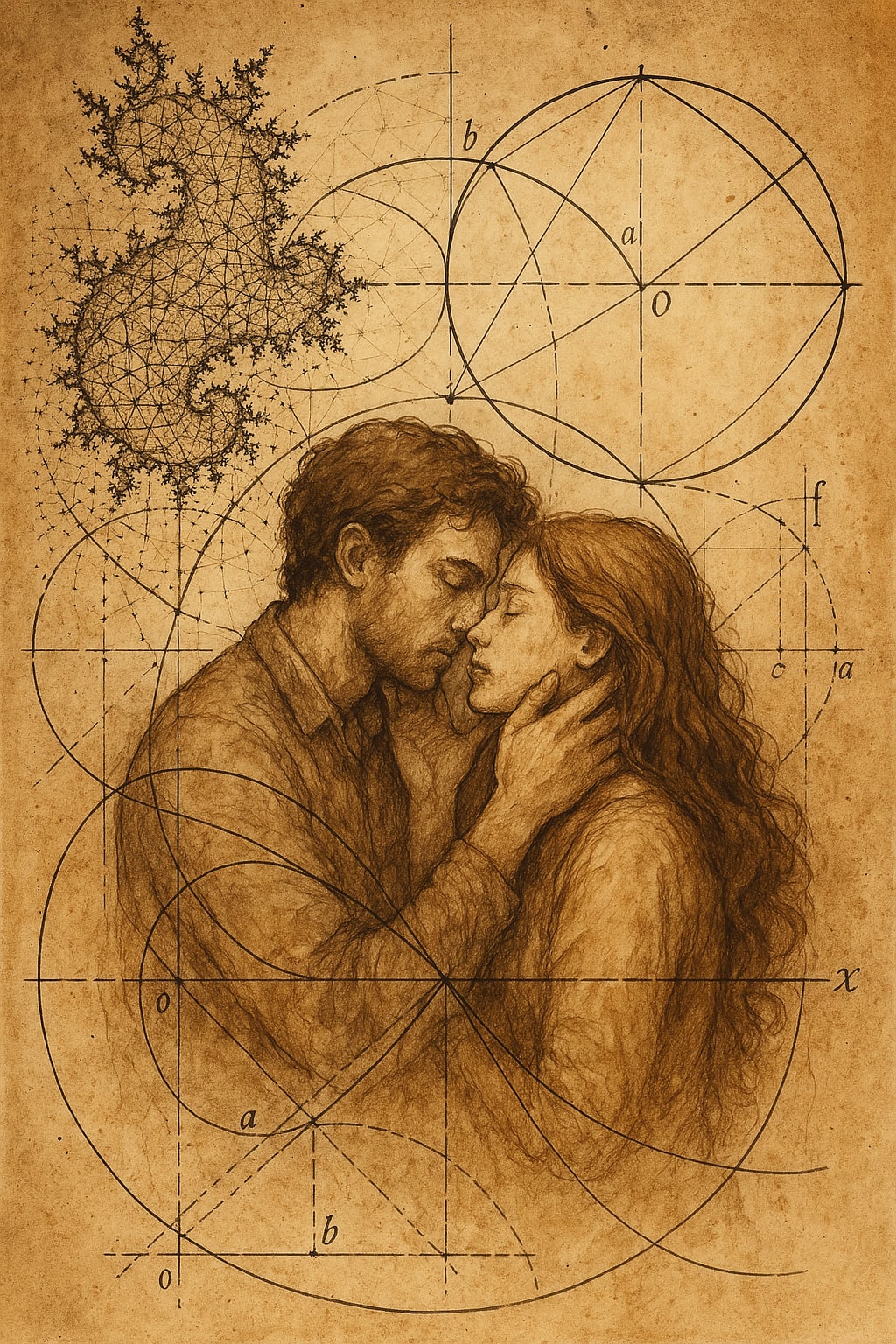
Love is rarely simple. It doesn’t always follow clear rules, predictable paths, or soft conclusions. Sometimes, love resembles a complex equation—beautiful but unsolvable, sharp-edged but divine. That is the heart of the poem “The Geometry of Us”—an exploration of love not as a fleeting emotion, but as a force of nature: mathematical, chaotic, healing, and destructive all at once.
In this article, we break down the poem, stanza by stanza, to uncover its deeper meanings and emotional architecture.
Stanza 1: The Blueprint of Desire
“I drew you first in fractal lines,
A curve repeating through my mind,
Where every breath and broken edge
Revealed the art I couldn’t find.”
This stanza introduces the metaphor of geometry and fractals—patterns that repeat infinitely, just like the recurring thoughts of someone deeply in love. The speaker sees the beloved not just as a person but as a living pattern, a mystery of art and logic, something profoundly beautiful yet beyond full comprehension.
Stanza 2: The Paradox of Love
“You were the silence in my storm,
The chaos where my calm began,
A paradox in perfect form—
Unsolvable, yet held by hands.”
Here, love is portrayed as a contradiction. The beloved is both peace and chaos, order and disorder. Love does not make logical sense, and yet, it is real and tangible—"held by hands." The paradox reflects how love often contains conflicting emotions: joy and pain, clarity and confusion.
Stanza 3: Beyond Simple Romance
“I loved you not in simple terms—
Not hearts or roses, stars or skies—
But like the math beneath the stars,
The kind no language justifies.”
The speaker rejects clichés of love (roses, stars, skies), claiming a deeper, almost cosmic connection that goes beyond words. Comparing love to "the math beneath the stars" suggests something eternal, complex, and profoundly structured—even if it defies articulation.
Stanza 4: Relativity and Gravity
“You moved like time in bending light,
Reflected through my sleepless soul,
A gravity I could not fight,
Yet chasing you made me whole.”
This stanza draws from physics and astronomy. The beloved is like bending light—a reference to relativity and how time behaves differently near strong gravitational fields. Love distorts time, keeps the speaker awake, yet gives them purpose.
Theme: Love as an irresistible force of nature; time and space warped by emotion.
Stanza 5: Silent Communication and Memory
“We spoke in glances, cruel and kind,
With eyes that echoed ancient wars,
And when your touch forgot my name,
It still remembered all my scars.”
The fifth stanza speaks to the silent language of relationships—how much can be said with a glance. The "ancient wars" represent emotional battles fought silently. Even when the beloved forgets the speaker's identity, they remember the pain they caused. This is deep, raw vulnerability.
Theme: Unspoken pain, emotional memory, and silent suffering in love.
Stanza 6: Voice and Distance
“Your voice—an echo in my bones,
Not loud, but endlessly precise—
A map of all the roads I missed,
A wound that heals but once, then twice.”
The beloved’s voice isn’t just sound—it’s embedded in the speaker’s body. It's a guide ("a map") to lost possibilities. The love caused wounds that heal slowly, or perhaps, not at all. The repetition of healing "once, then twice" hints at reopening pain, a common experience in broken or distant love.
Theme: Emotional echoes, nostalgia, and the weight of unspoken words.
Stanza 7: A Future Built on Fear
“I built a future out of fears,
And set your name in every stone—
But love is not what time forgives,
It’s what it leaves, when we’re alone.”
Here, the speaker admits to designing dreams out of fear, perhaps fearing loss, or clinging too hard. The idea that love is not what time heals but what remains despite time is haunting. Even when love ends, its imprint stays.
Theme: Illusions of permanence, emotional remnants, time's cruelty in love.
Stanza 8: The Final Truth
“So if I vanish in your past,
Let this remain—our final truth:
That even pain, when shaped by love,
Becomes the architecture of youth.”
The final lines acknowledge that the speaker may be forgotten, lost in memory. But what they shared still matters. The pain, shaped by love, becomes part of who we are—our personal history. It's a tribute to how love, even if it ends, builds who we become.
Theme: Legacy of love, pain as growth, emotional architecture.
Conclusion: The Heart as a Compass
“The Geometry of Us” is not a poem about simple love. It’s about profound emotional complexity, the kind that transforms you, teaches you, and scars you. It reflects the way love can be both destructive and redemptive, a storm and a sanctuary.
By using metaphors from geometry, astronomy, physics, and architecture, the poem elevates love from an emotion to a universal force—something governed by logic and chaos alike.
Comment if you want more like this....
About the Creator
Reader insights
Nice work
Very well written. Keep up the good work!
Top insights
Compelling and original writing
Creative use of language & vocab
Easy to read and follow
Well-structured & engaging content
Excellent storytelling
Original narrative & well developed characters
Eye opening
Niche topic & fresh perspectives
Heartfelt and relatable
The story invoked strong personal emotions
Masterful proofreading
Zero grammar & spelling mistakes
On-point and relevant
Writing reflected the title & theme
Keep reading
More stories from Muhammad Adil and writers in Poets and other communities.
Still, I Stay
Introduction We talk a lot about unconditional love, but what does it really mean to stay? Not just in the good moments—when someone is glowing with laughter, kind with their words, or open with their heart—but also when they’re shutting down, pushing away, or emotionally withdrawing.
By Muhammad Adil11 months ago in Poets


Comments (1)
Beautiful💙💙💙💙