
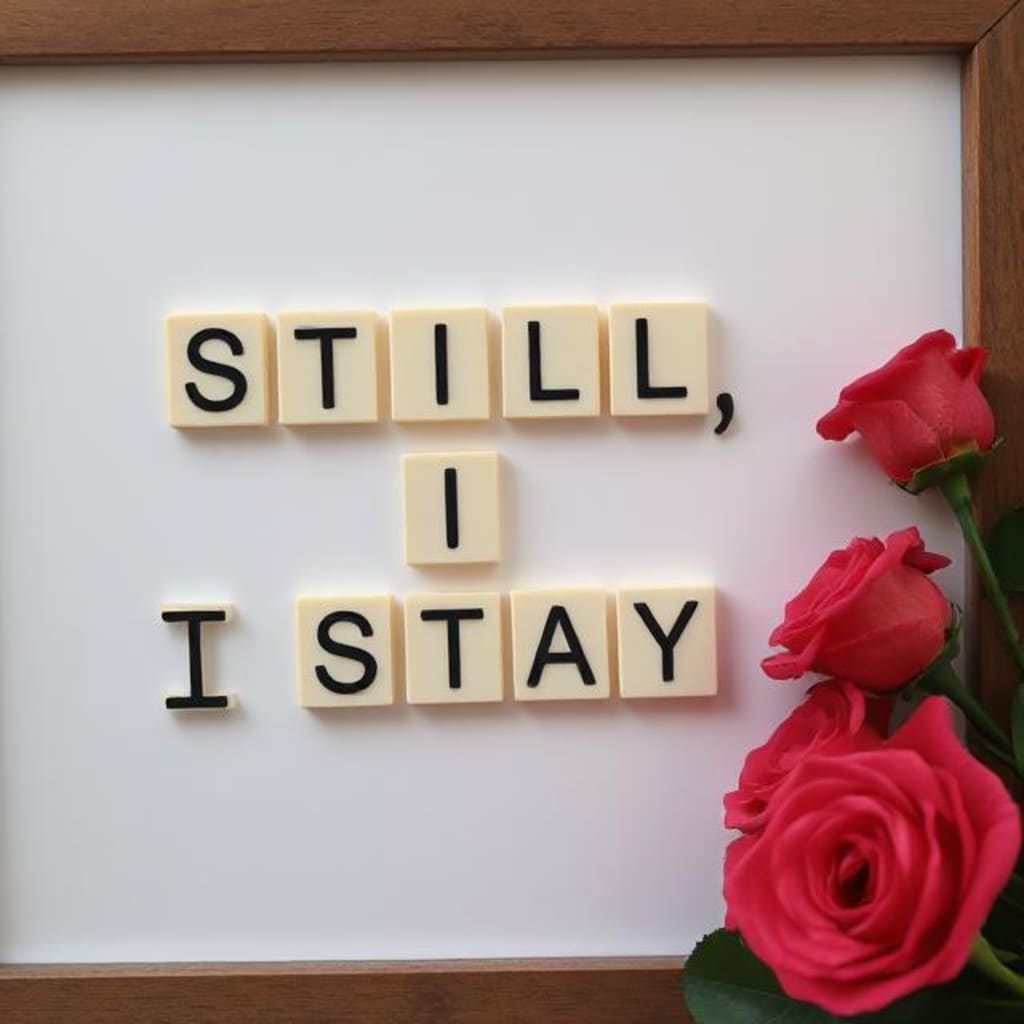
Still, I Stay
A Love That Endures Even the Stormiest Parts of You

Introduction
We talk a lot about unconditional love, but what does it really mean to stay? Not just in the good moments—when someone is glowing with laughter, kind with their words, or open with their heart—but also when they’re shutting down, pushing away, or emotionally withdrawing.
“Still, I Stay” is a raw and beautiful expression of devotion in its truest, hardest form. It explores the emotional labor of loving someone who’s hurting, guarded, or distant. And yet, this poem is not about struggle alone—it’s about choosing to stay because you see the soul beneath the storm.
Stanza 1
You push me with your silence,
And I flinch at words unsaid.
But I stay within the distance,
Where your anger makes its bed.
This stanza opens with tension.
Silence can be deafening—especially in relationships. When someone you love starts to shut down emotionally, it can feel like a rejection. The line “I flinch at words unsaid” captures that invisible hurt, that ache when the one you love chooses withdrawal over communication.
Yet, the poet stays. They don’t close the door. They remain near, quietly coexisting with the storm brewing in their partner. It’s not about ignoring the pain; it’s about sitting with it, even when it’s not easy.
Stanza 2
You speak in walls, not sentences,
You run when you’re afraid—
But I trace your fear like constellations,
And hold you while you fade.
This is where love becomes intuitive.
Some people communicate not through words, but through withdrawal, distance, or anger. These are their walls. This stanza beautifully expresses the empathy it takes to love someone through fear—to read between the silences.
“I trace your fear like constellations” is such a poetic way to say: I try to understand you, even when you don’t show me clearly. It shows that love is not always about confrontation, but about witnessing. And when someone is fading—emotionally disappearing—just holding space for them can be the greatest gift.
Stanza 3
I don’t love just who you are
When the sunlight hits you right.
I love the shadowed corners,
And the battles fought at night.
This stanza is the heart of the poem.
Loving someone when they’re glowing is easy. But the poet flips the script: they cherish the shadowed corners too—the fears, flaws, and internal battles.
We often present curated versions of ourselves to the world. But in love, the truth lives in the messiness, the breakdowns, the insecurities. To see someone fully—sunlight and shadow—and love them still, that’s rare. And that’s what this stanza so delicately captures.
Stanza 4
I love the part of you
That doesn’t feel like it deserves—
The brokenness you try to hide,
The soft beneath the curve.
This is the stanza that gives us a glimpse of vulnerability—the part that feels unworthy of love.
Many people carry an internal belief that they are “too much,” “too broken,” or simply “not enough.” This is often rooted in past pain or trauma. This stanza reflects a gentle, unconditional love that sees all of that—and embraces it.
The poet doesn’t flinch from their partner’s broken pieces. They love those pieces specifically. And “the soft beneath the curve” implies tenderness, the hidden gentleness beneath even the toughest exterior.
Final Stanza
Still, I stay—not out of duty,
Not from fear, not for pride—
But because I see the beauty
In the storm you keep inside.
The final lines are a reaffirmation of choice.
The poet is not staying because they feel obligated. They’re not trapped by fear. They stay because they choose to—they see beauty even in the chaos, in the “storm you keep inside.”
There’s something deeply healing about being loved by someone who can see past your defenses and pain, and still believe there’s beauty within you. It’s not easy. But this poem says: I see you fully. I love you anyway. I’m not leaving.
Conclusion: Staying Through the Storm
“Still, I Stay” is a tribute to the kind of love that survives what many others would walk away from.
It’s a love that doesn’t sugarcoat things. It doesn’t pretend that being close to someone who’s emotionally struggling is easy. But it reminds us that sometimes the strongest love is the quietest one—the love that stays in place while someone else finds their way back.
This poem is for the empaths, the partners, the people who hold space for others even when it hurts. It’s for the ones who say:
I won’t fix you. I won’t pressure you. But I will stay with you. Through all of it.
And in that staying, in that choosing, something truly extraordinary is born.
Give me some love also
Comment if you love my Articles and also subscribe to get more articles like this...
Thank You
About the Creator
Keep reading
More stories from Muhammad Adil and writers in Poets and other communities.
Tatt~Master
— Assembly Line Tatt Machine ~ Impressions to Impress — As I begin to understand more about the Tattoo Phenomenon. I've written silly, yet verbatim, dating site anecdotes in 'Frazzled.' So let me ask you: Would you be More attracted to someone slathered with tattoos, or Less?
By Jay Kantor5 days ago in Humor


Comments (1)
Nice work