
“The Clockmaker’s Secret”
Time doesn’t heal all wounds—but sometimes, it hides them.

Story
The shop stood at the edge of the old district, where narrow cobblestone streets twisted like veins through forgotten buildings. Most people walked past it without noticing. Those who did notice rarely stepped inside.
The sign above the door read simply: K. Delacroix, Clockmaker.
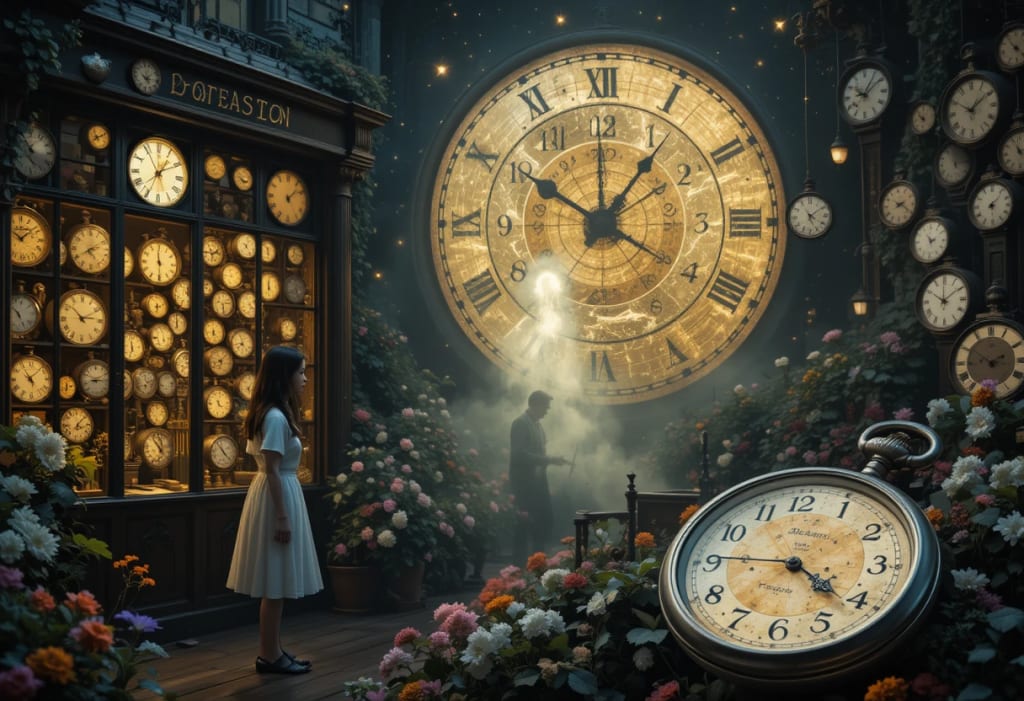
Inside, the air was thick with the sound of ticking. Dozens of clocks lined the walls—grandfather clocks with polished wood, pocket watches gleaming behind glass, cuckoo clocks with tiny painted birds waiting in silence. Every tick was slightly out of sync, a chorus of time running not quite together, like a hundred separate hearts.
Mr. Delacroix sat behind the counter, his hands delicate and steady despite his age. He had eyes that seemed always to be listening—to the clocks, or perhaps to something deeper.
People brought him broken watches, heirlooms, pieces of history they wanted restored. And he always repaired them, no matter how damaged, no matter how impossible the task seemed. But there was a rumor in the city, whispered by those who believed in stranger things: if you brought him a clock at midnight, he wouldn’t just fix it. He would show you something you weren’t supposed to see.
One night, just before midnight, a girl named Elara walked into the shop. She couldn’t have been more than nineteen, her hands shaking as she clutched a small, silver pocket watch.

“It doesn’t work,” she said, placing it on the counter. “It belonged to my father. He… he died last winter.”
Delacroix studied her carefully, then the watch. He didn’t ask why she had come at midnight. He simply wound the key, and the hands twitched faintly.
“This watch doesn’t just measure hours,” he murmured. “It measures moments.”
Elara frowned. “What do you mean?”
He didn’t answer. Instead, he gestured to the back of the shop. “Would you like to see?”
She hesitated, but followed him. Behind the counter was a door she hadn’t noticed before. It opened into a room filled not with clocks, but with a single massive timepiece covering the wall—a clock with no numbers, only shifting constellations on its face. The hands moved in strange patterns, not in circles but in spirals and arcs.
“This,” Delacroix said, “is the true heart of the workshop. Every clock I repair is a thread tied to this one. And sometimes, if you know how to listen, it can show you… echoes.”
“Elara,” he said softly, “do you wish to see your father one last time?”
Her breath caught. “You can do that?”
“Not I,” Delacroix corrected. “Time itself.”
He placed the silver watch into a slot at the base of the great clock. The gears inside began to turn with a groan, the constellations shifting rapidly across the face. The shop around them seemed to blur, the ticking swelling until it drowned out every thought.
And then—silence.
When Elara opened her eyes, she was no longer in the shop. She stood in a sunlit garden she recognized instantly. Her father knelt beside the flowerbeds, soil on his hands, humming the tune he always hummed when he worked. He looked alive, whole, unaware she was watching.
“Papa…” she whispered.
But as she stepped forward, Delacroix’s voice echoed behind her:
“Careful. These are echoes, not doors. You cannot touch them. You cannot change them. You can only witness.”
Tears blurred her vision as she watched her father wipe sweat from his brow, laugh at something only he could hear. It lasted only moments before the vision faded, collapsing back into the ticking darkness of the shop
Elara wept quietly. “Why… why would you show me this, if I can’t have him back?”
Delacroix’s eyes softened. “Because grief is not silence, my dear. It is an echo. It lingers. It refuses to fade. The clocks do not erase pain, but they remind us—love was real, and it mattered.”
She looked at him then, truly looked, and realized why his eyes carried such heaviness. “You’ve used it yourself, haven’t you?”
Delacroix smiled faintly, though it trembled. “My wife’s laughter is still in these walls. I hear it every night. The clocks keep it alive for me, though the world insists she is gone.”
For a long time, neither spoke. Only the ticking filled the air.
When Elara finally left the shop, dawn was breaking, painting the streets with pale gold. The watch in her hand ticked steadily now, its heartbeat strong. She knew she would never forget what she had seen.
Behind her, Delacroix returned to his counter. He lifted another broken watch, hands steady as ever. But when he pressed it to his ear, for just a moment, he thought he heard laughter again.
And he smiled.
Because time, for all its cruelty, still remembered.
About the Creator
Keep reading
More stories from waseem khan and writers in Poets and other communities.
The Taste of Lies
The Taste of Lies “Bitter words linger longer than sweet ones, and some truths never wash away.” Lila always believed that honesty was like sugar—sweet, comforting, and easily savored. But over the years, she learned the other taste of the world: lies.
By waseem khan6 months ago in Poets



Comments
There are no comments for this story
Be the first to respond and start the conversation.