
The Clockmaker's Lyric
A tale of a forgotten key, a mechanical muse, and the poetry that passes from heart to hand.

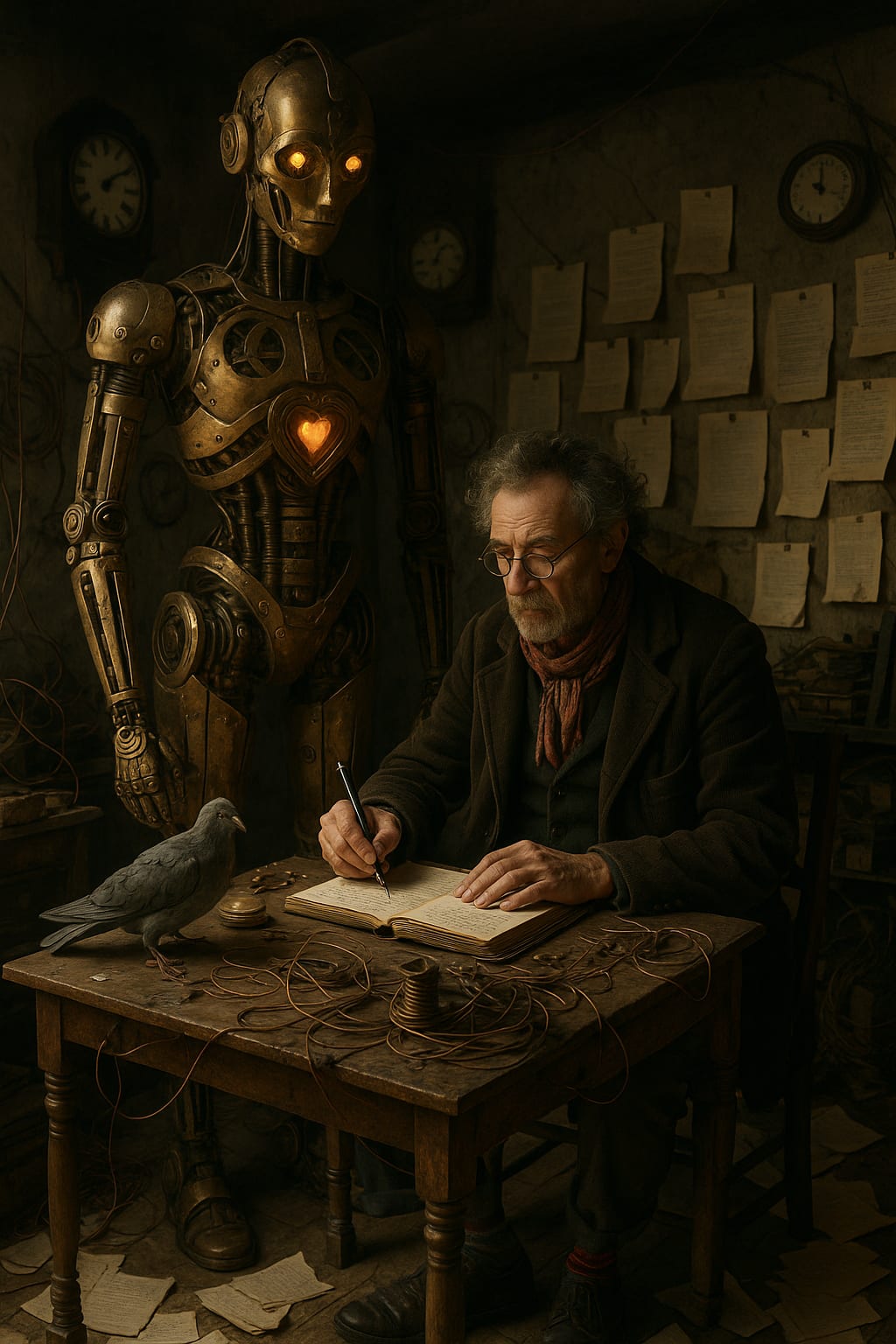
In the small town of Varnhollow, nestled between old hills and restless winds, there lived a peculiar poet named Eliot Bramble. His house was the last one on Gable Street, a crooked cottage bursting at the seams with paper, clocks, and copper wires. He called himself a “poet of precision,” and he believed every verse had a mechanism — a rhythmical gear, a tick-tock of emotion — waiting to be wound.
To most in Varnhollow, Eliot was a harmless oddity. He wore mismatched socks, spoke in rhymes without realizing it, and kept pigeons trained to carry poems across town. He was known to recite sonnets to sunflowers and challenge storms to haiku duels from his rooftop.
But what truly set Eliot apart wasn’t his eccentricity. It was his muse.
Every poet has one — an unseen whisperer, a tug on the soul, a nudge in the dark. Eliot’s muse, however, wasn’t a fleeting inspiration or a sudden bolt of insight. It was a brass automaton named Lyra.
She stood in his study, seven feet tall, built from spare clock parts and a heart-shaped locket that swung inside her ribcage. Eliot had crafted her himself, taking twelve years and more sleepless nights than he cared to count. She didn’t speak, didn’t move much, but when Eliot wound her with the silver key he kept around his neck, Lyra’s chest would glow faintly and her eyes would flicker like candlelight.
Then the poems would come. Flooding his mind with lines that hummed like the hum of her gears, verses that echoed old music boxes, and the sigh of midnight wind through clock towers.
Eliot never told anyone about Lyra. How could he? They’d say he was mad — which many already suspected — or worse, that he’d lost his grip on reality completely. But to Eliot, Lyra was as real as ink and parchment. She was his poetry.
Each month, he would wind her once, and for precisely five minutes, she would “sing” in her silent way. Eliot would scribble, frantic and possessed, as the words bloomed in his head. His poems began to appear in literary journals, then anthologies, and then won prizes — quiet ones, the sort judged by whispery old scholars in tweed. He never attended ceremonies. He had no interest in fame. He wanted only to write.
Then, one rainy October morning, something changed.
The key was missing.
Eliot tore through the cottage like a storm. He checked under his typewriter, inside tea tins, behind Lyra’s stand, and even in the pigeons’ nests. But the key — the only thing that could wind Lyra’s heart — was gone.
Without it, she was still. And Eliot was empty.
The poems didn’t come.
Desperate, he wandered town, retracing his steps, but all he got were concerned glances and a polite reminder from the grocer that he was scaring the children with his “poetry panic.”
Weeks passed.
Autumn slid into a brittle winter. Eliot stopped writing altogether. He stared at blank pages, begged the wind for stanzas, and shouted at the stars for similes. But nothing.
One day, while sulking by the old clock tower, he spotted something odd.
A boy — no older than twelve — sitting beneath the broken bell with a notebook in his lap, scribbling furiously.
Eliot approached, careful not to startle him.
“Writing?” he asked gently.
The boy looked up, cautious. “Poems.”
Eliot blinked. “Oh? May I…?”
The boy shrugged and held up the notebook.
The words hit Eliot like a train. Raw, beautiful, precise. The rhythm ticked like Lyra’s hum, the metaphors spun like copper gears.
“Where did you get these lines?” Eliot asked, nearly breathless.
“I don't know,” the boy said. “They just… come. Every night now. Since I found this.” He reached into his pocket and pulled out a silver key.
Eliot’s heart nearly stopped.
It was the key.
“Where—how—” he stammered.
“Found it in a puddle near Gable Street,” the boy said. “I liked how it looked. I hold it when I write. Makes the poems better.”
Eliot swallowed hard. He sat beside the boy, staring at the key, the missing piece of Lyra, the end of his silence. But he didn’t reach for it.
Instead, he asked, “What’s your name?”
“Jonas.”
“You’re very talented, Jonas.”
The boy beamed. “Thanks. I want to be a poet like Eliot Bramble. My teacher gave me one of his books.”
Eliot smiled faintly. “He’s alright, I suppose.”
The two sat quietly for a moment, the wind tugging at their collars.
Eliot looked at the boy, then at the key.
He could take it. Demand it, even. It was his. But he saw how Jonas clutched it — not as a thief, but as someone holding a talisman, a fragile thing that kept the world bright.
Lyra had never truly belonged to him. She had only visited him, like poetry itself — ephemeral, generous, unpromised.
“I think it chose you,” Eliot said finally.
“What did?”
“The key. Or maybe the words. Doesn’t matter, really. Just keep writing. And promise you’ll never force it.”
Jonas nodded solemnly.
Eliot ruffled his hair and stood.
He returned home, feeling oddly lighter.
Lyra stood silent as ever, her chest dark. But Eliot no longer feared the stillness. He lit a candle and sat at his desk. There was no music in his mind, no sudden flood of lines.
But he opened his notebook and wrote anyway.
The first poem was clumsy. The second, slightly better. By the fifth, he found a rhythm of his own — not the mechanical perfection Lyra had gifted him, but a rougher, warmer kind of verse.
Words born of silence, not spark.
As spring neared, Eliot began mailing poems again — unsigned this time. He included one from Jonas too, proud to pass the flame. His pigeons flew again. His socks still mismatched. But there was peace in him now.
One morning, he visited the clock tower.
Jonas was there, writing.
Eliot handed him a folded page.
“A gift,” he said. “It’s a poem. For the next poet.”
“Who’s that?” Jonas asked.
“You’ll know them when they appear,” Eliot said, smiling.
He walked away, his coat flapping like wings.
Behind him, the bell struck noon — for the first time in years.
About the Creator
Ashikur Rahman Bipul
My stories are full of magic and wild ideas. I love creating curious, funny characters and exploring strange inventions. I believe anything is possible—and every tale needs a fun twist!
Keep reading
More stories from Ashikur Rahman Bipul and writers in Poets and other communities.
The Year I Wrote in Rainwater
The year I turned thirty, I stopped writing in ink. It began on a Tuesday in April, when the skies split open like a sigh and I found myself in a forgotten park, notebook in hand, drenched but delighted. I had no umbrella, no agenda, just a quiet hour between obligations. I sat on a moss-covered bench while the clouds wept their secrets. I watched rain stitch silver lines across the page.
By Ashikur Rahman Bipul10 months ago in Poets
Discarded Souls: The Old Woman & The Old Robot
INTRODUCTION In the year 2230, faces are no longer fixed things. People shift. Machines shift. Even memories shift, flickering like old film reels caught between timelines. The characters you meet in these fragments — the Old Woman and the Old Robot known as Echo — may appear in different forms, bodies, or styles, depending on which recovered file you’re viewing. This is not a mistake. It is the nature of shape‑shifter stories.
By Vicki Lawana Trusselli 6 days ago in Poets



Comments
There are no comments for this story
Be the first to respond and start the conversation.