


The air in Mira’s childhood home in Chittagong was thick with the scent of old wood and monsoon damp. At twenty-seven, she was a freelance writer, accustomed to the frenetic pace of city life in Dhaka. But now, standing in the living room where her father once read her bedtime stories, she felt unmoored. His sudden passing two weeks ago had brought her back to this house, a place she hadn’t visited in years.
Her father, Abbas, had been a clockmaker, known for crafting timepieces that seemed to hum with life. His shop, a small annex to the house, was a haven of ticking gears and polished brass. Mira had loved watching him work as a child, his hands steady as he coaxed broken clocks back to life. “Every clock has a story,” he’d say. “Fix the story, and the clock will sing.” But after her parents’ divorce when she was twelve, Mira had drifted from him, their bond fraying under the weight of her mother’s bitterness and her own teenage rebellion. Now, he was gone, and the regret gnawed at her.
Sorting through his belongings, Mira found a letter tucked in his desk, addressed to her in his looping script. “Mira, my light,” it began. “There’s a clock in the attic, one I never finished. It’s for you. Find its heart, and you’ll understand.” Her chest tightened. What did he mean? She hadn’t been in the attic since she was a girl, when it was her secret hideout for reading adventure books.
That evening, she climbed the creaky stairs, a flashlight cutting through the dust. The attic was a maze of forgotten things—old trunks, cracked mirrors, and stacks of yellowed novels. In the corner, under a tarp, stood a workbench. On it was a brass clock, its face etched with stars and vines, its hands frozen at midnight. It was unlike any of her father’s other works, almost otherworldly in its beauty. Beside it lay a leather journal, its cover embossed with a single word: Timekeeper.
Mira opened the journal. The first page, in her father’s hand, read: “This clock does not measure time. It holds it. To wind it is to see what was, what might be. Use it wisely.” The entries that followed were cryptic, describing moments—her father’s first meeting with her mother, a childhood memory of his own father, a day he watched Mira learn to ride a bike. Each ended with a note: “Held in the clock.” Mira’s pulse quickened. Was this a diary, or something more?
She took the clock and journal downstairs, setting them on the dining table. The clock’s gears were intricate, but one was missing—a small, heart-shaped piece. She searched the attic but found nothing. That night, unable to sleep, she wound the clock’s key, half-expecting nothing. Instead, a soft hum filled the room, and the air shimmered like heat rising from pavement. The world blurred, and Mira found herself standing in her father’s shop—not as it was now, but as it had been fifteen years ago.
A younger Abbas sat at his bench, repairing a pocket watch. Mira, a girl of twelve, burst in, her face streaked with tears. “Why do you and Ma fight?” she demanded. Abbas looked up, his eyes heavy. “We’re trying, Mira. Sometimes love gets tangled.” The memory wasn’t new, but seeing it felt raw, like peeling back a scar. The scene faded, and Mira was back in the dining room, her cheeks wet. The clock had stopped again.
Over the next days, she wound it repeatedly. Each time, it showed her a moment from her father’s life—some with her, some without. She saw him teaching her to write her name, his pride glowing. She saw him alone after the divorce, staring at a photo of her. She saw him crafting the clock in the attic, whispering, “For Mira, when she’s ready.” Each vision left her shaken, piecing together a man she’d only half-known. But the clock always stopped, its missing gear halting the story.
One afternoon, a neighbor, an elderly woman named Sufia, stopped by with a pot of biryani. “Your father was special,” she said, her eyes kind. “His clocks… they fixed more than time.” Mira hesitated, then showed her the brass clock. Sufia’s face lit up. “The Timekeeper,” she murmured. “He told me about it once. Said it was his heart’s work.”
“Do you know about the missing gear?” Mira asked. Sufia shook her head but suggested visiting the old market where Abbas bought his supplies. “Maybe someone there knows.”
The market was a labyrinth of stalls, fragrant with spices and loud with haggling. Mira found a shop tucked in a corner, its sign reading Rahim’s Antiques. Rahim, a wiry man with a white beard, recognized the clock when she described it. “Abbas was a dreamer,” he said. “He bought strange pieces from me for that one. The gear you’re looking for… it’s not metal. It’s something personal.”
Mira frowned. “Personal?”
“Something that holds meaning,” Rahim said. “He said the clock would only work for the one it was meant for.”
Back home, Mira scoured the journal for clues. One entry caught her eye, dated the day she’d left for Dhaka after high school: “Mira’s gone. I gave her the locket. Maybe one day she’ll open it.” Her breath hitched. The locket—a small, heart-shaped pendant her father had given her before she left. She’d never worn it, too angry at him then. It was in her jewelry box in Dhaka.
She rushed back to the city, retrieving the locket. Inside was a tiny brass gear, shaped like a heart, with a note: “For the clock, and for you.” Her hands trembled as she returned to Chittagong and fitted the gear into the clock. It clicked into place, and the hands began to move.
This time, the vision was different. She stood in a garden, not from her past but from somewhere else—a place of endless twilight, with flowers that glowed like stars. Her father was there, younger, smiling. “You found it,” he said.
“What is this?” Mira asked, her voice breaking.
“A gift,” he said. “The clock holds time, but it also lets you say what you couldn’t. I’m sorry, Mira, for the years we lost. I loved you always.”
She reached for him, tears falling. “I’m sorry too. I should’ve come back.” They stood there, not touching but connected, until the garden faded. The clock stopped, its work done.
Mira kept the clock on her mantel, its hands still. She wrote about it in her journal, not as a story for publication but for herself. The visions had healed something in her, letting her forgive her father—and herself. She visited her mother, sharing the locket’s story. They talked, not erasing the past but softening its edges.
Inspired, Mira started a blog, The Clockmaker’s Daughter, sharing tales of her father’s clocks and the lives they’d touched. Readers sent their own stories—of heirlooms, regrets, second chances. The blog grew, a quiet space for healing. Mira even began repairing clocks, learning her father’s craft. Each tick felt like a conversation with him.
A year later, she returned to Chittagong for her father’s memorial. In the attic, she lit a candle by the workbench, the clock glowing softly. Outside, the moon hung low, and she felt him in the breeze. She was the timekeeper now, holding moments for others—and for herself.
About the Creator
Shohel Rana
As a professional article writer for Vocal Media, I craft engaging, high-quality content tailored to diverse audiences. My expertise ensures well-researched, compelling articles that inform, inspire, and captivate readers effectively.
Keep reading
More stories from Shohel Rana and writers in Poets and other communities.
Grief’s Canvas
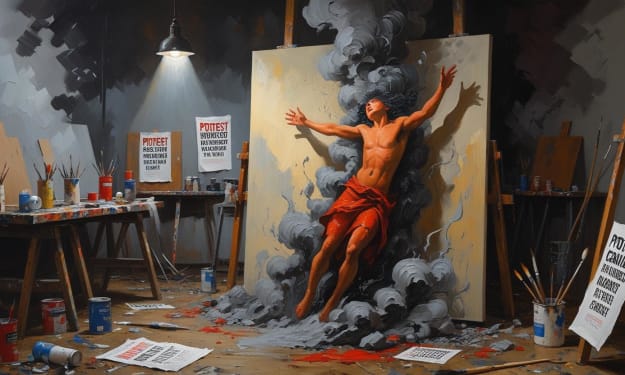
Painting Through Pain I stood in a cramped basement gallery last month, staring at a canvas by Perla Santiago, a contributor to Salt in the Wound. The painting was raw—swirls of crimson and ash gray, a figure clawing upward from a scorched earth, its face half-formed but screaming life. It wasn’t just art; it was a wound laid bare, a howl of grief turned into color. Perla, a Chilean artist who lost her brother in the 2019 protests, painted it during a blackout, using scavenged pigments mixed with tears. In Salt in the Wound, a zine collecting dispatches from artists in crisis, visual art like Perla’s holds beauty and pain in the same breath. This is the story of how artists paint through grief, transforming loss into something that refuses to be forgotten.
By Shohel Rana7 months ago in Poets



Comments
There are no comments for this story
Be the first to respond and start the conversation.