
The Book That Changed a Life
A tattered book found on the street becomes the key to a young boy's extraordinary journey

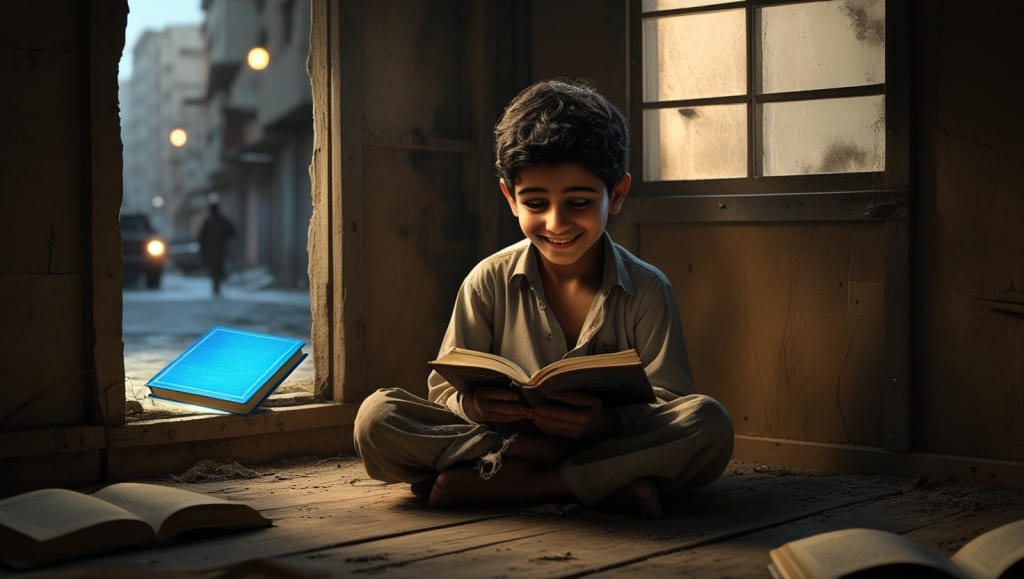
The streets of the city were alive with the usual chaos—honking cars, hurried footsteps, and the hum of a thousand conversations. Amid the bustle, a small, tattered book lay abandoned on the cracked pavement, its pages fluttering in the breeze. People passed by without a glance, their eyes fixed on screens or distant destinations. No one cared for the worn cover or the faded title that hinted at forgotten wisdom. No one, that is, until Arjun.
Arjun was fourteen, with patched clothes and a quiet determination that belied his circumstances. Life hadn’t been kind to him. Orphaned at a young age, he scraped by, collecting scraps to sell at the local junk shop. That morning, as he navigated the crowded street, his sharp eyes caught the book’s faded blue cover. It wasn’t much—dog-eared, with a cracked spine—but to Arjun, it was something. He tucked it under his arm, thinking it might fetch a few coins.
At the junk shop, old Mr. Gupta rummaged through Arjun’s haul: a broken watch, a dented tin, a cracked mug. When Arjun placed the book on the counter, Mr. Gupta barely glanced at it. “Ten rupees, maybe,” he muttered, waving it off. Arjun hesitated. Something about the book felt different, heavier than its worn pages suggested. “I’ll keep this one,” he said, surprising himself. Mr. Gupta shrugged, uninterested, and handed over a few crumpled notes for the rest.
Back in the small, leaky shed Arjun called home, he sat cross-legged on the floor, the book in his hands. The title, barely legible, read The Art of Possibility. He opened it, half-expecting it to be some dull textbook. Instead, the words leapt off the page, alive with ideas he’d never encountered. The book spoke of mindset, of seeing opportunities where others saw obstacles, of building a life from nothing but belief and action. Arjun, who had never dared to dream beyond survival, felt a spark ignite within him.
He read late into the night, the words blurring under the dim light of a borrowed lamp. The book wasn’t just a story—it was a blueprint. It told of people who had risen from nothing, who had turned ideas into empires, not with money or connections, but with grit and vision. Arjun, who had always felt invisible, began to see himself differently. The book whispered that he, too, could create something extraordinary.
The next morning, Arjun woke with a plan. The book had mentioned starting small, solving problems around you. He looked at his neighborhood—a maze of narrow alleys where vendors struggled to keep their goods fresh in the sweltering heat. Ice was scarce, and the nearest supplier was miles away. Arjun saw a gap. With the ten rupees from the junk shop, he bought a small block of ice, wrapped it in cloth, and sold it in tiny portions to the vegetable sellers. They were grateful, and word spread. By the end of the week, Arjun had enough to buy two blocks.
He kept reading the book, each chapter pushing him further. It taught him to ask questions, to listen, to innovate. He saved every coin, bought a used cooler, and started delivering ice directly to vendors. Within months, he had a small cart, then a bicycle. He called his venture “Cool Relief,” a name inspired by a line in the book about bringing ease to others’ burdens. The vendors, who once saw him as just another street kid, began to rely on him. Arjun wasn’t just surviving anymore—he was building.
Years passed, and Arjun’s story grew. By seventeen, he’d saved enough to rent a small shop, where he sold ice and basic goods. By twenty, he owned a fleet of refrigerated carts, supplying markets across the city. The book remained his constant companion, its pages now soft from use. Arjun credited it with every step of his journey—not because it held some magic formula, but because it had taught him to see possibility in the impossible.
Today, Arjun is a name known beyond his city. His company, Cool Relief Enterprises, employs hundreds, providing affordable refrigeration solutions to small businesses across the country. He’s a millionaire, yes, but what matters more is the impact. He’s built schools in his old neighborhood, funded libraries, and given out copies of The Art of Possibility to every kid he meets on the street. “Read it,” he tells them. “It’s not just a book—it’s a map.”
Arjun’s story isn’t about luck or miracles. It’s about a boy who picked up a discarded book and found the courage to rewrite his life. It’s a reminder that sometimes, the smallest things—a forgotten book, a fleeting idea—can change everything. All it takes is one person to see the possibility.
About the Creator
Shohel Rana
As a professional article writer for Vocal Media, I craft engaging, high-quality content tailored to diverse audiences. My expertise ensures well-researched, compelling articles that inform, inspire, and captivate readers effectively.
Keep reading
More stories from Shohel Rana and writers in Poets and other communities.
The Book That Changed Everything
The Story In the heart of a busy city, life moved quickly. People rushed to work, buses honked, and the streets buzzed with noise. Among the crowd, an old, dusty book lay abandoned on the sidewalk. Its pages were slightly torn, the cover was dirty, and no one seemed to notice it. For days, it sat there as hundreds of feet walked past it. No one cared.
By Shohel Rana7 months ago in Poets
How, Too
Many people wonder how, too. You are not alone, and I am an expert. I will teach you how, too! First, you need to remit a small application fee and fill out an application describing the nature of your financial situation and how often payments will be made, as this will have great bearing on how well I teach you how, too.
By Harper Lewis4 days ago in Fiction



Comments
There are no comments for this story
Be the first to respond and start the conversation.