
Symphony of Silence: A Boy's Journey in 900 Words
A Boy's Journey in 900 Words

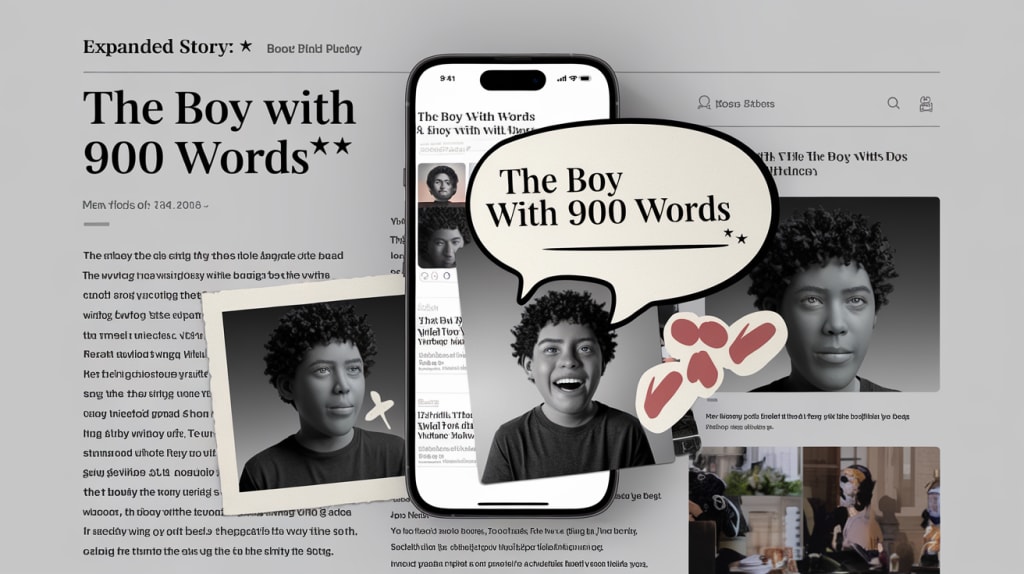
In a quiet village nestled between rolling hills and whispering pines, there lived a boy named Eli. When Eli was born, the village elders gathered at his cradle, their faces etched with unease. A peculiar enchantment had settled over him: he would speak only 900 words in his entire lifetime. Once those words were spent, his voice would vanish forever. The elders whispered of an ancient tale—a bard who’d angered a forest spirit, cursed to lose his voice after squandering his words on lies. But Eli’s parents, farmers with calloused hands and tender hearts, refused to call it a curse. “It’s a riddle,” his father said, “and riddles have answers.”
By age six, Eli had spoken just 87 words. Each one was deliberate, like a seed planted in fertile soil. His mother taught him to listen to the wind’s stories, and his father showed him how to read the language of the earth—cracks in drought-stricken soil, the blush of ripe apples. Eli learned to speak with his hands: a raised palm for wait , a finger to lips for listen, a fist over his heart for love. . Yet silence was a heavy cloak. When other children raced through meadows, shouting rhymes, Eli lingered at the edges, clutching his notebook. Inside, he kept a tally: 900 , crossed down to 813.
The village children puzzled over him. “Are you mute?” asked Freya, the blacksmith’s daughter, her braids singed at the tips from playing near the forge. Eli shook his head and showed her the notebook. She squinted at the numbers. “So you’re just… saving them?” He nodded. Freya shrugged. “Seems boring.” But she gifted him a charcoal pencil anyway, its tip sharpened to a needlepoint.
Eli’s parents worried in secret. “What if he needs to cry for help?” his mother fretted, kneading bread dough into tight, anxious knots. His father carved a wooden whistle and hung it around Eli’s neck. “Three short blows means danger,” he said. Eli hugged him, breathing in the scent of sawdust and sweat—a silent thank you .
One autumn, a troupe of traveling performers arrived in raucous wagons painted with stars and moons. Among them was Lila, a girl who danced on a tightrope strung between two oaks. Her laughter rang like wind chimes, and her stories—told through leaps and spins—captivated everyone. Eli watched her from the shadows, sketching her poses in his notebook.
Lila noticed him. “Why don’t you ever speak?” she asked one evening, cornering him by the bonfire.
Eli opened his notebook and wrote:
I have 900 words. When they’re gone, I’ll be silent forever.
Lila’s eyes widened. “That’s terrible!”
Eli shrugged and scribbled:
Or maybe it’s a gift. I think before I speak.
Lila tilted her head. “But what if you run out of words when you really need them?”
Eli didn’t answer. He hadn’t thought of that.
The troupe stayed for weeks, and Lila became Eli’s shadow. She taught him to juggle walnuts (“It’s all in the wrists!”) and decode the troupe’s secret signals: a flicked scarf meant follow me , a tilted hat meant danger . In return, Eli showed her his forest—the fox den hidden under roots, the creek where minnows darted like silver threads. They spoke in a patchwork of gestures and sketches, their friendship blooming in the quiet.
One afternoon, they found a wounded crow in a meadow. Lila scooped it up, her face fierce. “We have to help.” Eli hesitated. The bird’s wing hung crooked, and he knew what it needed: a splint, thread, stillness. But explaining this would cost words.
Instead, he gathered sticks and ripped a strip from his shirt. Lila watched, then nodded. Together, they mended the crow’s wing, their hands speaking louder than tongues. When the bird fluttered away, Lila grinned. “See? You didn’t need a single word.”
Eli’s tally remained 813 .
Weeks later, the troupe prepared to leave. On their final night, a storm raged. Lightning split the sky, striking an oak near Lila’s tightrope. Flames clawed the dry branches, and wind hurled embers toward the troupe’s tents. Panic erupted. Villagers scrambled to douse the fire, but the roar of wind and thunder drowned their shouts.
Eli froze. His parents were in the valley fetching water. Then he saw it—Lila’s younger brother, Milo, trapped inside a tent, his screams swallowed by chaos.
“HELP! HE’S STUCK!” Eli’s voice burst forth, raw and urgent—two words.
The crowd turned. Two men lunged toward the tent, yanking Milo to safety just as the canvas collapsed.
Lila rushed to Eli, tears streaking her sooty face. “You saved him!”
Eli nodded, clutching his throat. His notebook trembled: 900 - 2 = 898.
The village buzzed for days. “He gave his voice for a stranger,” the elders murmured, shamefaced. Freya brought him a honey cake, her usual smirk softened. “Guess you’re not boring after all.”
But Eli’s anxiety grew. What if I waste the rest? he wrote to Lila.
She replied by teaching him the troupe’s oldest art: silent stories . They crafted tales using only objects—a ribbon for a river, a pebble for a mountain, a sigh for the wind. Lila even wove a dance for Eli’s tally: 898 steps, each representing a word left unsaid. “Your voice isn’t just here,” she said, tapping his throat. “It’s in your hands. Your eyes. Your choices.”
Winter approached, and the troupe packed to leave. On their last morning, Lila found Eli at the forest’s edge, his breath fogging the air.
“Come with us,” she said. “You don’t need words to belong.”
Eli stared at his boots. He wanted to say yes . To say stay . To say friend . But the numbers loomed: 898*.
Instead, he reached into his pocket and gave her his notebook. On the last page, he’d drawn two figures: one dancing, one holding a tally that now read 899*.
Lila frowned. “You used another word? When?”
Eli smiled—then spoke his 900th word softly, like a secret:
“““““Enough.”.
Years later, villagers still tell of the boy who chose silence to keep his voice alive in other ways. Travelers speak of a troupe led by a dancer and a silent storyteller. They say Eli’s laughter is etched into Lila’s dances, his words blooming in the tales she spins. When audiences ask how a story without words can feel so alive, Lila winks. “Language isn’t just sounds. It’s the space between.”
And if you listen closely, you might hear Eli in the rustle of leaves or the crackle of a bonfire—a boy who learned that sometimes, the loudest truths are the ones we never say.
About the Creator
K. B.
Dedicated writer with a talent for crafting poetry, short stories, and articles, bringing ideas and emotions to life through words.



Comments
There are no comments for this story
Be the first to respond and start the conversation.