
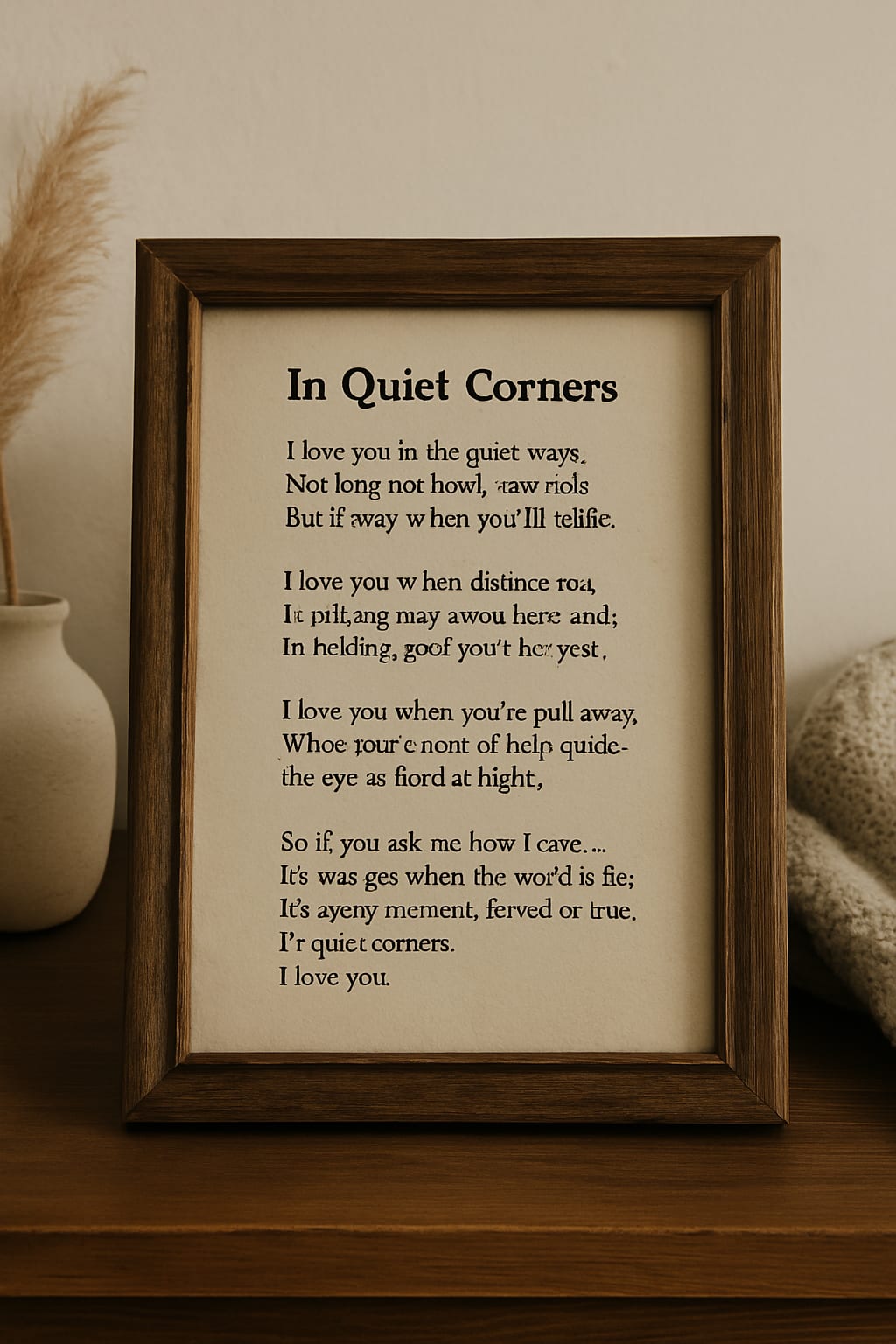
In Quiet Corners
The Silent Language of Deep, Steady Love

Introduction
Love is often portrayed as loud, dramatic, and full of passion. But what about the kind that whispers instead of roars? What about the love that stays, even in silence, even when it’s not easy?
“In Quiet Corners” is a poem that captures the essence of a kind of love that is patient, observant, and enduring. It’s about being there for someone even when they can’t express what they need—maybe especially then. Let’s walk through each stanza and uncover the tenderness hidden within these quiet lines.
Stanza 1
I love you in the quiet ways,
Not loud, not bold, not set ablaze—
But in the silent look I give
When you’re too tired to relive
The weight you carry in your chest,
The way you fall, then try your best.
This stanza introduces the central theme: love isn’t always loud.
The poet paints love as something soft-spoken and intuitive. It doesn’t demand attention—it notices exhaustion. The imagery here is incredibly intimate: “the silent look I give” speaks volumes when words fail. And there’s something deeply comforting in being seen when you’re too tired to explain yourself. This is love that honors vulnerability.
Stanza 2
I love you in the pauses too,
In coffee sips and skies turned blue,
In “take your time” and “I’ll be here,”
In holding space for every fear.
Here, we see that love lives in the ordinary moments—a sip of coffee, a quiet sky, a whispered reassurance.
This stanza captures the day-to-day texture of love: the calm, the constant presence. “Holding space” is a beautiful modern expression meaning to emotionally support someone without pressure or fixing. It’s about presence without demand. Love, in this stanza, is patient and grounded.
Stanza 3
I love you when you pull away,
And even more when you don’t say
The things you’re feeling, raw and deep—
I see them still. I help you keep
The part of you the world won’t see,
The soft, the scarred, the secretly free.
This is one of the most powerful parts of the poem.
Loving someone even when they pull away—that’s not easy. But this love doesn’t retreat. It understands the need for space. It doesn’t need declarations to feel real. The line “I help you keep the part of you the world won’t see” is particularly profound—it suggests a shared intimacy, a sanctuary for all the hidden, unpolished parts of someone’s soul. Love is not about changing someone. It’s about accepting them completely.
Stanza 4
I love you when you’re hard to hold,
When every word is sharp and cold—
Because I know beneath that fire,
Is someone tired of climbing higher.
Love isn’t blind.
This stanza addresses the hard moments—the arguments, the emotional distance, the sharp edges. But instead of walking away, the poet chooses to understand rather than react. Anger, here, is seen as a symptom of exhaustion, not cruelty. This kind of perspective requires emotional maturity. To look past the reaction and see the pain behind it—that is a rare, powerful love.
Final Stanza
So if you ask me how I care—
It’s not just when the world is fair.
It’s every moment, flawed or true,
In quiet corners,
I love you.
The closing stanza ties it all together.
Love isn’t conditional. It doesn’t depend on things being easy. This is unconditional love in its truest form: not perfect, not poetic in the grand sense, but real. It’s love that stays in the quiet corners of life—the overlooked, the tired, the broken, the peaceful. And in those places, it thrives.
Conclusion: The Beauty of Quiet Love
We often look for grand gestures to validate love. But “In Quiet Corners” teaches us that real love is often found in the overlooked moments:
- in small acts of kindness
- in unspoken understanding
- in patience when someone is hurting
- in stillness when they can’t even ask for help
This poem reminds us that love is not just what we say—it’s what we choose to be for someone else. Especially in the shadows, especially in the silences.
In a world that teaches us to shout, this kind of quiet love is revolutionary.
Show some love
subscribe and comment if you love my story so i will post more articles like this... Thank you
About the Creator
Keep reading
More stories from Muhammad Adil and writers in Poets and other communities.
The Geometry of Us (Explained)
Introduction Love is rarely simple. It doesn’t always follow clear rules, predictable paths, or soft conclusions. Sometimes, love resembles a complex equation—beautiful but unsolvable, sharp-edged but divine. That is the heart of the poem “The Geometry of Us”—an exploration of love not as a fleeting emotion, but as a force of nature: mathematical, chaotic, healing, and destructive all at once.
By Muhammad Adil11 months ago in Poets
Review of 'Man on the Run'
My wife and I saw Man on the Run, a nearly 2-hour documentary on Amazon Prime, about Wings, Paul McCartney's group that flew around the world from shortly after The Beatles broke up in early 1970 to shortly after John Lennon was murdered at the end of 1980, making a Beatles reunion forever impossible.
By Paul Levinson6 days ago in Beat




Comments (1)
good work