
Small Doors in Cassadaga
Where the moss keeps secrets, and tiny doors keep watch.
The forest is quiet the way a room becomes quiet
when someone says, Tell me the truth
and the air decides whether to behave.
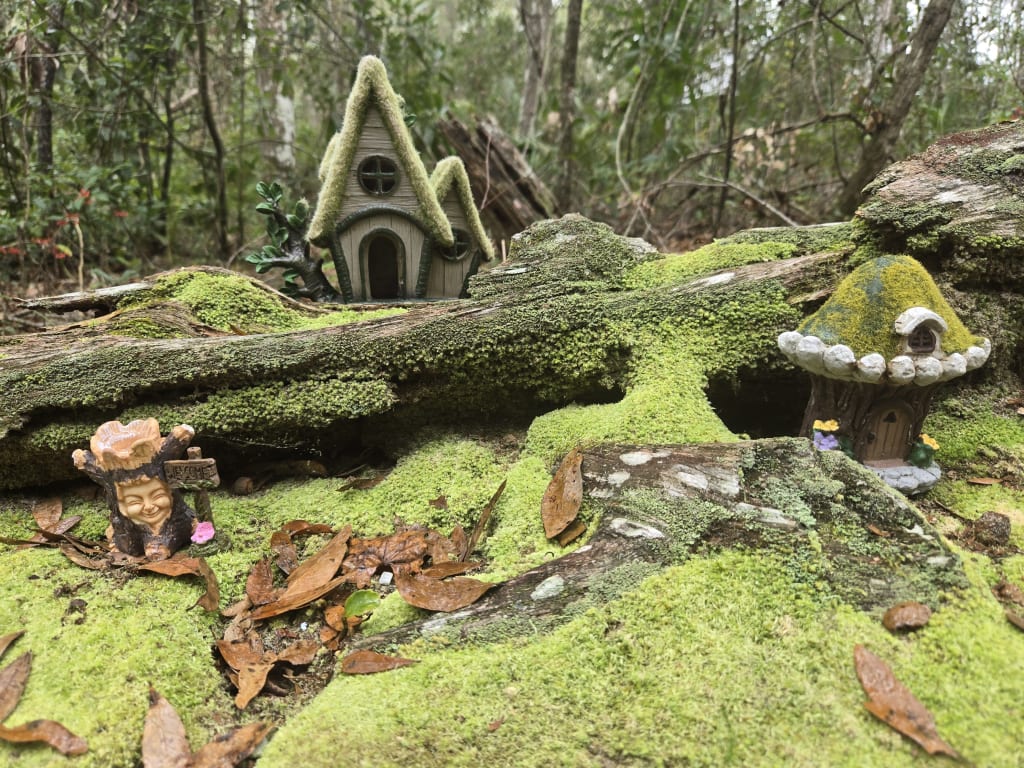
On a fallen log, the world shrinks itself politely,
turns bark into boulevard,
turns moss into an address you can kneel beside.
Two houses sit like thoughts you almost remember,
one with a steep green cap and a round window
that could be an eye
or a coin slot for prayers.
The other wears a roof the color of old lichen and gold,
a scalloped rim of white stones,
flowers placed near the door
as if beauty is a password.
And there, to the left,
a small face grinning from the undergrowth,
holding up a sign that reads WELCOME
like the woods are hosting something.
Cassadaga does that.
It makes hospitality out of mystery,
a place founded on the idea
that love doesn’t end
just because bodies do.
Not far from here the Camp learned to build permanence,
a community drafted in paperwork and belief,
a town where a temple keeps its calendar
like a lantern keeps its flame.
People come carrying grief like a closed umbrella.
People come carrying curiosity
like a flashlight with fresh batteries.
Some arrive with faith.
Some arrive with a practiced squint.
Some arrive with both,
and that is the most human luggage of all.
In Cassadaga, even skepticism is allowed a chair.
It can sit in the back row, arms folded,
and still hear the hymns.
The messages, when they come,
are never delivered with thunder.
They arrive the way this moss arrives,
slow and soft,
a green insistence on what can grow over what fell.
Still, the ground remembers the heavy parts.
Not every story here is candlelit comfort.
Some are written in police ink,
names kept in files,
a house that went quiet too suddenly,
a year that won’t stop echoing.
Some are written in absence,
a mother-shaped gap in the timeline,
a child found where the woods
pretend not to know anything.
Cassadaga holds those truths, too,
not as spectacle,
but as weight.
And because people are people,
there are those who sell the ache back to you,
who lean into your sorrow like a cash register,
who say your fear has a price tag
and your relief costs extra.
So the town learns boundaries the hard way.
Ethics become more than a word on a brochure.
Belief becomes something you practice
with your eyes open.
That’s what these tiny houses feel like,
not just fairy charm,
but a lesson in scale.
A reminder that the unseen should not be worshiped blindly,
only listened to carefully,
the way you listen at a door
before you decide to knock.
Because sometimes the miracle is simple:
A stranger hands you a tissue.
A room full of quiet people breathes together.
A sentence lands in your chest
and loosens a knot you’ve carried for years.
And sometimes the miracle is smaller still:
Someone built a miniature welcome
and tucked it into a mossy crease of the world
as if to say,
There are places for tenderness, even here.
I think that’s Cassadaga’s true haunting.
Not ghosts in the wallpaper,
not footsteps on a hotel stair,
not a legend perched on a cemetery chair,
but the way the air keeps asking
the same gentle question
over and over,
soft as leaves falling onto green,
What do you want to do with the part of you
that still reaches?
The little doors do not answer.
They simply stay.
Waiting.
Welcoming.
And the moss, patient librarian of fallen things,
keeps the minutes
without ever insisting it can predict the ending.
About the Creator
LaRae Pynas
Hello, and welcome. I am LaRae Pynas. I am aspiring to become a published author and poet. I write children's, sci-fi, fantasy, young adult, psychological thrillers/fantasies, short stories, poetry, etc.
Keep reading
More stories from LaRae Pynas and writers in Poets and other communities.
A Knight of the Seven Kingdoms Series Review (Season 1)
As one of the biggest properties in fantasy, A Song of Ice and Fire remains immensely popular with audiences. After reaching far into the past with House of the Dragon, a second spin-off was on the cards. A Knight of the Seven Kingdoms serves up a bite-sized slice of action and drama, but it still claims a spot among the best small-screen titles.
By Robert Cain6 days ago in Geeks




Comments
There are no comments for this story
Be the first to respond and start the conversation.