

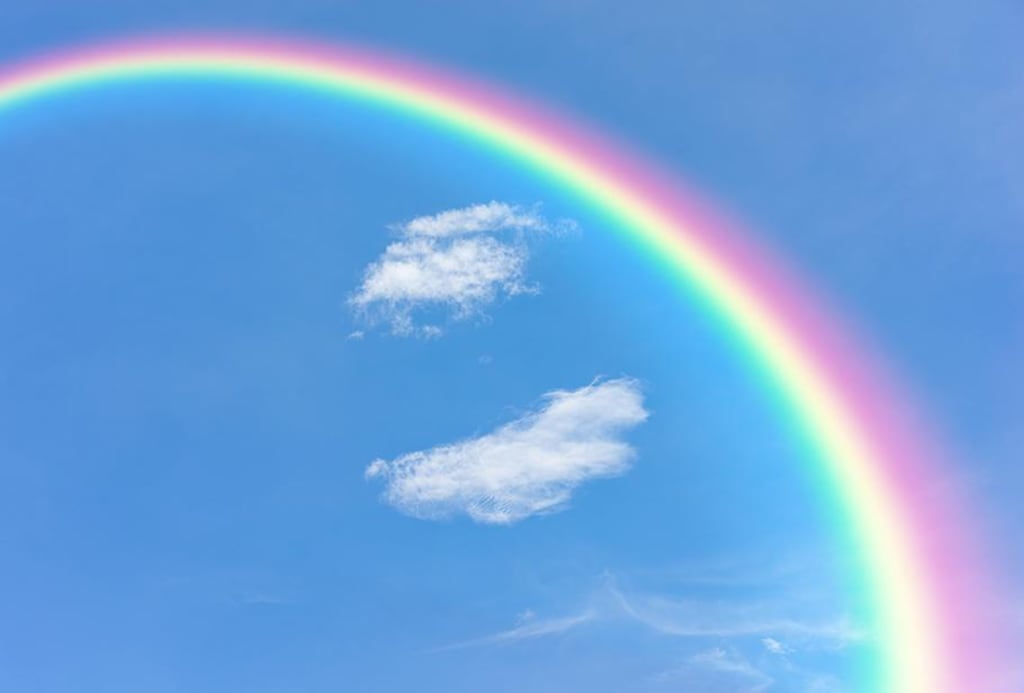
A rainbow is a meteorological phenomenon that occurs when sunlight is refracted, reflected, and dispersed through water droplets in the atmosphere. When the light hits the water droplets, it separates into its individual colors, which creates the recognizable arc of colors we call a rainbow. The colors of a rainbow, in order from the outer edge to the inner edge, are red, orange, yellow, green, blue, indigo, and violet. Rainbows can be seen in the sky opposite the sun, often after a rain shower or when water droplets are present in the air.
Rainbows are created when the light from the sun enters a raindrop and is refracted or bent, causing the different colors of the spectrum to separate and become visible. The angle at which the light enters and exits the raindrop determines the position of the rainbow in the sky. The red light is refracted the least, and the violet light is refracted the most, creating the distinctive arc of colors.
In addition to the traditional rainbow, there are also double rainbows, which occur when the light is reflected twice inside the raindrop, creating a secondary arc of colors above the primary rainbow. The colors of the secondary rainbow are in reverse order compared to the primary rainbow.
Rainbows have been the subject of many myths and legends throughout history, and they continue to hold a special fascination for people today. They are often associated with hope, promise, and good luck. Rainbows can also be seen in places other than the sky, such as in waterfalls or fountains where water droplets are present, and even in certain crystals and prisms.
Rainbows can also appear in different shapes and forms. Some rainbows appear as circular or even elliptical, but these are much rarer than the traditional arc-shaped rainbow. A circumzenithal arc is a rainbow that appears as an upside-down smile in the sky, and it is caused by the same refraction and reflection of sunlight through ice crystals instead of raindrops. Another type of rainbow is a fogbow, which is a fainter version of a rainbow that appears in fog rather than rain.
Rainbows have also inspired art, literature, and music. They have been used as symbols of diversity, unity, and inclusiveness. The rainbow flag, for example, is a symbol of the LGBTQ+ community and has become a powerful symbol of equality and acceptance.
Finally, there are many cultural and religious beliefs associated with rainbows. In many cultures, rainbows are seen as a bridge between the physical and spiritual worlds, and they are associated with divinity, peace, and harmony. The Bible, for example, describes the rainbow as a sign of God's promise to never again flood the earth. In Hinduism, rainbows are associated with the god Indra, who is said to use them as his bow.
About the Creator
How to Succeed at the Benson Directory®
Congratulations and welcome to the Benson Directory® employee #22391! As our newest call handler, you will have the privilege of speaking with dozens of unique and interesting people on a daily basis as well as the opportunity to earn bonuses for high performance. Contained within this handbook you will find a set of ease to follow instructions designed to help you settle in to your new role and begin paving the way to success.
By S. A. Crawford3 days ago in Fiction




Comments
There are no comments for this story
Be the first to respond and start the conversation.