

Words That Fight Back
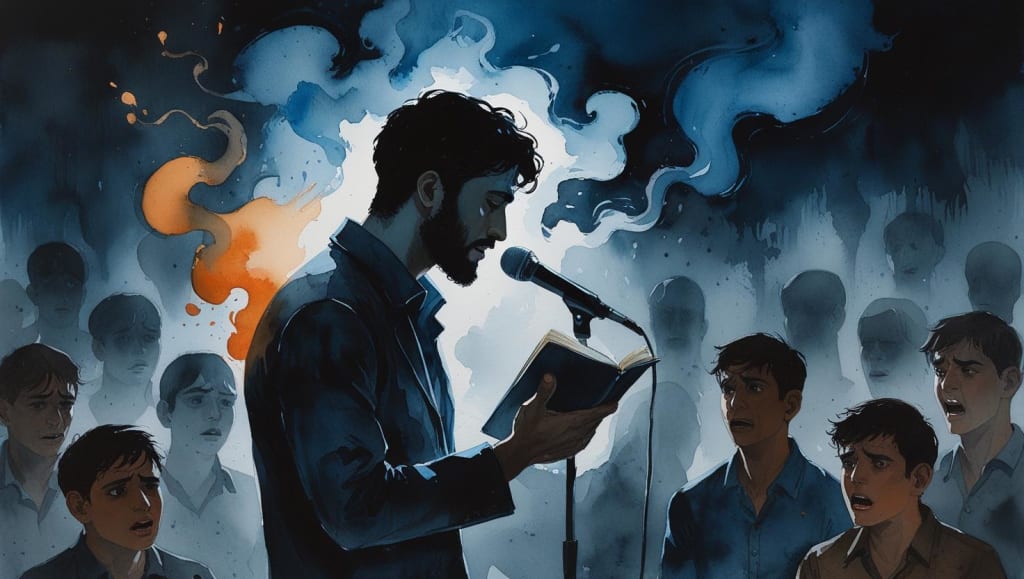
Last night, I heard a poem that cracked me open. It was read at a small rally in Lisbon, scrawled on a napkin by a poet named Yulu Ewis, a contributor to Salt in the Wound. Her voice trembled over the megaphone, reciting lines about a river choked with ash, a mother’s hands searching rubble. The crowd was silent, some weeping, others clenching fists. Her words weren’t just art—they were a weapon, sharp and unyielding, cutting through the numbness of a world that too often looks away. In Salt in the Wound, a zine collecting raw dispatches from crisis zones, protest poetry like Yulu’s is a battle cry, humanizing suffering and defying oppression. This is the story of how poets wield words to fight back.
The Blade of Poetry
Poetry has always been a weapon. From Pablo Neruda’s verses smuggled during Chile’s dictatorship to Mahmoud Darwish’s odes to Palestinian resilience, poets have long turned language into resistance. In Salt in the Wound, this tradition burns fiercely. The zine’s pages overflow with poems from places like Gaza, Myanmar, and Haiti—words scratched on scraps, whispered in blackouts, or shouted at barricades. These aren’t polished sonnets for literary journals; they’re jagged, urgent, stained with sweat and grief.
What makes poetry so dangerous? It’s not just words—it’s alchemy. A poem distills pain into something sharp enough to pierce apathy. It humanizes the dehumanized, forcing us to see the faces behind headlines. “Poetry makes you feel the weight,” says kp Rose, a poet from Myanmar whose work appears in Salt in the Wound. Their poem, “Monsoon of Bullets,” describes a protest crushed by junta forces: *“Rain falls, / boots crack bones, / my sister’s scream / a kite cut loose.” In sixteen words, kp Rose captures a massacre’s horror and a survivor’s defiance.
I reached kp Rose via encrypted email. They’re in hiding, moving between safe houses after their poetry drew junta threats. “Words are my only weapon,” they wrote. “I can’t hold a gun, but I can make people remember.” Their poems, shared in Salt in the Wound, have been read at exiled Burmese rallies in Thailand, their lines chanted like mantras. Poetry, for kp Rose, is both shield and sword—a way to survive and to strike back.
Voices from the Edge
Salt in the Wound is a mosaic of such voices. Yulu Ewis, a Mapuche poet from Chile, writes in a mix of Spanish and Mapudungun, her indigenous language. Her poem “River of Ash” mourns land stolen by corporations: *“The river forgets its name / but not its rage, / it carries our bones / to the sea’s throat.” Yulu read it at a 2024 land rights protest in Santiago, her voice steady despite tear gas. “Poetry is our memory,” she told me over a crackling Zoom call. “It keeps our fight alive when they try to erase us.”
In Gaza, a poet named Amina—whose work I’ve read in previous Salt in the Wound issues—writes during power cuts, her phone’s glow her only light. Her poem “Olive Grove” is a gut-punch: *“Roots drink blood, / still they grow, / my child’s hand / holds their shadow.” Amina’s poems, smuggled out via encrypted apps, have been recited at solidarity vigils in Amman and London. “I write to prove I’m not a ghost,” she told me once. Her words, raw and unpolished, carry the weight of a people refusing to vanish.
These poets don’t write for fame. Many, like kp Rose and Amina, use pseudonyms, their lives at risk. Others, like Yulu, face harassment or arrest. Yet they keep writing, because poetry is a refusal to be silenced. It’s a way to claim agency when everything else—land, safety, loved ones—has been stolen. “A poem is a seed,” Yulu said. “Plant it, and it grows in someone else’s heart.”
Poetry in Action
Protest poetry doesn’t just live on the page—it’s performed, shared, weaponized. At rallies, poets like Yulu become catalysts, their words sparking chants or sit-ins. In Myanmar, kp Rose’s poems are photocopied into zines like Salt in the Wound and passed at secret meetings. “I heard my poem read in Bangkok,” they said. “It felt like my voice crossed borders I can’t.” In Haiti, a poet named Marie, another Salt in the Wound contributor, reads her work at open mics in Port-au-Prince, her lines about hunger and resistance drowned out by distant gunfire. Her poem “Bread and Barricades” ends: *“My stomach growls, / but my tongue roars.”
These readings are acts of courage. In authoritarian regimes, a poem can be a death sentence. Marie told me she memorizes her work, burning drafts to avoid police raids. In Gaza, Amina recites her poems to neighbors in shelters, their whispers a quiet rebellion against the drone’s hum. “When we share poetry, we’re saying we’re still human,” she said. These moments—fleeting, fragile—build solidarity, reminding people they’re not alone.
Poetry also crosses borders. Salt in the Wound is distributed globally, its poems translated into Arabic, Spanish, Burmese, and more. Amina’s “Olive Grove” was read at a New York vigil, moving strangers to tears. Yulu’s “River of Ash” inspired a mural in Berlin. kp Rose’s work sparked a fundraiser for Burmese exiles. “I didn’t expect that,” kp Rose admitted. “I just wanted to scream. But now my scream’s echoing.” Poetry, in Salt in the Wound, becomes a global thread, linking struggles and amplifying voices.
The Power to Break and Heal
Why does poetry matter in a world of bombs and hunger? I’ve wrestled with this, my heart heavy from Yulu’s words, Amina’s grief, kp Rose’s rage. Poetry doesn’t stop bullets or feed the starving. Yet it does something else—it humanizes. It forces us to feel the cost of oppression, to see the child’s shoe in the rubble, the sister’s scream in the rain. It breaks our hearts open, and in that breaking, we find resolve.
Poet Audre Lorde once wrote, “Poetry is not a luxury. It is a vital necessity of our existence.” For the poets of Salt in the Wound, this is literal. Writing is how they survive, how they resist, how they dream. “I write to keep from hating,” Amina said. “To keep from disappearing.” Her poems, like Yulu’s and kp Rose’s, are acts of defiance, proof that beauty can grow in the darkest cracks.
Poetry also heals—not by erasing pain, but by naming it. At that Lisbon rally, Yulu’s poem didn’t end the crowd’s grief, but it gave it shape, a shared language. “When I read, I see people’s faces change,” she said. “They cry, they nod, they stand taller.” Poetry builds bridges between isolated souls, reminding us we’re not alone in our fight.
Words That Won’t Die
As I write this, I’m still reeling from Yulu’s poem, its words swirling like smoke in my mind. Salt in the Wound is full of such poems—raw, jagged, alive. They’re not just words; they’re weapons, wielded by poets who refuse to be erased. From Amina’s Gaza shelter to kp Rose’s hidden safe house, from Yulu’s Santiago streets to Marie’s Port-au-Prince stage, these voices demand we listen.
Poetry as a weapon doesn’t always win battles, but it wins something else: memory. It ensures the oppressed are not forgotten, their pain not reduced to statistics. It plants seeds of resistance, growing in hearts across borders. These poets, with their crumpled notebooks and trembling voices, are warriors. Their words break us, heal us, and call us to fight.
About the Creator
Shohel Rana
As a professional article writer for Vocal Media, I craft engaging, high-quality content tailored to diverse audiences. My expertise ensures well-researched, compelling articles that inform, inspire, and captivate readers effectively.
Keep reading
More stories from Shohel Rana and writers in Poets and other communities.
The Zine Rebellion
Why DIY Art Still Matters I found my first zine in the summer of 2020, tucked under a pile of flyers at a protest in Brooklyn. It was a stapled stack of photocopied pages, rough-edged and smudged, screaming with hand-drawn skulls and furious poetry about police brutality. It wasn’t polished or pretty, but it hit like a fist. That zine—called No Quiet Surrender—felt alive, a piece of someone’s soul pressed into my hands. In a world drowned by algorithms and corporate noise, zines like Salt in the Wound are making a comeback, raw and unfiltered, giving voice to those the mainstream ignores. They’re not just art—they’re acts of rebellion, proof that DIY culture still burns bright.
By Shohel Rana7 months ago in Poets




Comments
There are no comments for this story
Be the first to respond and start the conversation.