
Poetess
Reveal thyself

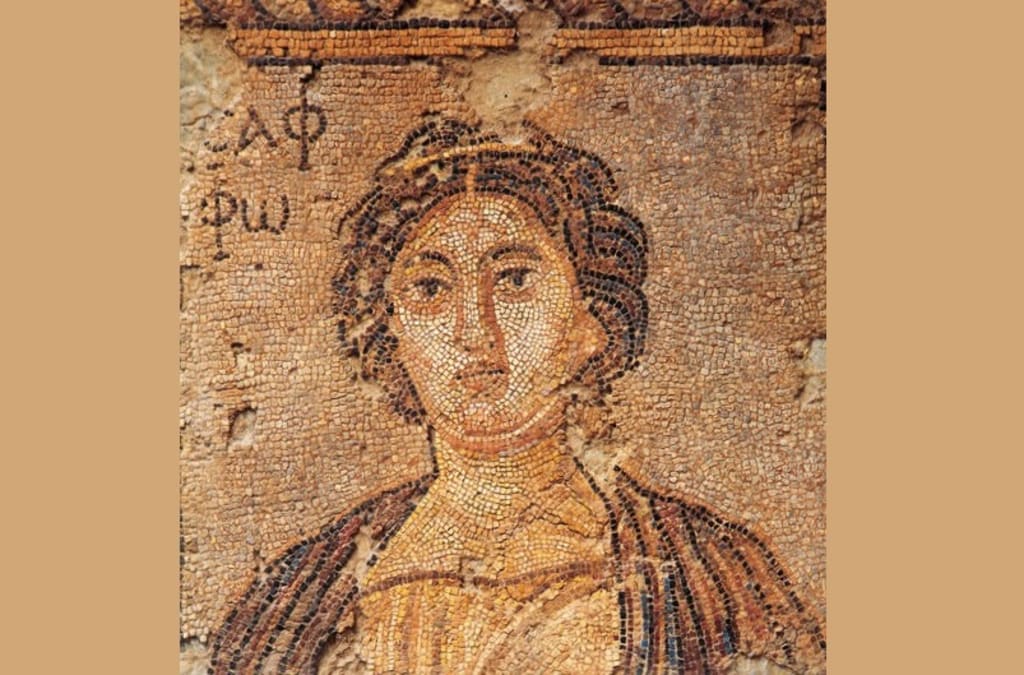
Little is known of the poetess, Sappho. No, let me try again. Little is known of THE POETESS (Sappho). By "The Poetess" I am referring to the ancient Greek poet from Eresos or Mytilene on the island of Lesbos. She was known, at that time in history and for centuries after, for her lyric poetry, written to be sung accompanied by music. I emphasize "The Poetess" because she was referred to as such by classic scholars of ancient Greece and Rome, in much the same way that Shakespeare is often referred to as The Bard. Although there is an argument that Robert Burns also deserves the title and may have been known as The Bard before the title was attributed to Shakespeare.
Featured image: Roman-era mosaic from Sparta, depicting the poet Sappho, as identified in Greek lettering (Σαφφω) to the left of the head. This and all other images via Wikimedia Commons.
Though little factual knowledge, there is much speculation. For a history of the different theories about Sappho, I would suggest you check out the entry in Wikipedia, which is where most of the factual information in this article comes from.
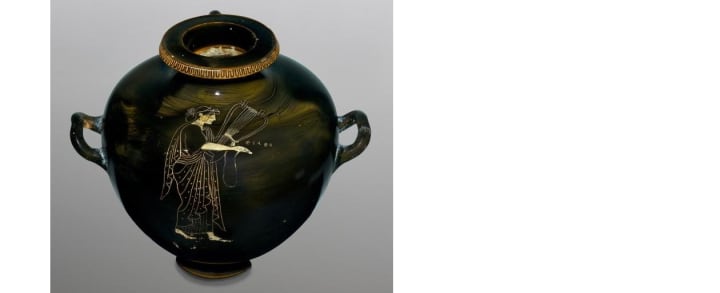
Sappho playing a lyre, from around 510 BCE. National Museum, Warsaw via Wikimedia Commons
You may know that Sappho has long been considered the ‘original’ Lesbian, her place of birth being the Greek island of Lesbos. It is by no means certain if she was a lesbian, in the modern sense of the world. Though it was quite likely that she loved women. Her time was, after all, long before Christian morality descended upon the world. In such times, same-sex relationships were not considered remarkable and homosexuality was not proscribed by law in the way that it was in the 19th and 20th centuries. It is of course still forbidden in some cultures.
Sapphic: A literary term meaning love between women, sometimes a euphemism for lesbianism. Can also mean the four line poetic form identified with Sappho
Does it matter whether Sappho was a lesbian or not? I would suggest not because her story will always be identified with love between women. Her love poems will always reflect the most profound expression of love in a way that has strong resonance to any reader, this one included. Sappho's work also speaks of the universality of love. A celebration of the modern thought that: Love is love.
Most of Sappho's literary works have sadly been lost to time. Some are retained only in fragments.
- And then Love shook my heart,
- like the wind on the mountain,
- troubling the oak-trees.
I can think of no better description of the sudden realisation of love for another person than as described in the above verse, even though something of the feeling may have been lost in translation.
One could almost describe Sappho as a goddess of love. Why not? She has been depicted in artistic references hand in hand with Eros, Greek god of love. Her words are associated with Aphrodite, goddess of love. In the Roman Catholic sect of the Christian faith, a person can be 'canonized', declared a saint, a person who intercedes with God on behalf of mortals. Why not declare Sappho to be a saint or goddess of love and of lesbians?
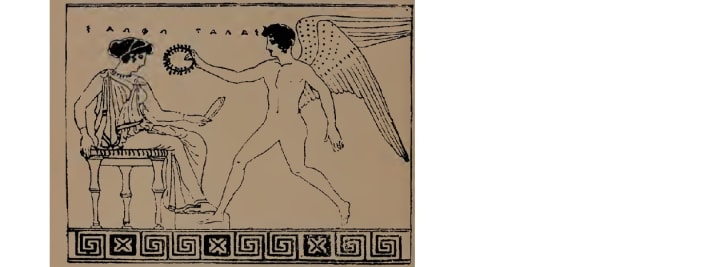
But you, O Dika, wreathe lovely garlands
But you, O Dika, wreathe lovely garlands in your hair, Weave shoots of dill together, with slender hands, For the Graces prefer those who are wearing flowers, And turn away from those who go uncrowned.
These excerpts and more Sapphic verse may be found at: poetryintranslation.com
I have a daughter, golden
- I have a daughter, golden,
- Beautiful, like a flower
- Kleis, my love
- And I would not exchange her for
- All the riches of Lydia……
Should reference to "a daughter" be taken literally, or could it be a figurative reference to a younger women loved by Sappho?
Love is love
- Like the sweet-apple reddening high on the branch,
- High on the highest, the apple-pickers forgot,
- Or not forgotten, but one they couldn’t reach…
Thanks for reading
About the Creator
Raymond G. Taylor
Author living in Kent, England. Writer of short stories and poems in a wide range of genres, forms and styles. A non-fiction writer for 40+ years. Subjects include art, history, science, business, law, and the human condition.
Keep reading
More stories from Raymond G. Taylor and writers in Poets and other communities.


Comments (6)
This is fantastic - Sappho is such a fascinating figure, yet her remaining works often don't get the attention and love they deserve (in my opinion). Thank you for sharing this :D
This was very educational, thanks Raymond 😊
I've heard of the term sapphic but never knew anything about Sappho. Thank you so much for sharing this!
Wonderful
Wonderful! Heartbreakingly beautiful poetry! Thanks for sharing this, Ray!
Great lecture on Sappho. I remember studying some of her poems for a Humanities course (Western Civ) in college.