
Poet Emotions
When Words Become Feelings and Feelings Turn Into Art
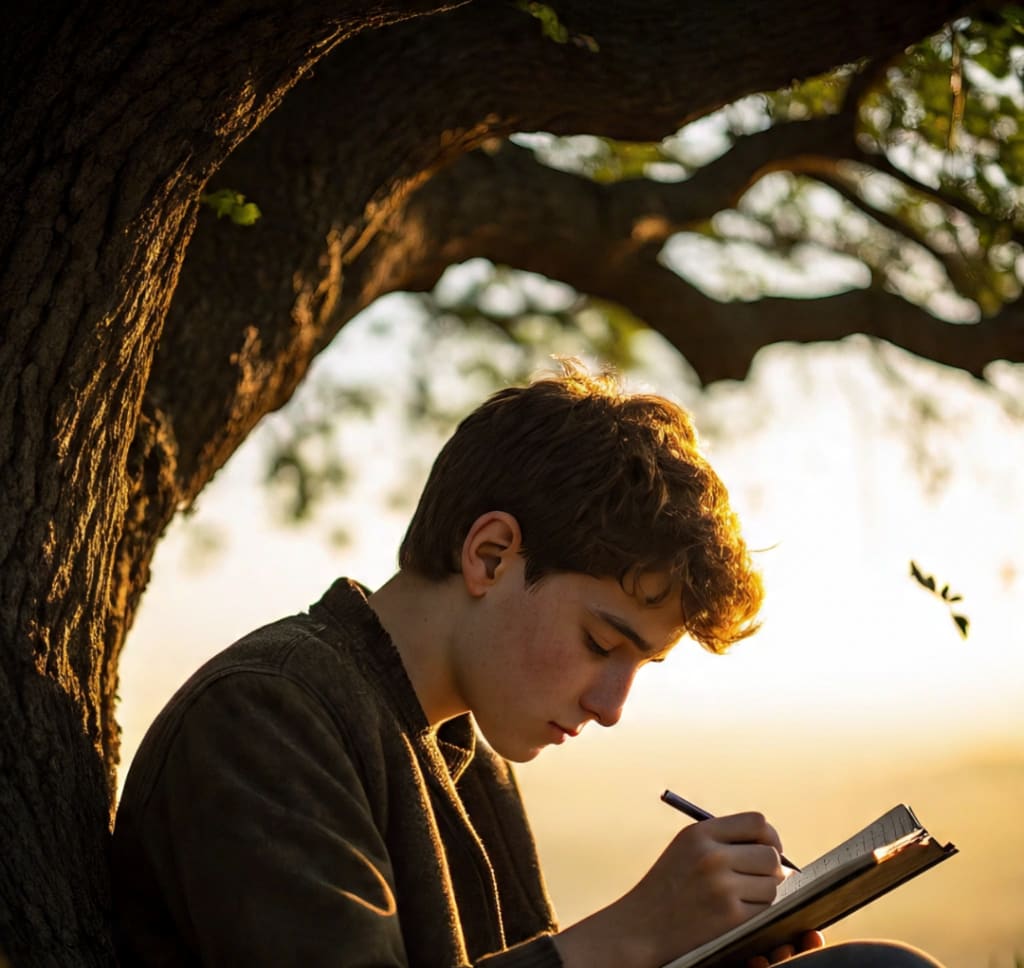
The evening sky was painted in gentle shades of orange and gold as Arham sat beneath the old banyan tree in his backyard. A notebook rested on his knees, and his pen tapped lightly against its corner. The world around him was calm, yet his mind swirled with a thousand thoughts — emotions he couldn’t explain, but always tried to write down.
He was a boy of few words, not because he didn’t have thoughts, but because he felt them too deeply. Every emotion — joy, sorrow, wonder, or pain — echoed louder inside his heart than it did in the outside world. And so, he found refuge in poetry. It was his way of turning chaos into calm, and silence into expression.
That day, as a light breeze passed through the leaves, he began to write:
“Some hearts don’t speak in sound,
They whisper in verses, soft and profound.”
Arham smiled faintly. Poetry wasn’t something he planned; it was something that happened to him. It came from somewhere deep — like a spring of emotion hidden beneath his soul. When others talked about their day, he wrote about the sunlight dancing through the window, or the rain that carried memories.
For him, words were not just letters; they were feelings wearing clothes.
He remembered how his teacher once asked the class to describe happiness. Some said it was ice cream on a hot day, others said it was winning a game. When his turn came, Arham had quietly said, “Happiness is when your heart smiles even before your lips do.” The whole class had fallen silent. That was the moment he realized — emotions had their own language, and poetry was his way of speaking it.
At home, his parents often found him lost in thought, staring at a blank page. They wondered if something was wrong. But Arham wasn’t sad — he was listening to his own heartbeats, waiting for them to turn into rhythm and rhyme.
One rainy afternoon, as he wrote near the window, his younger brother peeked in. “Why do you always write alone?” he asked curiously.
Arham smiled. “Because when I write, I meet myself.”
The boy didn’t understand then, but Arham knew — poetry was his mirror. It showed him what words couldn’t say out loud.
Sometimes, when he felt lonely, he wrote about hope — not the loud kind, but the quiet kind that keeps you going. He believed every emotion had a voice; it just needed the courage to speak. And poetry was that courage.
One day, his English teacher announced a poetry contest. Arham hesitated at first — he never wrote for praise, only for peace. But that night, he looked at the blank page and decided to share a piece of his soul. He wrote a poem titled “The Silent Voice.”
When the results came, Arham didn’t expect anything. But when his name was called as the winner, the applause felt like music. For the first time, he realized that when feelings are pure, they reach hearts beyond words.
That evening, standing on the stage, he said softly,
“I never thought my emotions could speak for me. But now I know — poetry isn’t about writing; it’s about feeling. Every word I write carries a heartbeat.”
From that day, Arham continued to write — not just for himself, but for everyone who ever felt something too deep to explain. His poems began to appear in school magazines and local journals, each line filled with honesty and warmth.
He learned that emotions are not weaknesses; they are colors of the soul. Some people paint, others sing, and some — like him — write.
And every time he looked at his notebook, he smiled, knowing that poetry wasn’t simply about words. It was about turning feelings into art — capturing the invisible and making it eternal.
Because in the end, Arham believed one truth above all:
A poet doesn’t create emotions. He only reveals the ones that were already there — waiting to be understood.
About the Creator
Keep reading
More stories from Muhammad Saad and writers in Poets and other communities.
The Poet of Nature
In every era, there has been one soul who listens not only to people but to the whispers of the earth itself. The Poet of Nature is such a soul — one who finds poetry not in grand halls or crowded cities, but in the rustle of leaves, the rhythm of rain, and the golden glow of dawn. This story celebrates the life and spirit of those poets who transform nature’s silence into eternal music through their words. On the edge of a quiet lake, surrounded by emerald hills and the perfume of wildflowers, sat Elias, a poet who believed that the truest language on earth was not spoken — it was felt. Every morning, he walked barefoot across the dew-soaked grass, greeting the day as if it were a dear friend. His notebook was never empty for long, for even the simplest scene — a bird diving into water, a breeze dancing through branches — became a living verse in his mind. Elias often said, “Nature never hurries, yet she completes everything in time. A poet must do the same.” His belief was that poetry is not about words alone, but about connection — the invisible thread that binds human hearts to the pulse of the world around them. To him, a single petal carried more meaning than a library of unfeeling lines. He was deeply inspired by great poets like William Wordsworth, Robert Frost, and Emily Dickinson, who each in their own way turned landscapes into lessons. Wordsworth saw nature as a teacher of peace and wisdom, Frost found life’s choices mirrored in woods and paths, while Dickinson felt the divine presence in every flower and breeze. Elias studied them not to imitate, but to understand how nature could speak through human expression. As he wrote, Elias realized that the beauty of the natural world lay in its balance — its quiet power, its patience, its endless renewal. He noticed how the river never resisted the rocks but flowed around them, teaching him to move through life’s obstacles with grace. He watched the sun disappear every evening, only to rise again with unwavering certainty, and learned that endings are often beginnings in disguise. One afternoon, a young student named Lila found him sitting under the old oak tree. She had read his poems in a local magazine and wanted to know how he wrote them. “Do you sit here waiting for words to come?” she asked. Elias smiled gently. “No, child. I don’t wait for words — I wait for silence. When the world grows quiet enough, nature begins to speak.” He taught her to listen — not just with her ears, but with her soul. To notice the way sunlight painted the surface of water, how every shade of green had its own emotion, and how the wind carried stories older than time. Through him, Lila discovered that poetry is not invented; it is revealed — waiting patiently within the folds of nature. As years passed, Elias’s health began to fade, but his passion never did. Even when he could no longer walk to the lake, he sat by his window, writing about the clouds, the scent of rain, and the song of crickets at night. His final collection, Whispers of the Earth, was published shortly before his passing. Each poem was a mirror of his spirit — calm, eternal, and deeply connected to the world he so loved. Readers who opened his book found more than verses; they found peace. His words reminded them that nature is not something outside us — it lives within us. Every heartbeat, every breath, every tear is part of the same rhythm that moves the oceans and sways the forests. Today, when people visit the lakeside where Elias once wrote, they say they can still feel his presence in the air — in the flutter of a bird’s wing, in the ripple of water, in the hush before sunset. It is as if the Poet of Nature never truly left; he simply became one with the very poetry he spent his life writing. And perhaps that is the truest destiny of every poet of nature — to let their words dissolve into the world they loved, leaving behind not just poems, but a legacy of harmony between the human heart and the living earth.
By Muhammad Saad 4 months ago in Poets



Comments
There are no comments for this story
Be the first to respond and start the conversation.