
The Poet of Nature
Where Words Bloom Like Flowers and Verses Whisper with the Wind
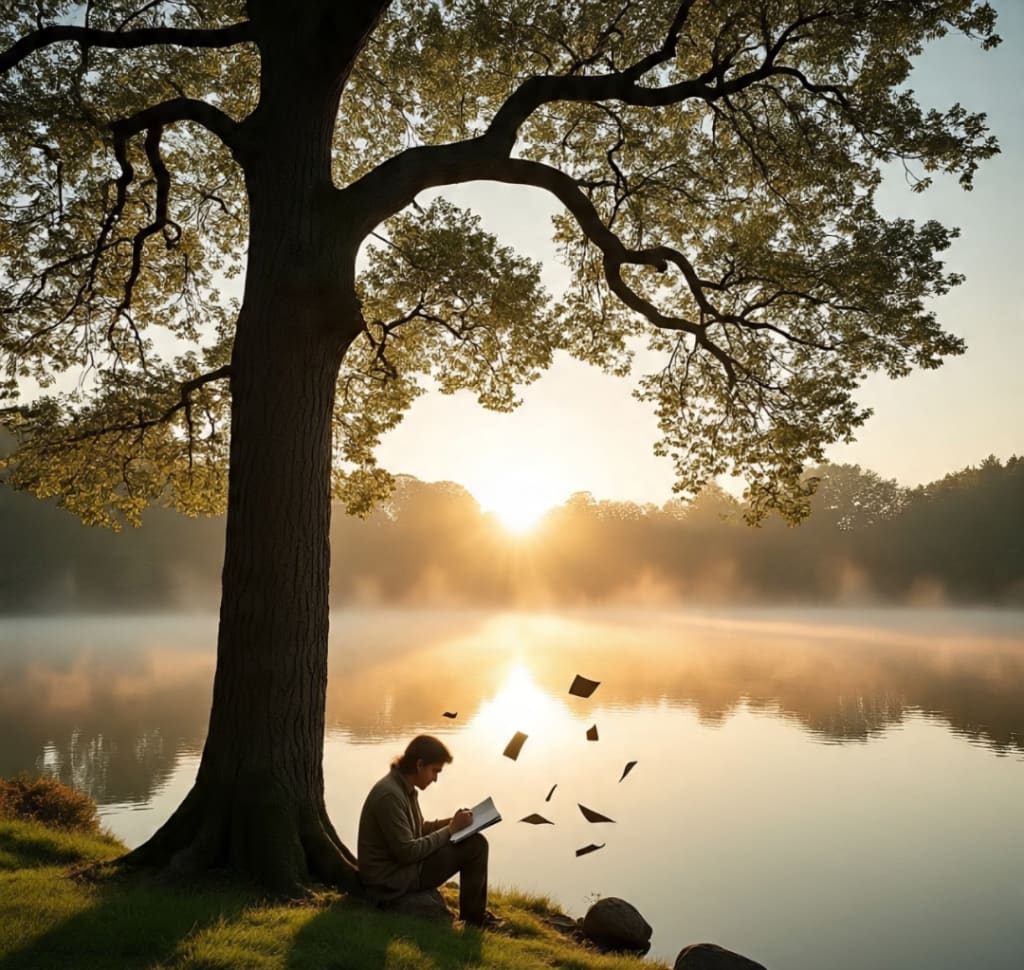
In every era, there has been one soul who listens not only to people but to the whispers of the earth itself. The Poet of Nature is such a soul — one who finds poetry not in grand halls or crowded cities, but in the rustle of leaves, the rhythm of rain, and the golden glow of dawn. This story celebrates the life and spirit of those poets who transform nature’s silence into eternal music through their words.
On the edge of a quiet lake, surrounded by emerald hills and the perfume of wildflowers, sat Elias, a poet who believed that the truest language on earth was not spoken — it was felt. Every morning, he walked barefoot across the dew-soaked grass, greeting the day as if it were a dear friend. His notebook was never empty for long, for even the simplest scene — a bird diving into water, a breeze dancing through branches — became a living verse in his mind.
Elias often said, “Nature never hurries, yet she completes everything in time. A poet must do the same.” His belief was that poetry is not about words alone, but about connection — the invisible thread that binds human hearts to the pulse of the world around them. To him, a single petal carried more meaning than a library of unfeeling lines.
He was deeply inspired by great poets like William Wordsworth, Robert Frost, and Emily Dickinson, who each in their own way turned landscapes into lessons. Wordsworth saw nature as a teacher of peace and wisdom, Frost found life’s choices mirrored in woods and paths, while Dickinson felt the divine presence in every flower and breeze. Elias studied them not to imitate, but to understand how nature could speak through human expression.
As he wrote, Elias realized that the beauty of the natural world lay in its balance — its quiet power, its patience, its endless renewal. He noticed how the river never resisted the rocks but flowed around them, teaching him to move through life’s obstacles with grace. He watched the sun disappear every evening, only to rise again with unwavering certainty, and learned that endings are often beginnings in disguise.
One afternoon, a young student named Lila found him sitting under the old oak tree. She had read his poems in a local magazine and wanted to know how he wrote them.
“Do you sit here waiting for words to come?” she asked.
Elias smiled gently. “No, child. I don’t wait for words — I wait for silence. When the world grows quiet enough, nature begins to speak.”
He taught her to listen — not just with her ears, but with her soul. To notice the way sunlight painted the surface of water, how every shade of green had its own emotion, and how the wind carried stories older than time. Through him, Lila discovered that poetry is not invented; it is revealed — waiting patiently within the folds of nature.
As years passed, Elias’s health began to fade, but his passion never did. Even when he could no longer walk to the lake, he sat by his window, writing about the clouds, the scent of rain, and the song of crickets at night. His final collection, Whispers of the Earth, was published shortly before his passing. Each poem was a mirror of his spirit — calm, eternal, and deeply connected to the world he so loved.
Readers who opened his book found more than verses; they found peace. His words reminded them that nature is not something outside us — it lives within us. Every heartbeat, every breath, every tear is part of the same rhythm that moves the oceans and sways the forests.
Today, when people visit the lakeside where Elias once wrote, they say they can still feel his presence in the air — in the flutter of a bird’s wing, in the ripple of water, in the hush before sunset. It is as if the Poet of Nature never truly left; he simply became one with the very poetry he spent his life writing.
And perhaps that is the truest destiny of every poet of nature — to let their words dissolve into the world they loved, leaving behind not just poems, but a legacy of harmony between the human heart and the living earth.
About the Creator
Keep reading
More stories from Muhammad Saad and writers in Poets and other communities.
Poetry at Noon
The afternoon sun had reached its gentle peak, filling the world with a mellow golden glow. The town seemed to breathe slower at this hour, as if even time paused to rest in the warmth. For Alina, it was the perfect moment—the sacred hour of stillness she called poetry at noon. Every day, after the morning’s rush of work and noise, she would retreat to the small park near her home. It wasn’t grand or famous—just a patch of green surrounded by old trees, a stone bench, and a tiny pond where dragonflies danced above the water. But to Alina, it was a haven of quiet inspiration. She carried with her a brown leather notebook, worn at the edges, and a pen that had outlived countless refills of ink. She sat beneath her favorite oak tree, feeling the sunlight spill over her shoulders. The hum of the world around her faded as her thoughts began to take shape. Words came to her not like commands, but like whispers—gentle, inviting, alive. “At noon, the sun writes on the skin of the world,” she wrote, smiling softly. She paused, letting the breeze turn a page for her. A group of children played nearby, their laughter blending with the soft rustling of leaves. Every sound seemed to belong in her poem, as though the afternoon itself was collaborating with her. Writing had always been Alina’s escape and her connection. Through poetry, she found a way to express feelings that speech often failed to hold—grief, hope, wonder, and love. Years ago, after her father passed away, it was poetry that helped her rediscover joy. He had been the one who introduced her to it, often reading lines aloud from his favorite poets as sunlight filtered through their kitchen window. “Every poem,” he once said, “is a small prayer to the moment.” That memory lingered as she wrote. Her lines flowed with gratitude—for life, for memories, for the golden peace of the afternoon. Suddenly, a voice interrupted her thoughts. “That looks beautiful,” said a young man holding a camera. He smiled, his eyes reflecting the same sunlight that danced on her pages. Alina looked up, startled but not annoyed. “Just a few lines,” she replied modestly. “Do you write often?” he asked. “Every afternoon,” she said. “It’s my way of listening to the world.” He chuckled. “I guess I do the same, but with photographs. I try to capture moments before they disappear.” They shared a quiet laugh, realizing they were both chasing the same thing—beauty in fleeting time. He introduced himself as Omar, a photographer who often wandered through the park looking for inspiration. That day, however, he had found it not in scenery but in the sight of someone writing beneath the sun. “May I take a picture?” he asked gently. Alina hesitated, then nodded. As he adjusted his lens, she returned to her notebook. The camera clicked softly, framing her in sunlight and shadow. When he showed her the photo, she was surprised—it wasn’t just her image he had captured, but the serenity of her moment. The light on her notebook, the stillness of her smile, the poetry of the afternoon—all frozen perfectly in that single frame. “That’s beautiful,” she whispered. “So are your words,” Omar replied. “Maybe one day, they’ll meet again—your poem and this picture.” The thought made her smile. They talked for a while longer, sharing stories of art, dreams, and the quiet beauty of ordinary days. When he finally left, Alina felt something new stirring in her heart—an unwritten poem forming softly, like sunlight spilling across a blank page. As the day drifted toward evening, she wrote one last line before closing her notebook: “At noon, I found the world speaking in golden tones— and I listened.” She looked up at the sky, now glowing amber, and felt a deep peace settle within her. Poetry had given her words; the afternoon had given her meaning. And somewhere in that harmony of light and life, she realized—every moment holds its own poem, waiting for someone to listen.
By Muhammad Saad 4 months ago in Poets




Comments (1)
“Nature never hurries, yet she completes everything in time. A poet must do the same.” Thanks for this amazing write up 👏🏽