
Mysterious Greek Poet
About the Greek poet Homer


When it comes to finding out about Greek poets it is amazing to discover that there is at least some information available. Homer is well-known for being the poet who wrote the epic stories of “The Iliad” and “The Odyssey” much to the delight of people who appreciated this kind of writing and loved to read poetry and to the dismay of all the students who had to analyze these two stories.

QUOTES
“Hateful to me as the gates of Hades is that man who hides one thing in his heart and speaks another.”
—Homer
Birth of Homer
It is supposed that the Greek poet Homer came into this world between the 12th and 8th centuries BC on the coast of Asia Minor. He is famous for his epic poems The Iliad and The Odyssey both of which had a great effect on Western culture.
Mystery Behind the Poet
There are those who look upon these epic poems as not having been written by one man but having been written by a group all of whom each told their own tales. At that time storytelling was an oral tradition and Homer could have compiled the various stories and then memorized them. This poet’s style seems to have been of a minstrel poet or balladeer, similar to later poets like Virgil or Shakespeare. The repetitive parts in his stories are like a chorus or refrain, suggesting that they were written to be musically recited. However, the works of Homer are looked upon as epic rather than lyric poetry, which originally was recited while holding a lyre in hand. With all of this controversy, the greatest mystery remains as to whether there was a Homer or not.
Looking At the Poet’s Life
There has always been guesswork done when it came to Homer’s birth and if he was a real person his birth date could be anywhere from 750 B.C. all the way back to 1200 B.C. Since The Iliad tells the story of the Trojan War then many think that Homer would have lived around that time. Some guess that he must have lived in Ionia, Smyrna or elsewhere along the Asia Minor coast or perhaps the island of Chios.
The dialect in which The Iliad and The Odyssey were written is considered Asiatic Greek, especially Ionic. Afterward, this particular dialect became the norm when it came to writing Greek literature.
The Poet Himself
ractically everything that is said about or referred to Homer has come from his poems. It is thought that the poet was blind because in The Odyssey there was a character named Demodokos, who was a blind poet/minstrel. In the epic tale, Demodokos was always welcomed into a gathering and amazed the audience with his epic tales and music. Due to this a great many busts and statues have been created showing Homer as having curly hair and a beard. and sightless eyes. For centuries many writers have tried to come up with a complete profile of the poet.
The two epic poems by Homer have become like archetypal road maps in the world of mythology. They also let people take a look into early human society and let them see what life was like in those days. People have long been fascinated with The Iliad as it tells the tale of the siege of Troy, the Trojan War, and Paris’ kidnapping of Helen, the woman with the lovely face that launched a thousand ships. The Odyssey begins after the fall of Troy and it is thought that Homer wrote The Iliad while still youthful but The Odyssey when he was already elderly. There are quite a few modern literary works that make use of both of these epic poems.
Homer might remain a mystery and his life virtually unknown but to the Greeks, he was the godfather of their national culture offering people the chance to read about mythology and look into ancient Greek life portrayed in these rhythmic tales that have endured the centuries.
From The Illiad, Book I, Lines 1 – 14
Achilles' wrath, to Greece the direful spring
Of woes unnumber'd, heavenly goddess, sing!
That wrath which hurl'd to Pluto's gloomy reign
The souls of mighty chiefs untimely slain;
Whose limbs unburied on the naked shore,
Devouring dogs and hungry vultures tore.
Since great Achilles and Atrides strove,
Such was the sovereign doom, and such the will of Jove!
Declare, O Muse! in what ill-fated hour
Sprung the fierce strife, from what offended power
Latona's son a dire contagion spread,
And heap'd the camp with mountains of the dead;
The king of men his reverent priest defied,
And for the king's offense the people died.
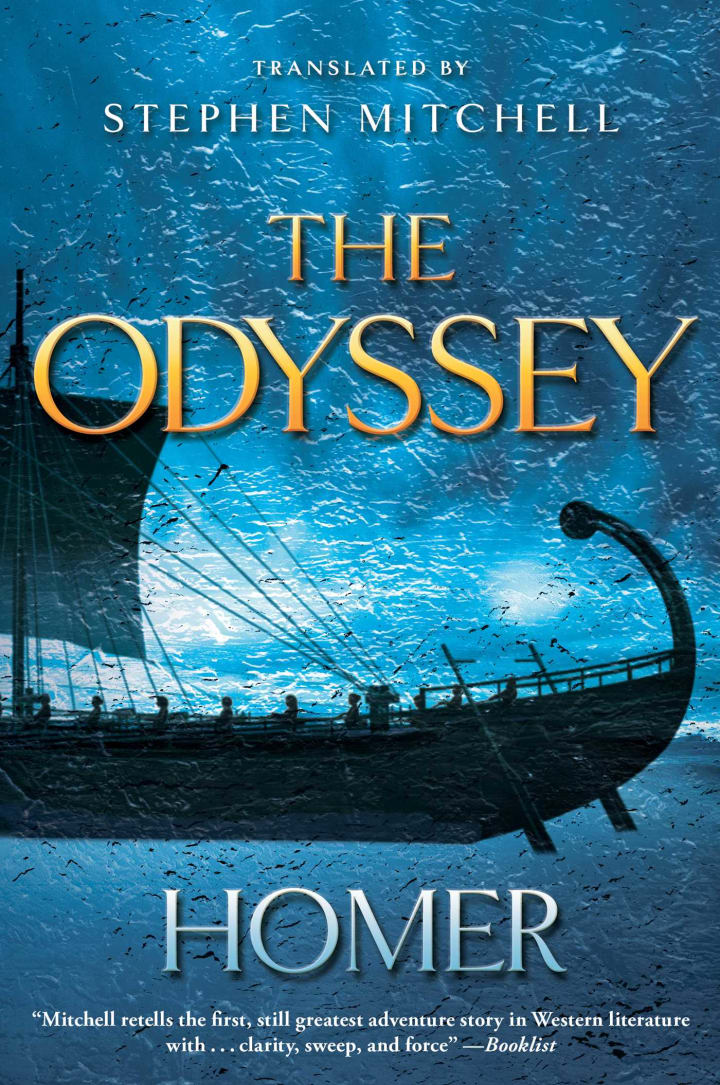
The Odyssey, Book I, Lines 1 – 20
SPEAK, MEMORY—
Of the cunning hero,
The wanderer, blown off course time and again
After he plundered Troy's sacred heights.
Speak
Of all the cities he saw, the minds he grasped,
The suffering deep in his heart at sea
As he struggled to survive and bring his men home
But could not save them, hard as he tried—
The fools—destroyed by their own recklessness
When they ate the oxen of Hyperion the Sun,
And that god snuffed out their day of return.
Of these things,
Speak, Immortal One,
And tell the tale once more in our time.
By now, all the others who had fought at Troy—
At least those who had survived the war and the sea—
Were safely back home. Only Odysseus
Still longed to return to his home and his wife.
The nymph Calypso, a powerful goddess—
And beautiful—was clinging to him
In her caverns and yearned to possess him.
About the Creator
Rasma Raisters
My passions are writing and creating poetry. I write for several sites online and have four themed blogs on Wordpress. Please follow me on Twitter.
Keep reading
More stories from Rasma Raisters and writers in Poets and other communities.
The Weight of Unconditional Love
Some people love you because of what you've done for them; this kind of love seems calculated. But some people love you simply because you are who you are. They don't want you to be like anyone else, nor do they expect you to exhaust yourself. They even want you to cherish yourself, and they worry about you losing yourself.
By Emily Chan - Life and love sharingabout 2 hours ago in Poets




Comments
There are no comments for this story
Be the first to respond and start the conversation.