
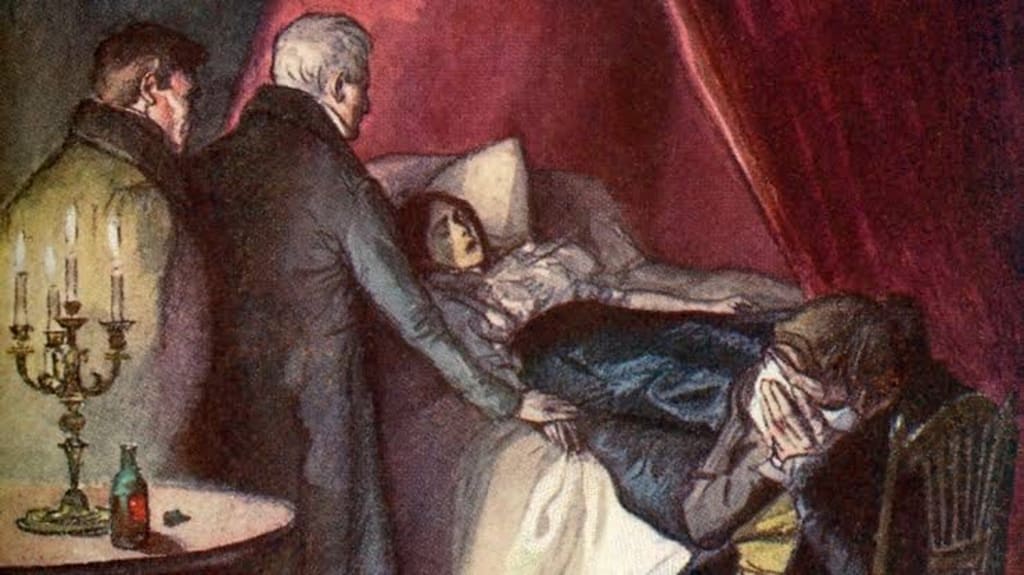
Gustave Flaubert's novel "Madame Bovary" is a masterpiece of realist literature that explores the life of Emma Bovary, a young woman who marries a provincial doctor but finds her life unfulfilling. The novel is a scathing critique of bourgeois society and its values, and it is considered one of the greatest works of literature in the French language.
The novel is divided into three parts, each of which explores a different phase of Emma's life. The first part of the novel depicts Emma's marriage to Charles Bovary, a mediocre doctor who is unable to satisfy her romantic and emotional desires. Emma begins to feel trapped and suffocated in her small town, and she becomes disillusioned with her life. She seeks excitement and adventure, and she embarks on a series of affairs with other men, including the wealthy landowner Rodolphe and the law student Leon.
The second part of the novel explores Emma's descent into financial ruin as a result of her extravagant spending and her affairs. She becomes heavily indebted to moneylenders and is forced to sell her possessions to pay off her debts. She becomes increasingly desperate and is consumed by her desire for material possessions and social status.
The third part of the novel depicts Emma's tragic end. She is consumed by her despair and disillusionment and ultimately commits suicide by swallowing arsenic. Her death is a powerful indictment of bourgeois society and its values, which Flaubert sees as empty and shallow.
One of the most striking features of the novel is Flaubert's use of language. He is a master of description, and he uses language to create vivid and powerful images of the world around Emma. His descriptions of nature, of the countryside, and of the characters are incredibly detailed and evocative. He also uses language to convey the inner thoughts and emotions of his characters, allowing the reader to enter into their psychological world and to understand their motivations and desires.
Flaubert's use of language is also notable for its precision and clarity. He sought to represent the world as it really was, without embellishment or distortion. He was interested in the details of everyday life, and he used language to create a realistic and accurate depiction of the world. This commitment to realism was a hallmark of the realist movement, of which Flaubert was a key figure.
The novel is also notable for its social and political critique. Flaubert was deeply critical of bourgeois society and its values, which he saw as shallow, materialistic, and oppressive. He saw Emma Bovary as a victim of this society, a woman who was denied the fulfillment of her desires and aspirations by the narrow confines of bourgeois morality.
Flaubert's critique of bourgeois society was echoed by other realist writers and artists of the time, who sought to represent the world as it really was and to explore the impact of social and economic changes on ordinary people. Realism was a reaction against the Romantic movement, which emphasized emotion, imagination, and individualism. Realists rejected the idealized and romanticized representations of the world that were popular in the Romantic era. They sought to represent the world as it really was, without embellishment or distortion.
In conclusion, "Madame Bovary" is a powerful and thought-provoking novel that explores the themes of love, desire, disillusionment, and social critique. Flaubert's use of language is masterful, and his commitment to realism is a testament to his artistic vision. The novel is a classic of realist literature, and it continues to be widely read and admired today. It is a must-read for anyone interested in the development of the novel as an art form
About the Creator
The Quiet Influence
The Quiet Influence An oracle on steadiness, softness, and returning to oneself Author’s Note This piece was written from a place of quiet integration rather than urgency—a moment when nothing needed to be solved, proven, or pushed through. I wrote it for those who are discovering that healing doesn’t always arrive as a breakthrough, but sometimes as a gentle settling into presence. If this feels anticlimactic, tender, or unexpectedly emotional, you’re not doing it wrong. You’re likely learning how to rest without disappearing—and how to let yourself be held without effort.
By Flower InBloom3 days ago in Poets



Comments
There are no comments for this story
Be the first to respond and start the conversation.