
Lessons in Forgetting
Poetry Prompts for Coping with a Parent’s Dementia
This won’t be a practical how-to essay equipped with links to the best meal replacement shake for adults or how to prepare to change your own parent’s diapers. Though that’s helpful, I’m hoping to give you the gift of your own writing. A chance to write your way through what is inherently painful and difficult. Weekly, I will post a poem I wrote as an example along with a poetry prompt to get you writing your own truths.
In my mid-thirties I said goodbye to my mom and not because she died or because we were estranged. I said goodbye nearly every day for a decade as Alzheimer’s took pieces of her, sometimes large chunks, like forgetting she had children, and other times, small details like people peel bananas before we eat them. Alzheimer’s may enter a room quietly like an electrical fire, but it burns the house down nonetheless.
Nearly two decades later, I’ve begun sitting in the afternoons with my friend’s ninety-year-old father. As one might suspect, he has moderate memory loss though he remembers his two granddaughters, his daughter, and son-in-law, and despite sundowning in the afternoons, he has a good sense of humor and can recollect and talk about his life with some detail and accuracy. The experiences I had with my mom prepared me for this job, and I realized I also could share more of what helped me with my friend and others.

Poetry has a long history as a healing art, and I know firsthand the benefits of writing. During my mom’s decline, I wrote poems, lots of them. Though I was already a published poet, I hid these new poems in a drawer. I felt they were too personal and perhaps I wasn’t ready to talk about her Alzheimer’s and the impact it was having on me and my family. One day several years later, I took the stack of poems out of a drawer and sent them to an editor friend who said, “Here’s your first book,” and he was right. Though that may not be your goal, the journey itself will be worth it.
The first poetry prompt involves writing about the moment or moments you realized something was wrong with your loved one. Write down a list of all the signs that you remember from early on. This can be a list or one long run-on sentence. Use whatever approach works best for you.
A few reminders whether you’re new to writing or have written many poems. Send your inner critic to time out for bad behavior. Write as much as you can without overthinking, without worrying about grammar or spelling, and without distractions. At some point in this series, I will talk about editing. For now, let’s allow words to come as they may and trust that we’re headed in the right direction. You can either read my poem or proceed to work on your own writing.
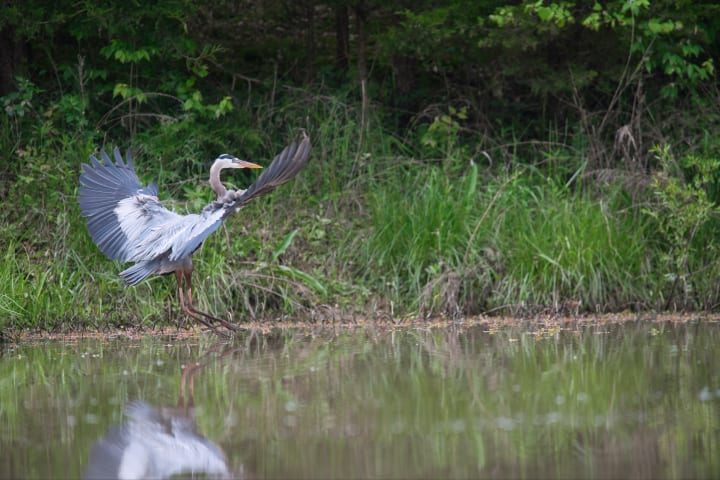
Winging It
Years before we knew
of her Alzheimer’s,
watching a great blue heron
startle the fog on Menokin Bay,
she struggled to find the bird’s
name. She spread her arms and said
Oh, flappity flap jack and laughed,
winging the air. The bird’s wings
skimmed so close to the water,
I thought he’d break the surface.
This is the first poem in my poetry book Lessons in Forgetting published by Main Street Rag in 2010 before my mom died. Though I’m very grateful the book got published, my main gratitude remains to the words themselves, to the process of writing, and to the healing journey writing takes us on if we’re willing. If you’ve found this page, may it be of service to you.
Thank you so much for reading and if you want to support the farm give this a like, check out our website, or send us a tip.
https://sites.google.com/view/freckles-farm-reiki-yoga/home
About the Creator
Freckles Farm
Freckles Farm is a haven for animals and people alike with rescued animals of all species. Anything one feels comfortable to donate will go directly towards helping the farm.
https://sites.google.com/view/freckles-farm-reiki-yoga/home
Keep reading
More stories from Freckles Farm and writers in Poets and other communities.
The Ride
“This is how people go crazy or come sane, either one feels the same at first,” I think. I’m riding a buckskin horse whose name I don’t know along a dirt path in the middle of Reserve, New Mexico. Reserve, a town of nearly 300, is in the Gila National Forest on the Arizona/New Mexico border. I’m on a student archaeology dig with the University of New Mexico, and I’ve been camping in a tent near an arroyo for over 2 weeks. One other detail: I have 2 ½ months clean and sober and have never felt weirder in my life.
By Freckles Farm5 years ago in Psyche


Comments
There are no comments for this story
Be the first to respond and start the conversation.