
Interpreter: Achromatic
achromatic: adj. 1. relating to or denoting lenses that transmit light without separating it into constituent colours 2. without colour – Oxford Concise English Dictionary

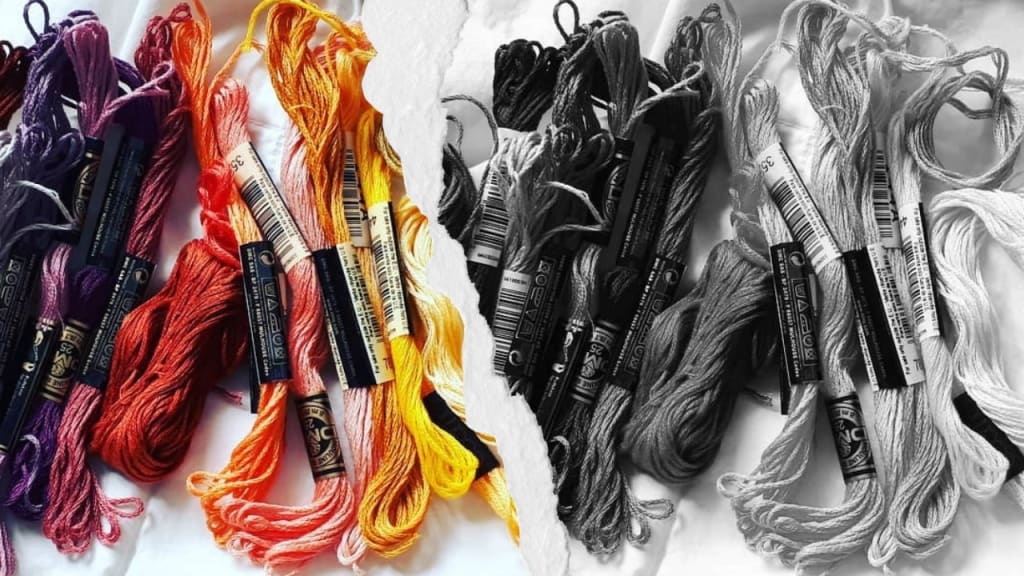
It’s hard to imagine
not seeing colour
because it’s all I’ve ever know.
From before I can remember
my mother asked me
(with curiosity) “what colour is that bird?”
(with urgency) “does this shirt clash terribly with these pants?”
Her eyes lack working cones, the science says,
so she sees in black and white
instead of colour
a world where red is equal to black
and yellow could just as easily be green or pink.
Occasionally I'll watch a black and white movie,
sitting close to the screen and
[[blindering my peripheral vision with my hands]]
willing myself to imagine what it might be like
but all I can think is “this looks old-timey.”
It is an uncertain loss,
a substantial yet weightless pull
of longing and description –
to perceive the glory of a grapefruit-tinged sunset,
or the satisfying juxtaposition of turquoise and orange
side-by-side.
But she doesn’t miss colour, my mom says,
since she never knew it.
She sees in greyscale, a rich array of every grey possible between black and white –
which sometimes flattens,
sometimes obscures,
and sometimes reveals more depth
than a colour-sighted person can perceive,
too dazzled are we by the green of the forest
to actually see all of it’s hues and shades.
My mother is fascinated by the many names for colours.
(with curiosity) “how is crimson different from burgundy?”
(with confusion) “would you say puce is like beige or rust?”
(with joy) “I think lavender really sounds like the smell.”
She hated the christmastime newsletter
black text on red paper rendered it unreadable.
Once she asked my why I’d handed her this sheet of dark paper
(it was the christmastime newsletter).
So I became an interpreter early on:
a describer,
a reader of signs,
an identifier of friends in the street,
and of approaching city bus destinations,
a guard of the crayon order, which MUST remain
red-redorange-orange-yellow-gold-lightgreen-kellygreen-pinegreen-purple-magenta-poopbrown-darkbrown-black-white
so that mom could draw things “right” when she wanted to.
And she wanted to.
Because crayons were responsible
for revealing the betrayal of her eyes,
and her early reading skills.
She learned to recognize the words through necessity –
red, brown, nude,
blue, tangerine, forest green,
aubergine, whatever that might be
(she tried to steer clear of the exotic ones) –
to avoid being the lone kid
who drew purple palaces
surrounded by orange moats
and devastatingly beautiful green princesses.
She was informed of the concrete facts
by Miss Jamison
three months into the school year when
the only crayons available were those with the papers peeled off:
“Only dragons are green, dear.
Castles are grey.
And a moat is filled with
blue water –
just like the river,
don’t you see?”
And I wish I could tell Miss Jamison that actually,
sometimes water isn’t blue,
and, in fact, some castles are sandy brown,
also, dragons are a figment of imagination so they can be any damn colour we please,
and haven’t we all been a little green with envy or the flu?
And just so you know, Miss Jamison,
my mother taught me more about
colour and curiosity,
potential and patience,
assumption and reality,
imagination and empathy,
than my colour-vision ever could have on it’s own.
About the Creator
Keep reading
More stories from writers in Poets and other communities.



Comments
There are no comments for this story
Be the first to respond and start the conversation.