
He Taught Me How to Disappear Softly
A poetic memoir of fading in a relationship where one partner grows distant while the other holds on. Why it works: Emotional depth + lyrical language = high engagement.


He Taught Me How to Disappear Softly
A Poetic Memoir
It didn’t happen all at once. Disappearances rarely do.
They begin with a silence that doesn’t quite fit the room,
a pause too long before a reply,
a gaze that drifts just past your face when you speak.
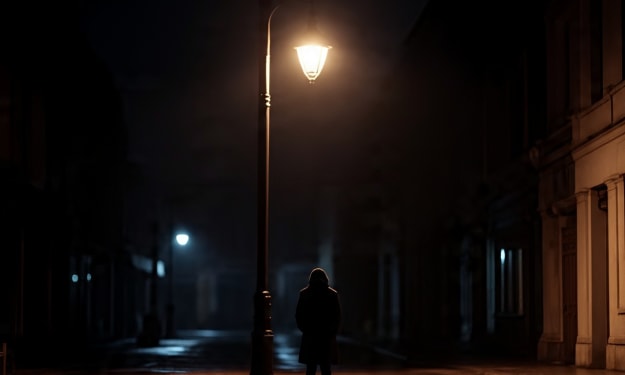
That’s how it began—with soft shadows, not storms.
He used to hold my hand like it meant something.
Fingers interlaced like roots, tangled and alive.
Now, his touch was polite. A handshake from a past life.
I remember the first time he let go
before I was ready,
and I laughed,
pretended it didn’t sting.
That’s how love teaches you to vanish:
first from their eyes,
then from their words,
and finally, from yourself.
He taught me the quiet art of absence
by practicing it in front of me,
day by day,
until I, too, became fluent in vanishing.
He stopped asking how my day was.
So I stopped thinking it mattered.
He stopped noticing the dress I wore for him.
So I stopped dressing like someone worth seeing.
He stopped staying up late to talk.
So I learned to hold conversations with my ceiling fan.
He didn’t need to say “I’m leaving.”
Every version of him already had.
There’s a cruel magic in watching someone
you love forget how to look at you.
He once looked at me like I was sunrise—
soft, golden, and worth waking for.
Later, he glanced at me
like a window he used to love,
now covered in dust,
too much effort to clean.
I tried everything.
Whispers in the night.
Jokes that once made him laugh.
Cooking his favorite meals.
Even silence.
But nothing brought him back.
That’s when I realized:
He wasn’t teaching me how to fix us.
He was showing me how to fade.
I started shrinking inside the house we shared.
Like furniture moved to the corner.
Like art no longer hung.
Like music no longer played.
I didn’t stop loving him.
But I did stop expecting anything from him.
And there’s a difference.
A quiet, aching difference.
One day, I walked into the kitchen,
and he was on the phone,
smiling—
that deep, crinkled-eyes kind of smile
I hadn’t seen in months.
But it wasn’t for me.
It was never for me.
The truth is,
I learned to disappear by trying to stay.
By holding on too long to what was already gone.
By being the only one asking questions
in a conversation with no sound.
I became quieter,
so he wouldn’t feel pressured.
Smaller,
so he wouldn’t feel trapped.
Kinder,
so he wouldn’t feel guilty.
And eventually—
I became almost invisible.
He never said goodbye.
People rarely do when they're already halfway gone.
Instead, he began using phrases like,
“I’ve been busy.”
“I need some space.”
“I’m just tired lately.”
Words that sounded like excuses
but felt like distance.
By the time he actually left,
he had been leaving for months.
And me?
I was already gone too.
Not from the house,
but from the woman I used to be.
But here’s the thing they never tell you—
sometimes disappearing is survival.
Sometimes it’s the body’s way of saying,
“I won’t shatter for someone who doesn’t see me.”
I started remembering myself
in small, brave ways.
I danced barefoot in the kitchen again,
not for him,
but for the rhythm of my own joy.
I bought myself flowers
because I missed the feeling
of being wanted.
I laughed loudly
at things only I understood.
And one morning,
I looked in the mirror
and saw her again—
the girl he taught to disappear
now learning how to return.
He taught me how to fade gently.
But life—
it taught me how to glow again.
And maybe that’s the lesson:
some people come into your life
not to stay,
but to show you how to leave yourself
without even realizing.
But if you’re lucky,
you find your way back.
Bit by bit.
Word by word.
Heartbeat by heartbeat.
I disappeared softly.
But I returned with thunder.
About the Creator
Keep reading
More stories from waseem khan and writers in Poets and other communities.



Comments
There are no comments for this story
Be the first to respond and start the conversation.