
Dust-Killed Melodies
How abandoned songs teach us what the living never said

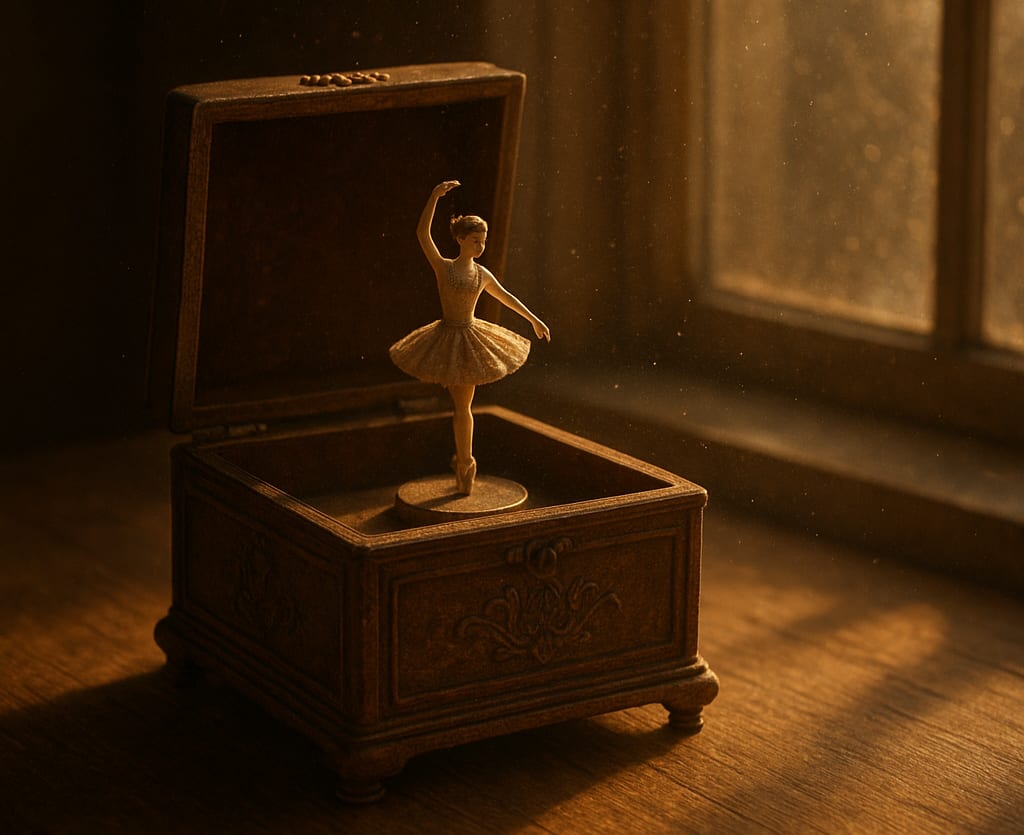
There are melodies in every life that never make it to the chorus.
Some die quietly, their notes thinning out the way old memories do—soft, almost apologetic. Others die louder, like a slammed door or a breath someone never takes again. And then there are melodies like the ones I lost, not to tragedy, not to time, but to the simple, cruel settling of dust. Songs that were meant to bloom but instead suffocated under the weight of everything unspoken.
I learned this the day I found my childhood music box.
It had been tucked on the highest shelf of my mother’s old cabinet, the one she kept locked for years, the one she said contained “things better left untouched.” When the house grew quiet after she left—gone not by death but by the kind of distance that takes root between people who forget how to speak to each other—I climbed a chair and opened that cabinet for the first time.
A soft gray film covered everything: letters, photographs, half-finished crafts, little worlds she once cared about. And in the middle of it all sat the music box—rose-gold edges worn, the ballerina inside frozen mid-twirl.
When I wound it, nothing happened. The melody that used to follow me into sleep had died somewhere in the dark. Dust-killed. Forgotten.
Standing there, I realized something I had ignored for years: it wasn’t just the music box. It was us.
We had let our own melody die the same slow, neglected way.
When I was young, she sang while she cooked—small things, humming while stirring lentils, tapping rhythm on plates, picking up lyrics like drifting feathers. By the time I turned sixteen, her songs had already quieted, swallowed by exhaustion, arguments, unspoken apologies, and the grief she carried in silence. The house grew lonelier in ways I couldn’t name back then, quieter in ways I didn’t know could hurt.
The melodies we lose aren’t always the tragic ones.
Sometimes they’re the ones we didn’t even notice were fading.
Sometimes they’re the ones we let dust settle over while telling ourselves there will be time to bring them back.
As I held the music box that day, I felt the weight of our unsung years—of the times I should’ve asked if she was okay, of the moments when she should’ve said she missed me, of the silence that expanded until it sounded like wind inside an empty room.
Dust doesn’t ask permission to settle. It simply arrives, slowly, invisibly, until one day it reminds you how long you’ve been looking away.
I think about that now whenever I catch myself saving something for later: a call I postpone, a message I ignore, forgiveness I delay, a dream I shelf because I believe it’ll still be waiting for me.
Melodies don’t wait.
They vanish in increments.
What dies from dust rarely returns the same.
I eventually repaired the music box. A tiny metal gear had stiffened, exhausted from years of inactivity. When it finally played again, the melody was slower, more fragile, more human—like a memory sung through a tired throat.
I didn’t try to resurrect what my mother and I lost. Some melodies aren’t meant to be replayed. But I did learn how to protect the ones still alive: the people who speak softly, the dreams that whisper, the hope that tries one more time.
The music box sits on my desk now, a reminder that silence is not neutral—it is erosion.
And that anything beautiful, left unattended, will eventually choke under the weight of dust-killed melodies.
About the Creator
LUNA EDITH
Writer, storyteller, and lifelong learner. I share thoughts on life, creativity, and everything in between. Here to connect, inspire, and grow — one story at a time.
Keep reading
More stories from LUNA EDITH and writers in Poets and other communities.
Why My Quiet Matters
I didn’t learn silence in the soft way. It wasn’t handed to me like a folded blanket or a warm cup of tea. My quiet was shaped in the echo after doors slammed, in the spaces where people spoke over me, in the long pauses where I waited for someone to see I was hurting. For years, my quiet felt like a bruise I couldn’t point to. It wasn’t peaceful. It wasn’t chosen. It was just where I went when the world didn’t leave room for me.
By LUNA EDITH3 months ago in Poets



Comments
There are no comments for this story
Be the first to respond and start the conversation.