
Dante Alighieri’s The Divine Comedy
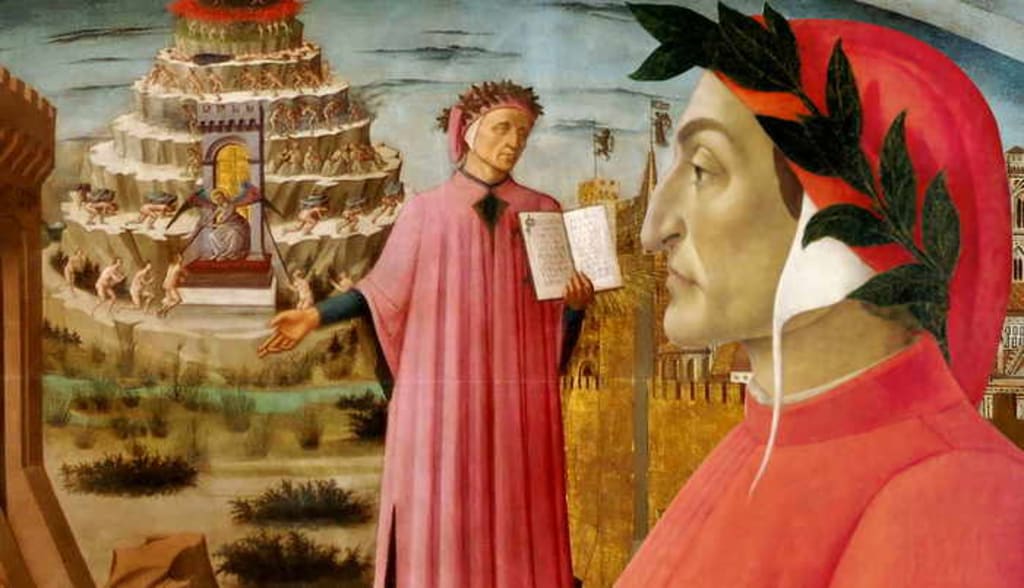
Dante Alighieri’s The Divine Comedy is one of the greatest works of world literature, written in the early 14th century. It is an epic poem that takes the reader on a journey through the three realms of the afterlife: Inferno (Hell), Purgatorio (Purgatory), and Paradiso (Heaven). The poem is an allegory, filled with symbolism and political commentary, and explores themes of justice, divine love, redemption, and the nature of sin.
Background and Structure
The poem is composed of 100 cantos, divided into three sections:
Inferno (34 cantos)
Purgatorio (33 cantos)
Paradiso (33 cantos)
Each section is written in terza rima, a rhyming scheme (ABA BCB CDC) that Dante himself invented.
Dante, the protagonist, is guided through the afterlife by two key figures: the Roman poet Virgil, who leads him through Hell and Purgatory, and Beatrice, his idealized love, who guides him through Heaven.
Inferno (Hell)
The poem begins on Good Friday of the year 1300 when Dante, lost in a dark forest, is confronted by three beasts representing different sins: the Leopard (fraud), the Lion (violence), and the She-Wolf (incontinence). Unable to escape, Dante is rescued by Virgil, who tells him he must journey through Hell and Purgatory to reach Heaven.
They enter Hell, which consists of nine concentric circles, each designated for different types of sinners:
Limbo – Home to virtuous pagans and unbaptized infants who suffer from eternal separation from God.
Lust – The souls of the lustful are blown about by a never-ending storm.
Gluttony – The gluttonous wallow in filth and are tormented by Cerberus.
Greed – The greedy (both hoarders and wasters) are condemned to push heavy weights against each other.
Wrath – The wrathful and sullen fight eternally in the River Styx.
Heresy – Heretics lie in burning tombs.
Violence – Divided into three rings: violence against others, against oneself (suicides), and against God (blasphemers, sodomites, usurers).
Fraud – Includes flatterers, hypocrites, and corrupt politicians, suffering various torments such as being submerged in boiling tar.
Treachery – The lowest circle, where traitors (including Judas Iscariot, Brutus, and Cassius) are trapped in a frozen lake with Satan at the center, chewing on their bodies.
Dante and Virgil escape by climbing down Satan’s body and emerge on the other side of the world, entering Purgatory.
Purgatorio (Purgatory)
Purgatory is depicted as a mountain with seven terraces, each representing one of the Seven Deadly Sins that souls must cleanse before entering Paradise:
Pride – Souls carry heavy stones to learn humility.
Envy – The envious have their eyes sewn shut.
Wrath – The wrathful wander in thick smoke.
Sloth – The slothful run continuously to make up for their laziness in life.
Avarice & Prodigality – The greedy lie face-down, reflecting on their sins.
Gluttony – The gluttonous suffer from extreme hunger and thirst.
Lust – The lustful are purified by fire.
At the top of Mount Purgatory is the Earthly Paradise, where Dante meets Beatrice. Virgil departs, as reason alone cannot take Dante into Heaven. Beatrice, symbolizing divine love, prepares Dante for the final stage of his journey.
Paradiso (Heaven)
Paradise consists of nine celestial spheres, representing different levels of virtue. Here, Dante meets saints and biblical figures who provide divine wisdom:
The Moon (Faith) – Souls who failed to keep their vows.
Mercury (Ambition) – Souls who pursued honor but still sought glory.
Venus (Love) – Lovers who served God through love.
The Sun (Wisdom) – Home to theologians and wise men.
Mars (Courage) – Warriors who fought for the faith.
Jupiter (Justice) – Righteous rulers and kings.
Saturn (Contemplation) – Those devoted to prayer and monastic life.
Fixed Stars (Faith, Hope, Love) – Saints like St. Peter, St. James, and St. John.
The Primum Mobile – The sphere of angels who move the universe according to God's will.
Beyond these is the Empyrean, where Dante finally sees God, a vision of pure light. He experiences divine unity and love, ending the journey with the famous final line: “The love that moves the sun and the other stars.”
Themes and Significance
Justice and Divine Retribution – The structure of Hell, Purgatory, and Heaven reflects the concept of divine justice, where sinners receive punishments that correspond to their sins.
Redemption and Free Will – Dante’s journey represents the soul’s ability to recognize its sins, repent, and achieve salvation.
The Role of Love – Beatrice represents divine love, guiding Dante toward God.
Political and Religious Critique – Dante includes real historical and political figures, criticizing corruption in the Church and government.
Impact on Literature
The Divine Comedy influenced literature, theology, and philosophy for centuries. It shaped the Italian language, inspired writers like Milton and T.S. Eliot, and remains a cornerstone of world literature.
Conclusion
Dante’s epic poem is more than just a religious vision—it is a deeply personal, philosophical, and artistic work that explores the nature of sin, the human soul’s journey, and the ultimate goal of divine love. It remains a masterpiece that continues to inspire readers worldwide.
About the Creator
Mr Ali
Hello EveryOne..!!
Bomb Scare
It was 2027, and the world never thought it would happen. A missle hit the United States, but it wasn't where they had anticipated. A little town in the northeast was hit by a missile strike, they didn't know why, and they didn't know exactly where it hit, but they did know it was a coastal community, somewhere between Maine and Delaware.
By Gregory Payton7 days ago in Fiction


Comments
There are no comments for this story
Be the first to respond and start the conversation.