
Cracked Open
How creation carves identity from silence

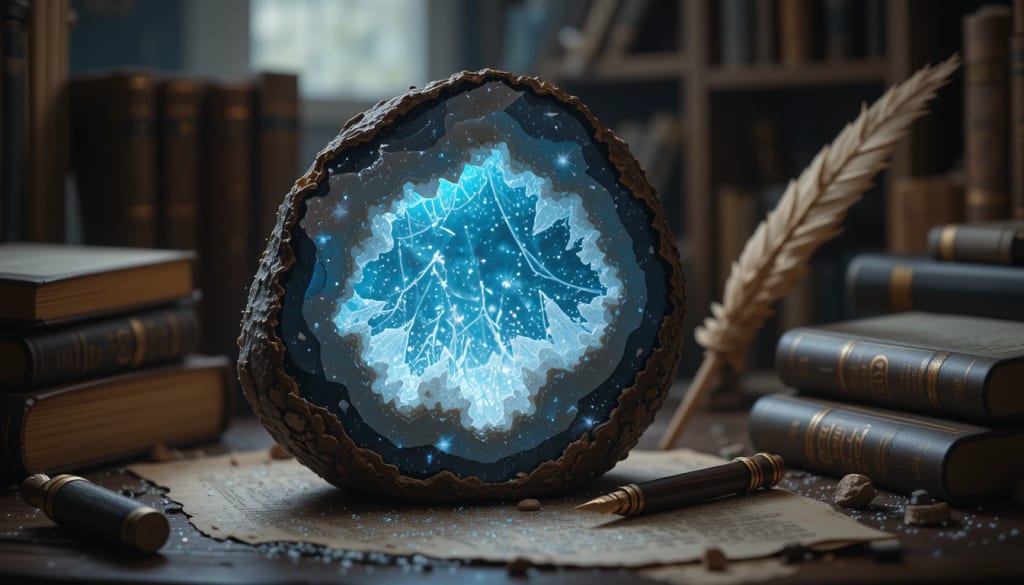
I don’t remember the exact moment I began to form, only that something pressed against my brow. It wasn’t a physical hand, but a force—an ancient whisper, a call to awaken. Some days I imagine it was Phanes, the primordial light, brushing a thumb across the darkness of my mind. A touch that lit the fuse of my inner cosmos.
Before that, I was nothing more than scattered potential. Unsorted thoughts. Dust.
Formation is rarely dramatic. It’s not always a lightning bolt. More often, it’s the slow compression and expansion of time. You fold inward, collapse beneath the weight of unasked questions, and then—somehow—you stretch outward again, searching.
I didn’t always know I was searching. But then, literature found me. Not as entertainment, but as a hammer.
Books, poems, essays—those weren’t just words. They were impact tools. Each sentence struck me like a tectonic thud, chipping away the calloused crust of a stagnant mind. Before long, I realized I wasn’t just reading to learn; I was reading to wake up.
We are all human geodes. From the outside, we seem ordinary. Solid. Closed.
But inside?
Inside are crystalline truths. Fragile, brilliant formations of self that only reveal themselves when cracked open—carefully, or sometimes brutally.
The writer’s role, I’ve come to believe, is to become both the geode and the geologist. We allow the world to split us open. Then we dig. We inspect. We name the colors of our pain. We describe the angles of our wonder. And through it all, we learn what we’re really made of.
Writing, for me, became an act of defamiliarization. I began to see even the most familiar parts of my life with alien eyes. Memory became myth. Routine became ritual. The mundane took on sacred shapes.
We write to figure out who we are—not just once, but again and again.
Each piece is a core sample taken from the cavern of our own cognition. Fiction, poetry, even criticism—they are the slow, rhythmic drips that form mental stalagmites. Each line a mineral deposit of a fleeting truth.
That’s why I reject the idea that machines can replace human creativity.
Yes, a computer can echo our words. It can mimic our forms, our styles. It can even shock us with how much it understands.
But it cannot want to create. It has no geode inside it waiting to be cracked open. No pulse beneath the surface.
When we form worlds with a pen—or a stylus, or a keyboard—we do more than construct. We invoke. Each story, each stanza, becomes a heterocosmos: a different world, sculpted not just from imagination but from contradiction. That contradiction is our humanity.
To be a writer is to be perpetually unsure. To press deeper into paradox. To carve characters not from logic but from memory, from wound, from insight that has no proof but still demands to be spoken.
We do not write because we know. We write because we seek.
And in that seeking, we engrave signets—each one bearing the unique stamp of our consciousness. Like ancient seals, our stories hold the proof that we were here, that we felt this, that we meant something.
There’s something beautiful about how transitory truth becomes timeless art.
Diamonds do not form overnight. They are pressure and time and waiting. So, too, are our thoughts. So too are the quiet moments of insight, when something clicks in the dark and we understand ourselves just a bit more clearly.
A single, honest thought—held up to the light—can become precious, even sacred. That’s what makes the axiom feel eternal: not its logic, but its resonance.
The masters know this. The greats. The ones who shape our understanding with a few well-placed syllables. They don’t just write books. They fashion Aionic Crown Jewels—timeless expressions of the soul’s architecture.
Their truths don’t pass away. They endure. Not because they were loud, but because they were carved carefully. From within.
And so I write.
Not to be understood by others, necessarily. But to understand myself. To echo that first thumbprint of awakening that began it all. To carry forward the formation.
Because I believe that to create is the closest we come to touching the eternal.
And if, someday, someone cracks open one of my sentences and finds something glittering inside—
Then maybe I was more than just dust.
Maybe I was becoming all along.
About the Creator
Shohel Rana
As a professional article writer for Vocal Media, I craft engaging, high-quality content tailored to diverse audiences. My expertise ensures well-researched, compelling articles that inform, inspire, and captivate readers effectively.
Keep reading
More stories from Shohel Rana and writers in Poets and other communities.
What Is Love?
What Is Love? It’s not just a feeling—it’s a lifelong echo of the soul. Love. A four-letter word that has inspired the greatest poems, the deepest heartbreaks, and the most unforgettable memories. Yet ask ten different people what love means, and you’ll hear ten entirely different answers. Some call it a spark. Others say it’s sacrifice. A few will point to a person. Some will speak with stars in their eyes, while others will talk with wounds in their voice.But beneath the definitions and the dictionary meanings lies something more profound: love is the quiet force that connects all living things. It's the soft thread that ties us to one another, not always loudly, but always meaningfully.
By Shohel Rana8 months ago in Poets
Love Poem: Manifestation Mantra for the Goddess of the Love, Smiling within an Alternate Dimension of Amusement
It starts with love. . . 🌹 🌻🌹 🌻🌹 🌻🌹 🌻🌹 🌻🌹 🌻🌹 🌻🌹 🌻 Finding love after being ghosted, finding a new heart and entering a new dimension of time and space. Love is healing. Love is light. Love is awakening to a new promise of life.
By WILD WAYNE : The Dragon Kingabout 20 hours ago in Poets


Comments
There are no comments for this story
Be the first to respond and start the conversation.