
Bucket
If you stand on all your rights, no one has any.
We show our better angels when we are pressed
or we show our worse. The test that tells who we are
comes when we are called to give to others
while under extreme duress. Then we see
who is really fearless and who is not.
If you just give in to the crowd and harbor resentment,
the test reveals your weakness to them—and would
to you, if you had the courage to see yourself.
___________________________________________________
Society keeps people in line—but doesn’t improve them—with shame.
___________________________________________________
Bucket
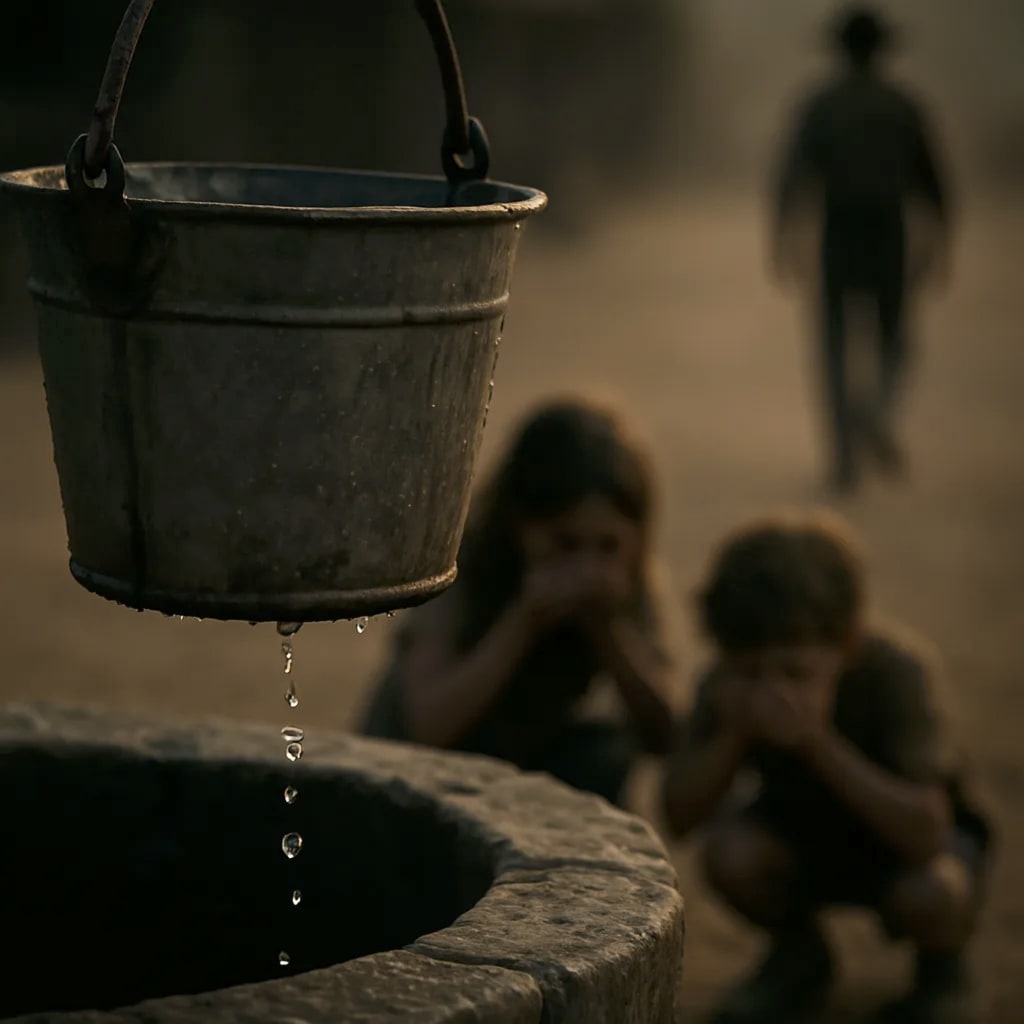
The sun baked the valley soil into the color of a burnt pie crust. Dust scuffed up with every step, fine as flour, and hung in the air. At the center of the rancher’s land stood the only working well. A galvanized bucket rested on the stone lip with a chain looped through the handle. A padlock shone bright against the rust of the chain.
The migrant worker came at dawn. His shirt clung with sweat though the air was still cool. In the shadow of the wagon’s cover, his children lay weak with lips cracked, eyes half-shut. He passed the fence where cattle pressed their muzzles against the wire, tongues swollen, eyes dull. Some had already collapsed. Flies blanketed their carcasses.
The rancher waited by the pump. His boots dug into the dust. His hand rested on the handle as though it were a rifle. “This is private,” he said. Behind him, the bucket gleamed.
The worker stopped three paces away. He kept his back straight. “Please. My children are thirsty. One jug.”
The rancher’s eyes flicked to the wagon, then away. “If I let you, everyone will come. My herd dies, my land is ruined. I worked for this well. It’s mine.”
Dust rose again as the sheriff pulled up. He listened to the migrant. He listened to the rancher. He leaned on the fence, spat into the dirt, and said, “Law says the landowner decides.” His eyes stayed down, as if he needed to scrutinize the burnt ground.
By this time, neighbors had gathered. They lined the fence, murmuring. The wind shifted, blowing the smell of rotting carrion along the fence.
The worker said quietly, “Should children have to die for your cattle?”
The rancher’s lips curled. “My herd is worth more than your family.”
A woman whispered, “God help us.” A boot dragged the dirt. Still no one moved.
The rancher lifted the bucket and rattled it. For an instant, the neighbors looked up. Then he dropped it with a clang. “Safe. You won’t touch it.” The worker’s fists opened and closed.
The neighbors at the fence were murmuring now. Boots shifted, arms crossed. The smell of the dead cattle rolled back across the yard, sour and thick. The rancher’s eyes darted once toward the wagon, then to the neighbors’ faces.
His jaw muscles bulged as he felt every eye turned toward him. He rattled the bucket again, as if daring someone to step forward. They only stared at him. The children were coughing.
The rancher spat in the dust. “Fine. Take it then, if you’re all so righteous.” He let go of the rope, and the bucket swung hard against the stone wall.
The neighbors moved in at once. One steadied the rope, another hauled. The bucket rose dripping, heavy, brimming. They carried it to the children, who drank without a word.
No one thanked him. The circle closed around the well, backs turned toward where he stood. He lingered a moment, watching the water pass from hand to hand, then walked off alone. He crossed the yard without looking back, grinding the dry earth into powder under his boots.
About the Creator
William Alfred
A retired college teacher who has turned to poetry in his old age.
Keep reading
More stories from William Alfred and writers in Poets and other communities.
Standing While Falling
Quotation from Friedrich Nietzsche "He who wrestles long with monsters should beware lest he himself become a monster. And if you gaze long into an abyss, the abyss also gazes into you. Man is not destroyed by suffering, but by the meaning he makes of it."
By LUCCIAN LAYTH4 days ago in Critique


Comments
There are no comments for this story
Be the first to respond and start the conversation.