
A Typo Tale in Technicolor
When Words Went Wild, and Spellcheck Just Watched

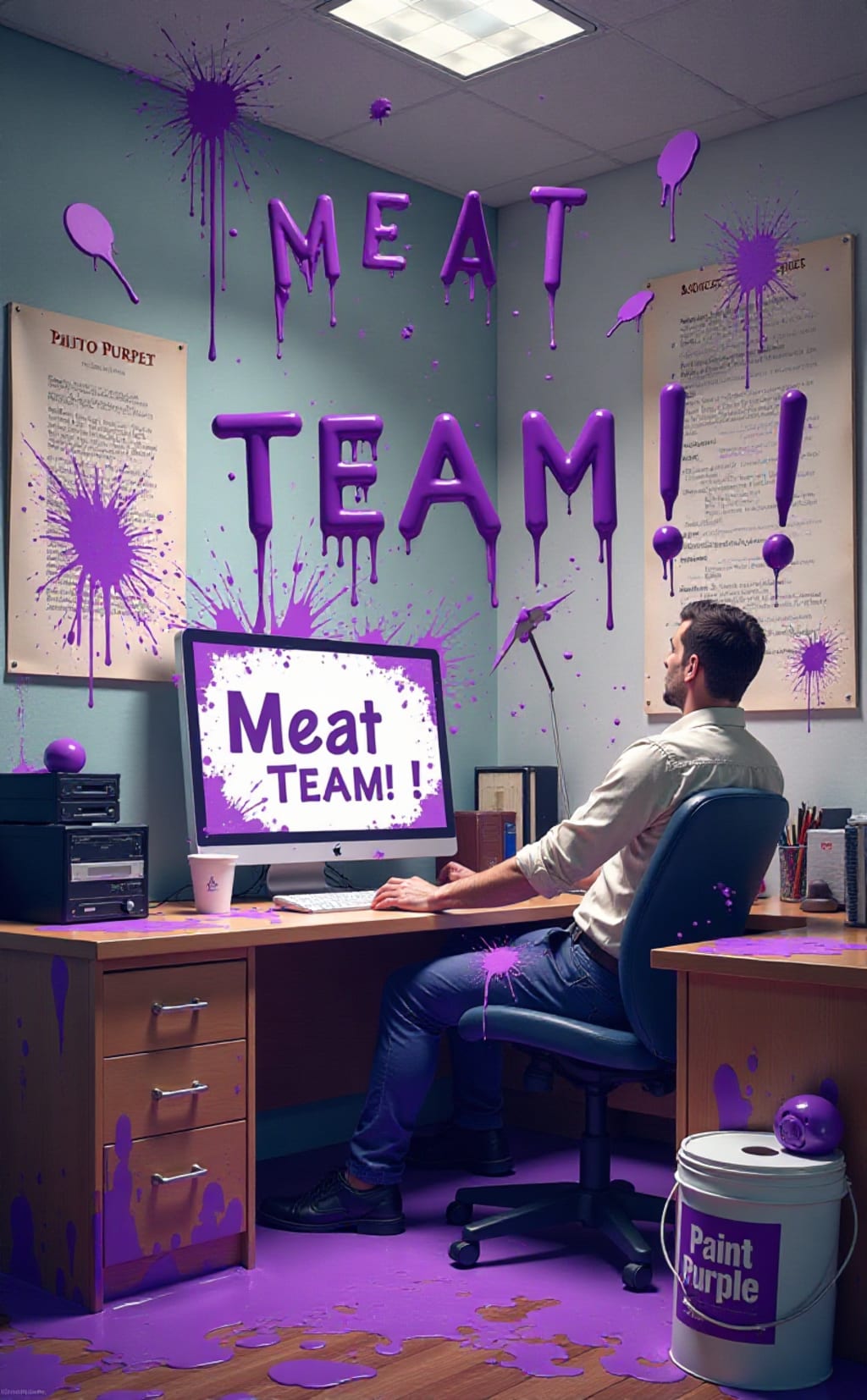
There comes a moment in every writer’s life—whether professional, casual, or somewhere in between—when the words escape the page and rebel. Not dramatically. Not maliciously. But with style. With flair. And most of all, with typos. And in one particular story, they did it with purple paint.
It all began with a harmless sentence. A friendly internal memo meant to say: "Let’s schedule a brief meeting." Instead, it read: "Let’s schedule a bried meeting." A typo, a tiny hiccup of the fingers. But oh, what a beautifully slippery slope that would become.
That one word opened the door to chaos. Not just a grammatical mistake, but an artistic revolution. It felt like the keyboard had taken a deep breath, dipped its fingers in a bucket of metaphorical purple paint, and decided: “Today, I will create.”
The First Splash: Typo as Art
The "bried meeting" was just the beginning. Soon after, someone emailed the team with an update about “shifting focus” that—thanks to one rogue letter—became “sh*tting focus.” That unfortunate update was not only mortifying but also the moment it felt like the office had been dunked in a vat of purple.
It wasn’t just about the errors—it was about the spectacle. Suddenly, typos weren’t embarrassing. They were events. Each one exploded across group chats and whiteboards, much like a Jackson Pollock painting—only instead of paint, it was words gone gloriously wrong.
We started calling it “painting it purple”—the moment a message goes so off the rails it turns into something abstract, messy, but oddly beautiful.
Autocorrect: Our Accidental Graffiti Artist
We all rely on autocorrect to save us from ourselves, but let’s be honest—it often creates more mischief than magic. It’s the friend who enthusiastically helps you rearrange your living room, then drops a bookshelf on your foot.
Take my colleague Lisa, for example. She tried to message a client: “Looking forward to finalizing the project.” Autocorrect changed it to: “Looking forward to fertilizing the project.”
Well. That’s... earthy.
Another masterpiece happened when a senior manager tried to write "I appreciate your feedback" but sent "I appreciate your feedbag." Cue jokes about being fed hay and oats during the next performance review. The image of our boss as a business horse trotting around in a suit? Permanent.
These autocorrect mishaps were like rogue paint splatters on our tidy professional canvas. We couldn’t predict them. We couldn’t prevent them. But we could certainly laugh at them.
A Gallery of Glorious Gaffes
Inspired by this linguistic chaos, we created a “Typo Wall”—a digital space where the most ridiculous, awkward, and wildly misfired messages were proudly displayed. Each one got a purple stamp of honor: a small, pixelated paint splatter, signifying its place in the "Paint It Purple" hall of fame.
Some gems included:
“Let’s meat the new interns!” (Accompanied by a meat emoji someone unfortunately added for emphasis.)
“Pubic speaking workshop next Friday.” (We’re still recovering.)
“I’ll defiantly attend the meeting.” (Strong opinions expected.)
“Please bare with me during this process.” (Absolutely not, Kevin.)
These weren’t just mistakes—they were stories. Moments of unexpected vulnerability and humor that made our fast-paced, high-pressure workdays feel a little more human.
Purple Ink and Psychological Insight
But beyond the giggles, there’s something poetic about typos. They often happen when our minds are moving faster than our fingers. They occur at the intersection of speed, distraction, and the subconscious. And sometimes, they reveal truths we didn’t mean to say—but might’ve felt.
Why else would someone accidentally write “I hate to butter you” instead of “I hate to bother you”? Maybe it was time to be a little smoother.
Linguists and psychologists have long acknowledged that errors in language reflect more than fatigue or carelessness. They reflect our mental shortcuts, our social stress, our intention (or lack thereof). In other words: typos paint portraits of who we are in that moment.
So why not paint them purple? Why not celebrate those portraits?
Embracing the Mess
In an age obsessed with precision—spellcheck, Grammarly, AI writing tools (yes, I see the irony)—there’s something wonderfully rebellious about a good old-fashioned typo. It reminds us that language is a living, breathing, glitching thing. It can be chaotic. It can be absurd. It can wear mismatched socks and forget where it parked its metaphor.
One of my favorite purple moments happened during a virtual meeting where someone wrote in the chat, “Let’s brainstorm ideas for the new cam-pain.” What followed was 15 minutes of impromptu ad campaigns for a sad, crying camel mascot named “Cam Pain.” Someone made a logo. It became an unofficial Slack emoji.
It was ridiculous. It was beautiful. It was pure purple.
How to Survive (and Thrive in) a Typo-Storm
Let’s be clear—accuracy matters. You don’t want to send a fundraising letter asking for “pubic support.” But when the inevitable happens, here’s how to turn red cheeks into purple triumphs:
Laugh first, fix second. Most people love a shared mistake, especially if you can own it with humor.
Start a collection. Make a typo wall, a channel, or a scrapbook. Let the best ones live on.
Use typos as creativity prompts. That one typo could spark a poem, comic, or weird camel mascot. Go with it.
Slow down. Typos often mean your brain’s ahead of your keyboard. Take a breath—unless you enjoy performance art in your subject lines.
About the Creator
Keep reading
More stories from Habibullah khan and writers in Poets and other communities.
Echoes in the Crowd
In a world teeming with voices — tweets, posts, podcasts, and platforms — we are constantly speaking, broadcasting, sharing. Yet behind the endless stream of words lies a quieter, more vulnerable truth: many of us are still searching for someone who truly listens.
By Habibullah khan 10 months ago in Poets


Comments
There are no comments for this story
Be the first to respond and start the conversation.